The Gerrit User Summit 2023 took place in-person simultaneously in Sunnyvale, California on September 30th and in Gothenburg, Sweden until October 1st 2023. To accommodate the global community, it was live streamed on GerritForge TV so that individuals in various locations could participate, share their experiences, and contribute their ideas.
Stats and attendee feedback around the 2023 Summit
Snapshot
2 days
2 locations
84 registrations
over 70% attendance
34 companies
16 sessions
18 presenters from 8 organisations
Despite the challenges posed by the time difference, the community still got involved showing its commitment.
What is the opinion about the Summit?
A survey was sent to all of the attendees on both locations and even though there was a 30% response rate in USA and 17% in Sweden we delved into the details, and these are the comments received:
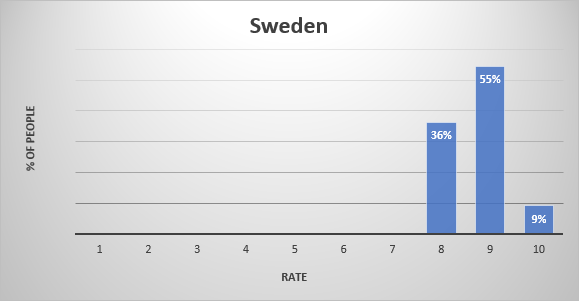
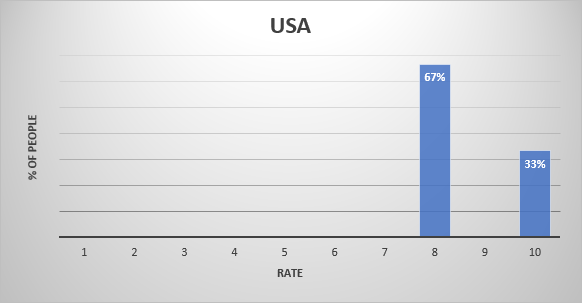
Q1: How would you rate the Gerrit User Summit 2023 edition?
While in USA, 9% of the respondents rated their experience at a 10, 55% rated it at a 9 and 36% gave an 8; in Sweden the great majority rated it with an 8. Where 10 was the highest positive rate, this feedback gives an idea of how satisfied attendees were in general with the User Summit. Understanding individual experiences and perceptions allows us to evaluate the event and identify areas for improvement.
Q2: What did you like the most about the 2023 Summit?
Attendees in California were thoroughly impressed with the technical excellence of the talks at the event and appreciated the valuable networking opportunities. On the other hand, Gothenburg attendees raved about the fantastic space and location of the venue. They found the off-camera discussions, presentations, and Q&A sessions incredibly interesting and enjoyable. Thought the use of Slido for Q&A was highly effective, giving attendees ample time to contemplate and engage with the speakers.
They also loved hearing organisations share their stories and the collaborative atmosphere for creating new design documents and proof-of-concept code. The attendees were left with the impression that the event brought together a multitude of talented individuals who delivered engaging talks. The event left high expectations for upcoming features and created an enthusiastic, positive atmosphere.They truly valued the chance to engage with fellow attendees and found the experience rewarding.
Q3: What did you not like about the 2023 Summit?
Attendees from both locations expressed their concern about the division of the summit into two locations and time zones, which made it challenging to connect with the entire group. While the idea of having simultaneous locations was appreciated, attendees in Gothenburg felt disadvantaged as they were unable to ask live questions to presenters due to the time difference with the USA. It was recommended not to repeat this approach in future events. However, overall, the attendees had a positive experience at the summit. They expressed their wish for Google to attend in the future and highlighted a missing feature in Slide that would allow for the separation of topics in questions.
Some attendees preferred the event to be held on weekdays rather than weekends, as it affected their personal time. Additionally, they expressed a preference for more user/project-driven success stories, as opposed to focusing solely on development and administrative topics. Some attendees also noted that there was a lack of diversity in the companies present. In Gothenburg in particular, they suggested choosing a venue with less noise for dinner to facilitate networking. Lastly, it was reported that the attendance felt to be relatively low especially in Gothenburg where the venue could have hosted hundreds of attendees.
Q4: What was your main objective in attending the Summit?
The attendees had two main objectives in mind: learning and networking. Going into further detail, they expressed various specific goals, including sharing research findings and enticing potential industrial partnerships. They were also keen on staying updated with the latest developments in the Gerrit ecosystem and gaining insights into how Gerrit is utilized within the community. Meeting people face-to-face was highly valued, as it provided a more personal and direct means of communication compared to email or Discord. Additionally, attendees wished to actively participate in the open-source Gerrit community and discover new directions for the product. Some mentioned that they were excited about the opportunity to listen to James Blair. For some attendees, the event offered a chance to reconnect with Gerrit after a period of absence. Some emphasised in the fact that fostering a positive open-source software community was a shared aspiration, alongside the desire to learn about how organisations utilise Gerrit in their processes. Overall, the attendees were motivated to make the most of the event, seeking knowledge exchange and valuable connections.
Q5: Do you consider to have achieved the objective?
A decisive 100% said to have achieved their goal by attending the Summit.
Reactivating the Gerrit community
Given the initiative to create a group of monthly in-person meet-ups (GerritMeets) to revive the community in the Bay Area (CA), in-person attendees at the summit in Sunnyvale, CA, were asked about their topics of interest, if they would attend in person, remotely live or watch the recorded content afterwards, and if they would participate by giving a talk.
Respondents agreed 100% that they would be willing to give a talk. They differed in the mode of attendance, as opinions were evenly divided between attending in person, joining remotely via live streaming, and accessing the recorded content after the meetup. The suggested topics were:
‘Getting started with pull-replication and multi-site’,
‘Research on code review’.
The invitation to these periodic meetings was extended to the global community and when asked for topics of interest, the topic ‘Hacking’ was added.
What’s next for 2024?
GerritMeets will start every month in 2024, from February. GerritMeets is periodic in-person meetup in the Bay Area, with the intention to live stream, so the global community can join as listener as well as with a talk, so everybody can learn & share knowledge and experience.
With Gerrit 3.9 been released in November 2023, 2024 will be the year of Gerrit 3.10, in May, and 3.11, in November.
Gerrit User Summit will be back in the autumn of 2024 with more interesting talks from the community
A genuine thank you goes out to all the participants and presenters who made the Gerrit Virtual User Summit 2023 a great success. We look forward to another exciting and even more engaging get-together next year in 2024!
Yolanda Jasso Gerrit Code Review – Community Manager
GerritForge has confirmed over 2023 its commitment to the Gerrit Code Review platforming, helping deliver two major releases: Gerrit v3.8 and v3.9.
The major contributions combined are focused on the plugins for extending the reach of the Gerrit platform, first and foremost the pull-replication and multi-site, as shown by the split of the 853 contributions across the projects, weighted by the number of changes and average modifications per change.
Pull replication plugin This is where GerritForge excelled in providing an unprecedented level of performance over anything that has been built so far in terms of Git replication for Gerrit. Roughly one-third of the Team efforts have contributed to the pull replication plugin, which provided over 2022/23 a 1000x speedup factor compared to Gerrit tradition factor. GerritForge has further improved its stability, resilience and self-healing capabilities thanks to a fully distributed and pluggable message broker system.
Gerrit v3.8 and v3.9 GerritForge helped release two major versions of Gerrit Code Review, contributing noteworthy features like Java 17 support, cross-plugin communication, importing of projects across instances and the migration to Bazel 7.
Owners plugin Jacek has completely revamped the engine of the owners plugin, boosting it with an unprecedented level of performance, hundreds of times faster than in the previous release, and bringing it to the modernity of submit requirements without the need to write any Prolog rules.
Multi-site plugin The whole team helped provide more stability and bug fixes across multiple versions of Gerrit, from v3.4 up to the latest v3.9.
JGit GerritForge kept its promises in stepping up its efforts in getting important fixes merged, including the optimisation of the refs scanning in Git Protocol v2 and the fix for bitmap processing with incoming Git receive-pack concurrency that we promised to fix at the beginning of 2023.
Migration of Eclipse JGit/EGit to GerritHub.io
The 2023 has also seen a major improvement in GerritHub stability and availability, halving the total outage in a 12-month period from 19 to 10 minutes, with a total uptime of 99.998% (source: PIngdom.com)
The whole process was completed without any downtime and a reduced read-only window on the legacy Eclipse’s instance git.eclipse.org, which was needed because of the lack of multi-site support on the Eclipse side.
What we did achieve from our goals of 2023
JGit changes: we did merge 22 changes in 2023, most of them within the list of our targets for the year. One related to the packed-refs loading optimisation was abandoned (doesn’t get much traction from the rest of the community), and the last major one left is the priority queue refactoring still in progress on stable-6.6. Also, thanks to the migration of JGit/EGit to GerritHub.io, David Ostrovsky managed to get hold of its committer status and will now be able to provide more help in support in getting changes reviewed and merged.
JGit multi-pack index support: we did not have the bandwidth and focus to tackle this major improvement. The task is still open for anyone willing to help implement it.
Git repository optimiser: we kick-started the activity and researched the topic, with Ponch presenting the current status at the Gerrit User Summit 2023 in Sunnyvale CA.
Gerrit v3.8 and project-specific change numbers: the design document has been abandoned because of the need of rethinking its end-to-end user goals. However, we found and fixed many use cases where Gerrit wasn’t using the project/change-number pair for identifying changes, which is a pre-requisite for implementing any future project-specific change number use-case.
Gerrit Certified Binaries: the Platinum Enterprise Support for Gerrit has been enriched in 2023 with the certified binaries programme, with enhanced Gatling tests and E2E validation using AWS-Gerrit. Many bugs have been found and fixed in all the active versions of Gerrit; some of them were very critical and surprisingly undiscovered for months.
GerritForge Inc. revenue targets in the USA: the revenues increased by 50% in 2023, which was slightly below the initial expectations but still remarkable, despite the latest economic downturn of the past 12 months. 100% of the business has been transferred to the USA, including the GerritForge trademark and logo and we are now ready to start a new robust growth cycle in 2024 and beyond.
Looking at the future with AI in 2024
The recent economic news in the past 6 months has highlighted a difficult moment after the COVID-19 pandemic: the conjunction of the cost of living crisis, rising interest rates and two new major wars across the globe have pushed major tech companies to revise their small to medium-term growth figures, resulting in a series of waves of lay offs in the tech sector and beyond.
Whilst the layoffs are not immediately related to a lack of profitability of the companies involved, it highlights that in the medium term there will be a lot fewer engineers looking after the production systems across the company, including SCM.
SCM and Code Review are at the heart of the software lifecycle of tech companies and, therefore, represent the most critical part of the business that would need to be protected at all costs. GerritForge sees this change as a pivotal moment for stepping up its efforts in serving the community and helping companies to thrive with Gerrit and its Git SCM projects.
How do we maintain SCM stability with fewer people?
Gerrit Code Review has become more and more stable and reliable over the years, which should sound reassuring for all of those companies that are looking at a reduced staff and the challenge of keeping the lights on of the SCM. However, the major cause of disruption is represented by what is not linked to the SCM code but rather its data.
The Git repositories and their status are nowadays responsible for 80% of the stability issues with Gerrit and possibly with other Git servers as well. Imagine a system that is receiving a high rate of Git traffic (e.g. Git clone) of 100 operations per minute, and the system is able to cope thanks to a very optimised repository and bitmaps. However, things may change quickly and some of the user actions (e.g. a user performing a force-push on a feature branch) could invalidate the effectiveness of the Git bitmap and the server will start accumulating a backlog of traffic.
In a fully staffed team of SCM administrators and with all the necessary metrics and alerts in place, the above condition would trigger a specific alert that can be noticed, analysed, and actioned swiftly before anyone notices any service degradation.
However, when there is a shortage of Git SCM admins, the number of metrics and alerts to keep under control could be overwhelming, and the trade-offs could leave the system congestion classified as a lower-priority problem.
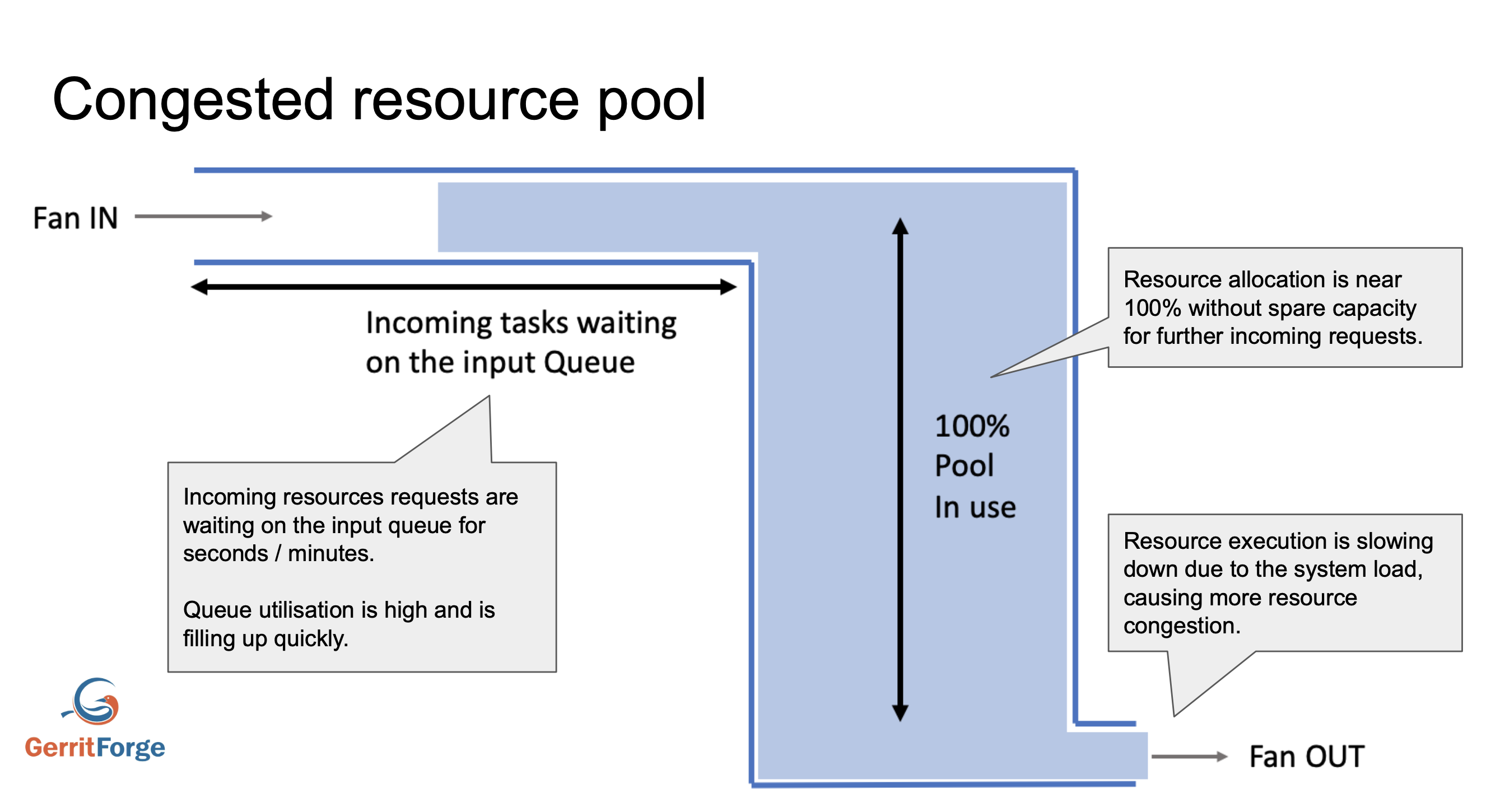
When a system congestion lasts too long, the incoming tasks queueing could reach its limits, and the users may start noticing issues. If the resource pools are too congested, the system could also start a catastrophic failure loop where the workload further reduces the fan out of the execution pool and causing soon a global outage.
The above condition is only one example of what could happen to a Git SCM system, but not the only one. There are many variables to take into account for preventing a system from failing; the knowledge and experience of managing them is embedded in the many of the engineers that are potentially laid off, with the potential of serious consequences for the tech companies.
GerritForge brings AI to the rescue of Git SCM stability
GerritForge has been active in the past 14 years in making the Git SCM system more suitable for enterprises from its very first inception: that’s the reason why this blog is named “GitEnterprise” after all.
We have been investing over 2022 and 2023 in analysing, gathering and exporting all the metrics of the Git repositories to the eyes and minds of the SCM administrators, thanks to open-source products like Git repo-metrics plugin. However, the recent economic downturn could leave all the knowledge and value of this data into a black hole if left in its current form.
When the work of analysing, monitoring and taking action on the data becomes too overwhelming for the size of the SCM Team left after the layoffs, there are other AI-based tools that can come to the rescue. However, none of them is available “out of the box” and their setup, maintenance and operation could also become an impediment.
GerritForge has a historic know-how on knowledge-based systems and has been lecturing the community about data collection and analysis for many years in the Gerrit Code Review community, for example the Gerrit DevOps Analytics initiative back in 2017. It is now the right time to push on these technologies and package them in a form that could be directly usable for all those companies who need it now.
Introducing GHS – GerritForge-AI Health Service
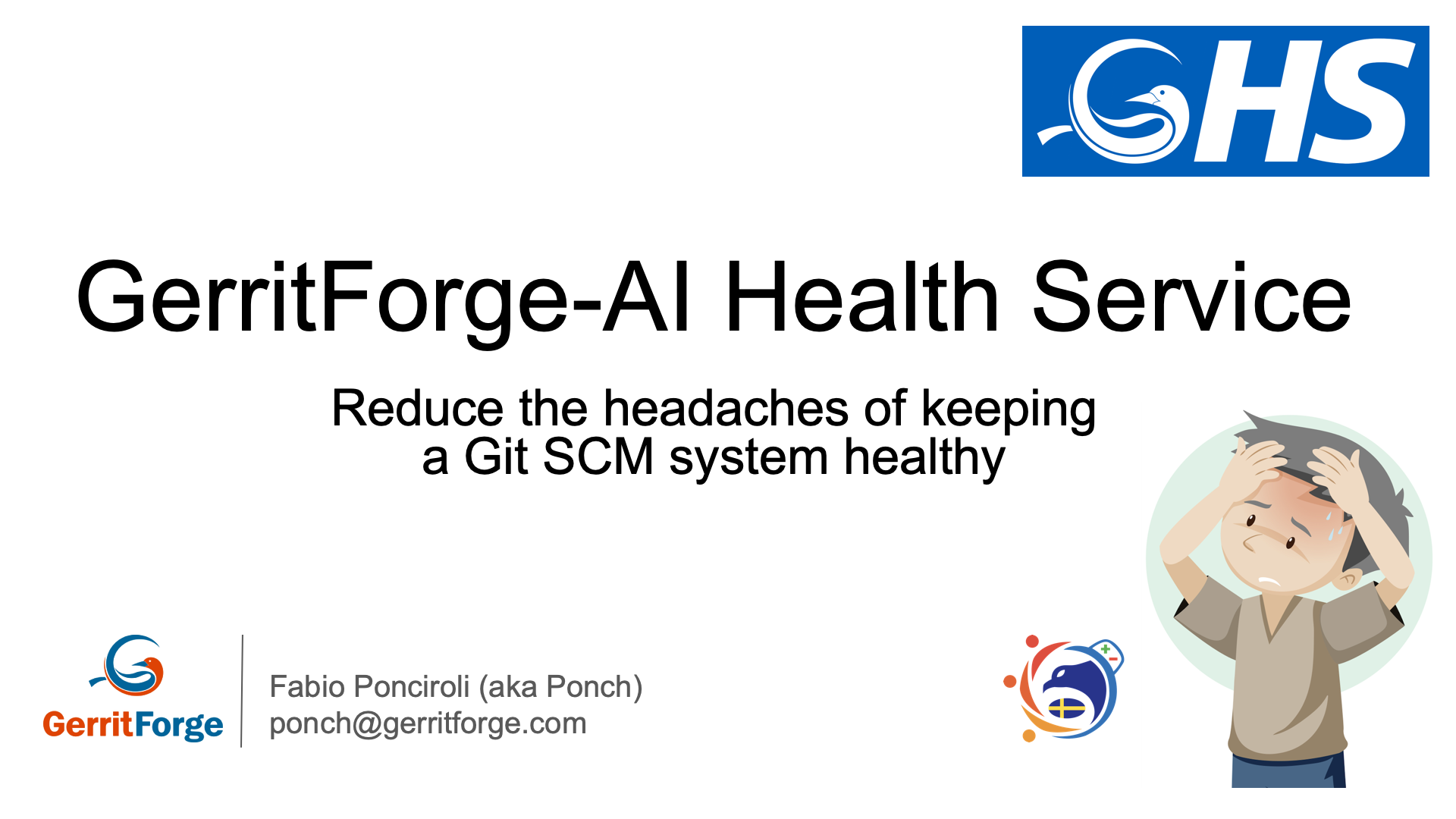
As part of our 2024 goals, GerritForge will release a brand-new service called GHS, directly addressing the needs of all companies that need to have a fully automated intelligent system for collecting, analysing and acting on the Git repository metrics.
The high-level description of the service has already been anticipated at the Gerrit User Summit 2023 in Sunnyvale by Ponch and the first release of the product is due in Q1 of 2024.
How does GHS work?
GHS is a multi-stage system composed of four basic processes:
Collect the metrics of your Gerrit or other Git repositories automatically and publish them on your registry of choice (e.g. Prometheus)
Combine the repository metrics with the other metrics of the system, including the CPU, memory and system load, automatically.
Detect dangerous situations where the repository or the system is starting to struggle and suggest a series of remediation policies, using the knowledge base and experience of GerritForge’s Team encoded as part of the AI engine.
Define a direct remediation plan with suggested priorities and, if requested, act on them automatically, assessing the results.
Stage 4, the automatic execution of the suggested remediation, can be also performed in cooperation with the SCM Administrators’ Team as it may need to go through the company procedures for its execution, such as change-management process or communication with the business.
However, if needed, point 4. can also be fully automated to allow GHS to act in case the SCM admins do not provide negative feedback on the proposed actions.
What the benefits of GHS for the SCM Team?
GHS is the natural evolution of GerritForge’s services, which have historically been proactive in the analysis of the Git SCM data and the proposal of an action plan. The GerritForge’s Health Check is a service that we have been successfully providing for years to our customers; the GerritForge Health Service is the completion of the End-to-End stability that the SCM Team needs now more than ever, to survive with a reduced workforce.
To the SCM Administrator, GHS provides the metrics, analysis and tailored recommendations in real-time.
To the Head of SCM and Release Management Team, GHS gives the peace of mind of keeping the system stable with a reduced workforce.
To the SCM users and developers, GHS provides a stable and responsive system throughout the day, without slowdowns or outages
To the Head of IT, GHS allows to satisfy the company’s needs of costs and head count reduction without sacrificing the overall productivity of the Teams involved.
GerritForge’s pledges to Gerrit Code Review quality and Open-Source
GerritForge has provided Enterprise Support and free contributions to Gerrit Code Review for 14 years, pretty much since the beginning of the project. We pledged in the past to be always 100% Open-Source and do commit to our promises.
For 2024, GerritForge will focus on delivering its promising Open-Source contributions to the stability and reliability of Gerrit Code Review, with:
Support for the Gerrit Code Review platform releases, Gerrit v3.10 and v3.11
Free support and development of the Gerrit CI validation process, in collaboration with all the other Gerrit Code Review contributors and maintainers
Free Open-Source fixes for all critical problems raised by any of its Enterprise Support Customers, available to everyone in the Gerrit Code Review community
Free Open-Source code base for the main four components of the new GHS product, following the Open-Core methodology for developing the service.
With regards to the initiatives that we started in the past few years, including pull-replication and multi-site, we believe they have reached a maturity level that would not need further major refactoring and extensions in 2024. We will continue to support and improve them over the years, based on the feedback and support requests coming from the Enterprise Support Customers and the wider Gerrit Open-Source community.
GHS AI engine and dogfooding on GerritHub.io.
GHS will have a rule-based AI system that will drive all the main decisions on the selection and prioritisation of the corrective actions on the system. As with all AI systems, the engine will need to start with a baseline knowledge and intelligence and evolve based on the experience made on real-life systems.
GerritForge’s commitment to quality is based on the base principle of dogfooding, where we use the system we develop every single day and learn from it. The paradigm is on the basis of our 14 years of success and we are committed to using it also for the development of GHS.
GerritForge has been hosting GerritHub.io since 2013, and tens of thousands of people and hundreds of companies are using it for their private and Open-Source projects every single day. The system is fully self-serviced; however, still relies on manual maintenance from our Gerrit and Git SCM admins.
We are committed to starting using GHS on GerritHub.io from day 1 and use the metrics and learning of the systems to improve its AI rule engine continuously. All customers of GerritForge’s GHS service will therefore benefit from historic knowledge and experience induced by the the learnings and optimisations made on GerritHub.io for the months and years to come.
GHS = Git SCM admins humans and AI-robots working together
GHS will revolutionise the way Git SCM admins are managing the system today: they will not be alone anymore, juggling a series of tools to understand what’s going on, but they will have an intelligent and expert robot at their service, driven by the wisdom and continuous learnings made by GerritForge, at their service every single day.
We expect a different future way of working in front of us: we are embracing this radical change in how people and companies work and making GHS serve them effectively and in line with our Open-Source pledges.
The future is bright with GerritForge-AI Health Service, Git and Gerrit Code Review at your service !
Luca Milanesio GerritForge CEO Gerrit Code Review Release Manager and member of the Engineering Steering Committee






 GerritForge Blog