
Why Traditional Git Servers Won’t Survive 2025

Git changed how we build software.

However, the world it was built for – local repositories and teams, along with simple, human-centric CI/CD pipelines – no longer exists.

Today, codebases are massive. Teams are global. And AI is generating code faster than ever before. Our infrastructure hasn’t kept pace, and traditional Git servers are reaching their limits.

Development Has Outgrown Traditional Git

Software development has exploded in both volume and velocity. According to Archive Market Research, the global software repository market will hit $15 billion in revenue in 2025, growing at 15% annually through 2033. GitHub now hosts over 420 million repositories, supporting more than 100 million developers – each pushing more commits, more frequently, and with more automation than ever.

At the same time, 97% of teams now use AI-assisted tools for vibe-coding, AI-agents for creating PRs and commits, automated AI-code-review, and AI-generated documentation. This results in a massive surge in server traffic, particularly read operations from increased test jobs and automated quality-checking processes, which are literally exploding.

Traditional scaling methods – adding more servers, bigger instances, or wider clusters – simply don’t address the core issue: the world has changed since Git was built 20 years ago.

The Breaking Point for Traditional Git Servers

The symptoms are now familiar to most engineering teams:

  • Slow performance. Git clones and fetches are taking several minutes or even timing out instead of completing swiftly in a few seconds.
  • Pipeline delays. CI/CD is waiting for repositories to be available for cloning or fetching, which delays the feedback cycle.
  • Storage capacity strain. Larger monorepos or multi-repo setups are hitting massive BLOB count and hitting ref limits. When storage is hosted on the Cloud or on shared disks, the increase in the directories and I/O transfer makes Git almost unusable.
  • Rising costs. Over-provisioned infrastructure is trying (and failing) to keep up. The provisional or elastic filesystem limits increase significantly, bringing operational costs to new heights never seen before, and putting more pressure on the budget.

The Archive Market Research report warns: “The rising complexity of software development necessitates efficient and reliable repositories for managing code, dependencies, and artifacts.”

In other words, the systems we depend on to deliver software are now slowing software down.

Scaling Smarter, Not Harder

At GerritForge, we believe that simply throwing more hardware at the problem is no longer enough: it is Git and its utilisation that need to be smarter. We have been researching on the use of AI for optimising the performance and scalability of repositories for over 3 years and shared our findings with the global scientific community.

That’s why we built GHS, an AI-powered accelerator for Git-based SCMs.

We have simulated and demonstrated how traditional tools would collapse and developed GHS, a brand-new model to overcome the traditional limitations of the Git repositories.

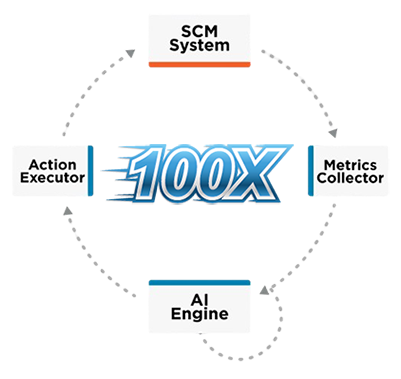
GHS learns how your repositories behave, your access patterns, your CI/CD workflows, and your traffic peaks – and, using reinforcement learning, automatically optimises performance in real-time.

With GHS, the whole development team will experience:

  • Up to 100× faster Git operations. Clones and fetches keep on completing at raw speed, without slowdowns, timeouts or slack.
  • Real-time auto-optimisation. The Git repositories are automatically monitored and optimised for speed, without manual operations.
  • Lower operational costs. The CPU and storage do not suffer from the overload of incoming traffic, delivering better performance on existing hardware. There is no need to scale up the infrastructure and costs massively.
  • Increased reliability. Git servers remain stable even under extreme load, eliminating the need for emergency restarts or maintenance.

Traditional scaling adds more servers. GHS scales using its sophisticated AI model to get the most out of what you already have.

The Gerrit User Summit 2025 made one thing clear: the era of traditional scaling is coming to an end.

As repositories grow and workflows evolve, the next generation of developer infrastructure must be intelligent, simplified & resilient. AI isn’t replacing developers – it’s augmenting them. But if your Git infrastructure can’t keep pace with this new level of activity, your entire SDLC pipeline will suffer.

2025 marks a turning point for software delivery. Traditional Git servers can’t keep up, but that doesn’t mean your team can’t. Because in modern DevOps, speed isn’t just efficiency, it’s a competitive edge.

Supercharge Your Git with GHS: Experience 100x Faster Performance

Slow Git isn’t just annoying – it’s expensive for everyone: developers wait for a CI/CD validation of their changes, SCM admins are wasting their time in fire-fighting SCM slowdown and broken pipelines, IT managers are wasting millions of dollars in CPU and Disk hosting costs.What if your Git operations could be up to 100x faster, and keep up with the new AI-vibe coding landslide of PR and changes?

100x Faster Git, Powered by AI

GHS is an AI-based accelerator for Git SCM that redefines performance:

  • Up to 100x faster clones and fetches.
  • CI/CD pipelines that run without SCM barriers.
  • Adapt automatically to your repository shape and make it faster.
  • Scale without slowdown even under heavy loads

This isn’t traditional “tuning.” GHS learns your repos and access patterns, then continuously optimises them so your Git server is always running at maximum speed.

How Does GHS Deliver 100x Faster Git?

  1. Measure Everything
    It collects detailed metrics in realtime on your repositories.
  2. Spot Bottlenecks
    GHS AI model is trained on recognizing the bottlenecks and take immediate action, before they become a problem
  3. Stay Fast
    Your Git stays consistently accelerated, not just temporarily boosted.

Why Speed Matters

  • Developers stop wasting hours on slow fetches and builds.
  • Release managers push features out faster.
  • IT leaders reduce infra costs by doing more with less.
  • Admins no longer fire-fight performance issues.

Every 1% of time saved in Git can add up to days of productivity across a large team. Imagine saving 100x that.

Who Needs 100x Faster Git?

  • Repositories of all sizes: AI-driven code generation and “vibe-coding” have dramatically accelerated the pace of software delivery.
  • Enterprises that have adopted the AI-pipeline want that value delivered faster to production.
  • Any team frustrated with slow CI/CD pipelines.

The GHS Advantage

  • Transformative speed: not just 2x or 5x faster, but up to 100x
  • SCM expertise: GerritForge’s decades of enterprise SCM know-how built in.
  • Proven reliability: Stability and uptime as performance scales.

Get Started Today

You can try GHS free for 30 days and experience the difference for yourself.

Why settle for slow Git when you can supercharge it with GHS?

Gerrit Code Review: A How-To Guide for new users!

So you think PRs are the only way you can do effective code review? Well, then you’ll be surprised to hear that ain’t the case!

If you’ve read my previous article, you’ll be aware that GitHub or GitLab are great for quick and easy integrations with CI/CD tooling and average for issue tracking/planning, but, in my opinion, miss the mark when it comes to facilitating effective code review.

Today, I want to show you a typical Gerrit workflow and explain why I believe it can greatly improve the quality of your reviews.

Let’s start by reiterating that PRs should be small so as to be easily reviewable, and it’s the creator’s job to make sure they are paired with a meaningful description. But don’t take it from me, you can read it directly on GitHub’s blog.
However, splitting out work into easily reviewable chunks is not easy or intuitive when following a PR-based approach as maintaining dependent PRs is cumbersome and error-prone, so let’s see how Gerrit facilitates this for developers.

Relation chains vs PRs

Let’s say that you’ve started working on a new feature. You realize early on that it’ll be a lot easier to implement if you do some refactoring beforehand. So you go ahead, do the refactoring, commit your work, then add the new feature and commit that too, as a separate commit.
If you’re working with a PR based workflow, before doing the above you’ve probably created a branch and are now about to push it to the remote to then create a PR from the UI, am I right?

Well, if you’re using Gerrit, you don’t need to do that. If your work is supposed to be merged on main, then you can develop directly on that branch, create those 2 commits and push them with git push origin HEAD:refs/for/main, we’ll decompose this command later, but for now let’s look at the effects of it.

As you can see in the screenshot above, Gerrit detects that you’re pushing two separate commits, so it automatically creates 2 new changes, one for each commit, against the branch you’re working on. There was no need to interact with the UI either.

But how did this happen? HEAD:refs/for/<branch-name> tells the Gerrit backend that you’d like to push your current local changes (HEAD) up for review against branch-name Gerrit then does all the magic for you.

Let’s now take a look at the UI:

There’s quite a lot to unpack here, so let’s go in order. First, Gerrit created a Relation chain for us, that includes both commits.
Then, in the commit message, we notice something maybe unexpected, a Change-Id. This is Gerrit’s way of tracking updates to a change. From now on, every time we push a new commit with the same Change-Id, Gerrit will understand it belongs to this change and update it accordingly. You could completely change the commit message, but, as long as you leave the Change-Id unchanged, Gerrit will understand where it belongs.

So let’s try doing that.

How to update changes

The main difference from what most people are used to here is that when you want to update a change, you don’t push a new commit; rather, you amend the existing one

First I need to checkout the change, I can do that by clicking on the DOWNLOAD button(highlighted in the image above), which will show this modal window

This gives me a few options for checking out said change without having to Google how to check out a specific ref or how to cherry-pick each time. So, I copy-paste the “Checkout” option and then run the following on my terminal.

You can see here that I’m not creating a new commit, but rather amending the same one.

Gerrit warns me now that I’ve not amended any files but only the commit message, no problems there, just a handy reminder.

As I’ve not changed the Change-Id, we can see that the change number is still the same. The UI now looks like this:

A few things to notice here. First, I’ve updated the commit message to add a description, great, but surely I wouldn’t want to lose track of the initial state of the change? Can I still see the previous version of this commit? YES!

When you amend your commit, you’re not losing the history of what was there before, you’re merely adding a new patchset to the change. Patchsets are what Gerrit calls each iteration of the commit.

You can also see how the next commit in the relation chain is now marked as an “Indirect relation.” This is because it is not based anymore on the latest version of its parent commit, which as just been updated, so let’s go ahead and fix it. First, we’ll need to select the commit we want to update and then click on the handy “Rebase” button, which will show the following modal

As this is a straightforward case, we’ll confirm the rebase on the parent change.

We can now see that the indirect relation message has disappeared. But how did Gerrit keep track of that? By creating a new patchset which tracks the updated version of the parent commit! Pretty neat, huh?

This leads us to our next topic:

Meaningful commit messages by design

Another problem I see with the PR workflow, or at least how it’s been implemented by the most popular tools today, is that it essentially leaves it up to each individual developer to commit meaningful messages. Whatever merge strategy you pick, neither of them allows for the commit message to be reviewed before it gets merged.

In Gerrit there is no PR description, the commit message IS the “PR description”. Further more, the commit message appears as file in its own right and users can comment on it. This allows reviewers to actually add comments on the message itself to ensure it’s up to scratch with whatever the company standards are.

Submitting the change

Finally, once the comment has been addressed and the change approved, we can click on Submit including parents, and both changes will be merged to the main.

As can be seen by running git log , which will look like this:

Conclusion

The one thing I’d like readers to take away from this article is that no, PRs are not the only way forward and there are solutions to the old problem of wanting to split up code reviews in more manageable chunks.

So let’s quickly review how Gerrit works:
You create changes by pushing commits using the “magic” command refs/for/<bran-name> .
When you want to update a change, you don’t push a new commit; rather, you amend the existing one. Gerrit keeps track of each update in the form of patchsets so you can see how each commit evolved over time.

You can then chain commits as you wish, allowing you to split your work in easily reviewable units.

Finally, commit messages are treated as first class citizens, they’re like any other file in the change, they can be reviewed and commented on, ensuring that no un-helpful commits are merged to the target branch.

Gerrit Code Review future in 2025 and beyond

(TL;DR) The Gerrit Code Review project has an ambitious roadmap for 2025 and beyond. Gerrit 3.12 (H1 2025) will focus on JGit performance improvements, X.509 signed commit support, and enhanced Owners and Analytics plugins. Gerrit 3.13 (H2 2025) aims to further optimize push performance, UI usability, and plugin updates, including Kafka and Zookeeper integrations.

The k8s-Gerrit initiative will improve Gerrit’s deployment on Kubernetes, ensuring better scalability and resilience. Looking ahead, Gerrit 4.0 (2026/2027) plans to decouple the review UI from the JGit server, enabling alternative review interfaces and improved flexibility.

The February 2025 GerritMeets in Sunnyvale CA on the 19th of February 2025 will be all about roadmap and Q&A on what we would like to see coming in Gerrit. See below more details about Gerrit Code Review in 2025 and the future ahead.

Gerrit 3.12 (Target: H1 2025)

JGit Performance Improvements

The development team is prioritizing significant performance enhancements in JGit, the Java implementation of Git used by Gerrit. Key objectives include:

  • Speeding Up Conflicting Ref Names on Push: This aims to reduce delays during push operations when ref name conflicts occur.
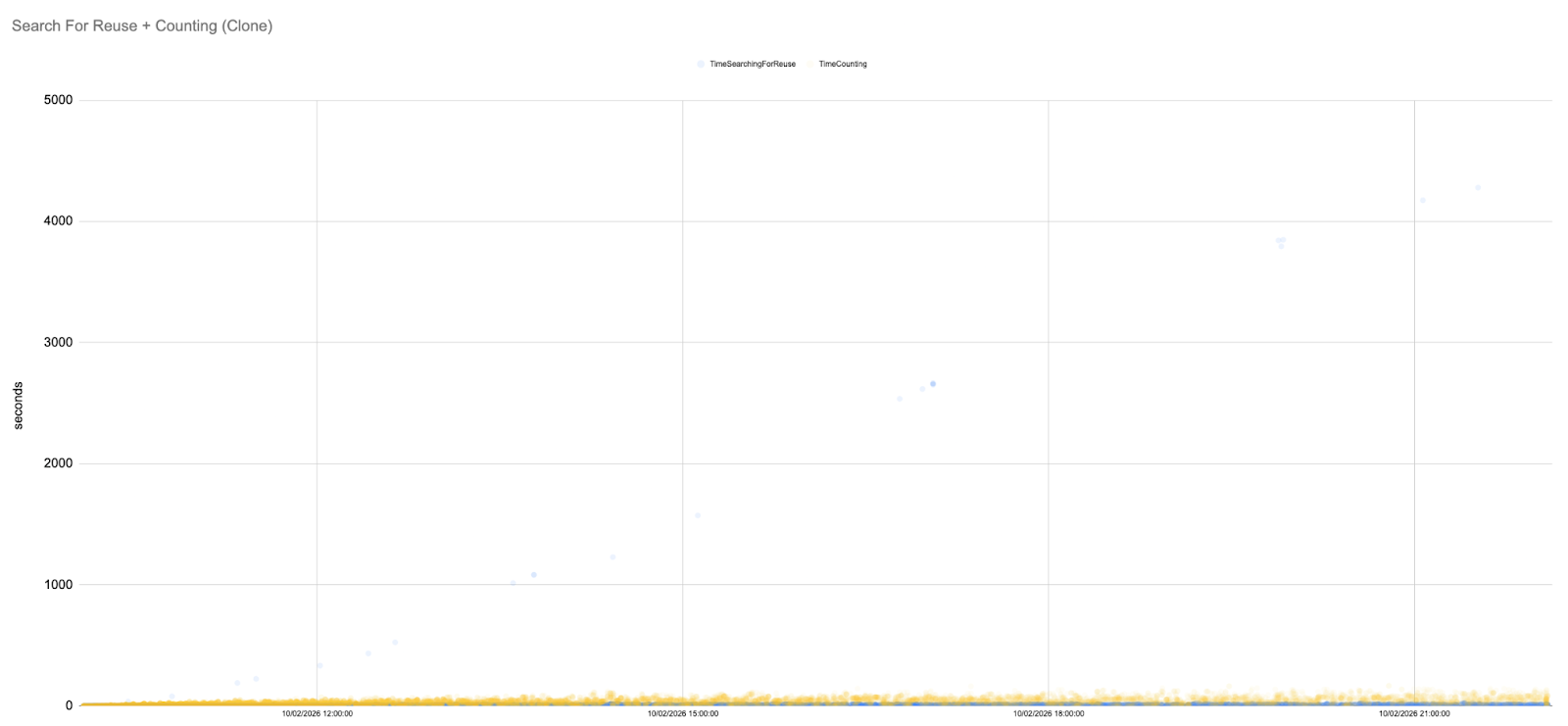
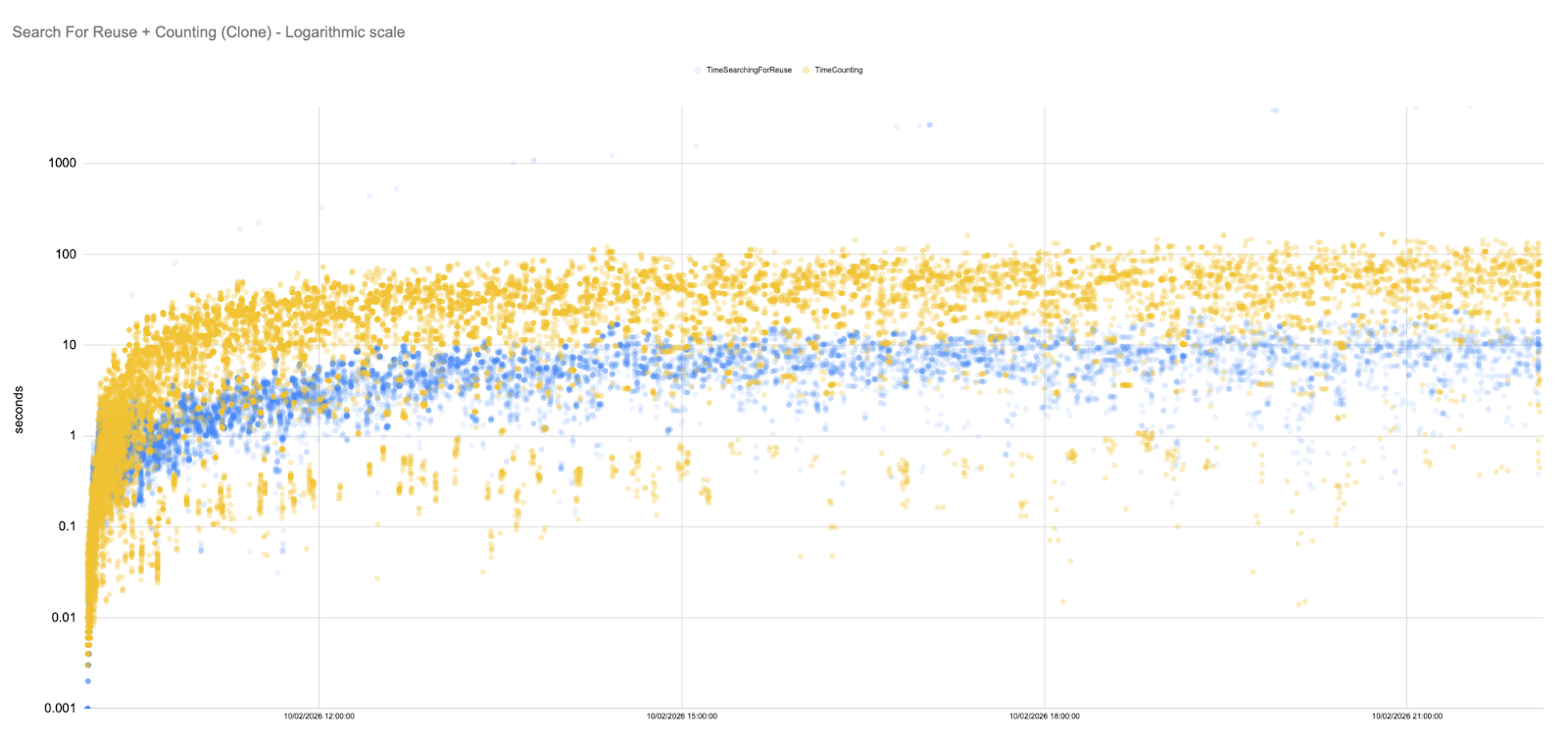
  • Enhancing SearchForReuse Latency for Large Monorepos: The goal is to improve latency by at least an order of magnitude, facilitating more efficient operations in extensive monorepositories.
  • Improving Object Lookup Across Multiple Packfiles: Efforts are underway to accelerate object lookup times by at least tenfold, enhancing performance in repositories with numerous packfiles.
  • Parallelizing Bitmap Generation: By enabling bitmap generation across multiple cores, the team aims to expedite this process, contributing to overall performance gains.

Gerrit Core Experience Enhancements

A notable feature planned for this release is the support for X.509 signed commits, which will bolster security and authenticity in the code review process.

Owners Plugin Improvements

Enhancements to the Owners Plugin are set to provide clearer insights and streamlined interactions:

  • Action Requirements Display: Explicitly showing required actions by each owner at the file level.
  • Detailed Pending Reviews: Offering more comprehensive information on pending reviews by owners.
  • Easier Contact with File Owners: Facilitating more straightforward communication with file owners.

Analytics Plugin Optimization

The analytics plugin is slated for improvements to enhance speed and usability:

  • Repo Manifest Discovery: Native support for discovering repository manifests.
  • Faster Metrics Extraction: Accelerated extraction of metrics for branches, aiding in quicker data analysis.

Gerrit 3.13 (Target: H2 2025)

JGit Performance and Concurrency Enhancements

Building upon previous improvements, version 3.13 aims to further optimize performance:

  • Optional Connectivity and Collision Checks: Improving push performance by allowing the skipping of certain checks when appropriate.
  • Customizable Lock-Interval Retries: Providing flexibility in managing lock intervals to enhance concurrency handling.
  • Read-Only Multi-Pack Index Support: Introducing support for read-only multi-pack indexes to improve repository access efficiency.

Gerrit Core and UI Experience Enhancements

User experience remains a focal point with planned features such as:

  • File List Filtering: Allowing users to filter the file list in the change review screen for more efficient navigation.
  • Headless Gerrit Packaging: Offering a version of Gerrit that serves only read/write Git protocols, catering to users seeking a streamlined experience.

Plugin Updates

The roadmap includes updates to key plugins:

  • Kafka Events-Broker: Upgrading to support Kafka 3.9.0, enhancing event handling capabilities.
  • Zookeeper Global-Refdb: Updating to support Zookeeper 3.9.3, improving global reference database management.

Replication Plugin Enhancements

Efforts to simplify configuration and improve performance include:

  • Dynamic Endpoint Management: Introducing APIs for creating and updating replication endpoints dynamically.
  • UI Integration: Displaying replication status within the user interface for better visibility.
  • Reduced Latency on Force-Push: Improving replication latency during force-push operations by applying objects with prerequisites.

k8s-Gerrit

The k8s-Gerrit initiative focuses on deploying Gerrit within Kubernetes environments, aiming to enhance scalability, resilience, and ease of management. This approach leverages Kubernetes’ orchestration capabilities to provide automated deployment, scaling, and management of Gerrit instances, facilitating more efficient resource utilization and operational consistency.

Gerrit 4.0 (Target: 2026/2027)

Looking ahead, Gerrit 4.0 is set to introduce significant architectural changes:

  • Decoupling Gerrit Review UI and JGit Server: This separation will allow the Gerrit UI and JGit server to operate as independent services, providing greater flexibility in deployment and scaling.
  • Enabling Alternative Review UIs: By decoupling components, the platform will support the integration of other review interfaces, such as pull-request systems, offering users a broader range of tools tailored to their workflows.

The Gerrit community is encouraged to stay engaged with these developments, as the roadmap is subject to change. Contributors planning to work on features not listed are advised to inform the Engineering Steering Committee (ESC) to ensure alignment with the project’s goals.

The future of Gerrit Code Review in 2025 and beyond is truly remarkable, come and join GerritMeets on Wednesday, February 19, 2025 – 11:45 AM to 1:00 PM PDT

Luca Milanesio
Gerrit Code Review Maintainer
Gerrit Code Review Release Manager
Member of the Gerrit Code Review Engineering Steering Committee

GerritForge 2024 in review: Git, Gerrit Code Review and more

As 2024 draws to a close, it’s a great time to reflect on the milestones and achievements of the GerritForge team in innovating Git performance with the release of GHS, supporting and advancing the Gerrit Code Review project with 20 releases and over 1.5k commits. This year has been one of exciting developments and initiatives that have made Gerrit stronger, more accessible, and better equipped to meet the needs of modern software teams. Here’s what GerritForge accomplished for the Git and Gerrit Code Review ecosystem in 2024.

2024 in numbers

  • 1,500 changes merged
  • 40 repositories involved in the Gerrit and JGit projects
  • 20 releases
  • 5 conferences, 6 meetups
  • 11 contributors, 4 maintainers
  • 20k man/hours spent in open-source projects

Managing the Releases of Gerrit 3.10 and 3.11

As usual, we continue to ensure the regular releases of new Gerrit versions. This year was no exception with the releases of Gerrit 3.10 and 3.11. These releases introduced new features, performance optimisations, and bug fixes to further solidify Gerrit as the leading code review tool for large-scale projects.

Our team cooperated with the Gerrit Code Review community to ensure these releases were stable, well-documented, and aligned with community needs. From coordinating release schedules to ensuring compatibility with plugins and integrations, GerritForge played a key role in making these versions a reality.

Key Highlights

  • Gerrit 3.10 brought major improvements in user experience, including refined UI capabilities and enhanced search functionality.
  • Gerrit 3.11 introduced critical updates to multi-site support, security enhancements, and significant performance boosts.

GerritMeets success in both the USA and Europe

The GerritMeets series has become a cornerstone of community engagement, and 2024 was no exception. GerritForge organised six GerritMeets across several locations, including California, Germany, and the UK, bringing together contributors, users, and maintainers to share knowledge, discuss trends, and explore use cases.
Each session covered a diverse range of topics, including:

  • Best practices for multi-site setups.
  • Advanced plugin development.
  • Gerrit performance tuning for large repositories.
  • Innovations in CI/CD workflows with Gerrit.

These virtual meetups provided a platform for collaboration and learning, reinforcing Gerrit’s community spirit. All the recordings of the 2024 GerritMeets are available as a playlist on the GerritForge TV YouTube channel.

World-class Enterprise Gerrit-as-a-Service on Google Cloud Platform

In 2024, GerritForge expanded Gerrit’s capabilities by adding support for Gerrit-as-a-Service (GaaS) on the Google Cloud Platform (GCP). This initiative makes it easier than ever for organizations to adopt Gerrit without the operational overhead of managing infrastructure.

Benefits of Gerrit-as-a-Service on GCP

  • Scalability: Leveraging GCP’s powerful infrastructure to scale Gerrit deployments for enterprises of any size.
  • Simplicity: Reducing setup and maintenance complexity, allowing teams to focus on development and code reviews.
  • High Availability: Utilizing GCP’s advanced networking and storage capabilities for improved uptime and disaster recovery.

By enabling Gerrit on GCP, GerritForge is broadening the tool’s accessibility, particularly for teams looking for a cloud-native, fully managed solution.

Gerrit User Summit with Qualcomm

This year’s Gerrit User Summit, organized by Qualcomm in collaboration with GerritForge, was a highlight for the community. Held at the Qualcomm HQ in San Diego, CA (USA), the summit offered a chance for Gerrit enthusiasts worldwide to come together in person.
The agenda featured:

  • Keynotes by Gerrit maintainers and industry leaders.
  • Hands-on hackathon for contributors and users.
  • Insightful panels on the future of Gerrit.

The collaboration with Qualcomm not only expanded the summit’s reach but also highlighted Gerrit’s growing importance in enterprise environments.

Showcasing GHS and Gerrit Code Review worldwide

This year, GerritForge actively participated in numerous conferences to showcase GHS and expand Gerrit’s visibility, and demonstrate its unique capabilities. These events were a fantastic opportunity to uncover GHS and showcase Gerrit to hundreds of developers who had never encountered it.

At these conferences, we showcased:

  • GHS: It demonstrates its seamless integration with Git and showcases a whopping 100x performance improvement over a vanilla setup thanks to the power of AI and reinforcement learning.
  • K8s-Gerrit: Highlighting how Gerrit deployed on Kubernetes provides unparalleled flexibility, performance, and multi-site support.

Through live demos, presentations, and Q&A sessions, we highlighted GHS and Gerrit’s ability to scale, its unique review model, and its role in making software delivery pipelines up to 100x times faster.

K8s-Gerrit Hackathon with SAP

Collaboration was at the forefront of the k8s-Gerrit Hackathon, co-hosted by GerritForge and SAP. The hackathon brought together developers from both SAP and GerritForge teams to tackle the challenges of Kubernetes-based Gerrit deployments and multi-site support.

Outcomes of the Hackathon

  • Enhanced scalability for k8s-Gerrit deployments.
  • Breakthroughs in multi-site replication and disaster recovery.
  • Valuable contributions to the Gerrit codebase and documentation.

The event exemplified the power of open collaboration, pushing Gerrit further into cloud-native development.

Looking Ahead to 2025

As we celebrate the progress made in 2024, we remain focused on the road ahead. GerritForge is committed to:

  • Public offering of GHS
  • Gerrit-as-a-Service in Google Cloud
  • Gerrit Code Review v3.12 and v3.13
  • More GerritMeets and Gerrit User Summit events

Our gratitude goes out to the Git and Gerrit Code Review communities, contributors, and partners who have made this year a success. Together, we’re building a tool that empowers teams to deliver high-quality code faster and more efficiently.
Here’s to an even more impactful 2025!

Daniele Sassoli – Gerrit Code Review Community Manager
Luca Milanesio – JGit Committer / Gerrit Code Review Engineering Steering Committee / Release Manager and Maintainer

GHS Worldwide Roadshow

We’re thrilled to announce that our team will be speaking about our advancements with GerritForge AI Health Service (GHS) at several prestigious conferences in the coming months. These events provide an incredible opportunity to share our innovative AI solutions with a broader audience, engage with industry experts, and showcase how GHS is revolutionizing the way organizations maintain the health and stability of their Gerrit and Git systems.

Our journey begins at the Linux Open Source Summit in Vienna, from the 16th to the 18th of September. This summit is a cornerstone event for the open-source community, and we couldn’t be more excited to discuss how GHS leverages AI to ensure the seamless performance of Git and Gerrit systems, even in the most demanding environments.

Next, we’ll be in Berlin for Git Merge on the 19th and 20th of September. Git Merge is the go-to event for Git enthusiasts and professionals alike, and we’re eager to dive deep into the technical aspects of GHS, sharing insights on how our AI solution optimizes system performance, reduces downtime, and empowers development teams to focus on what they do best—creating great software.

In October, we’re particularly excited about the Gerrit User Summit in San Diego, on the 10th and 11th. This event is especially important to us as it brings together the Gerrit community to discuss the latest developments and best practices. We’ll be showcasing how GHS is enhancing Gerrit environments by providing intelligent and automated health monitoring and ensuring peak performance.

Following that, we’ll speak at the OCX conference in Mainz, from the 22nd to the 24th of October. OCX is known for bringing together top minds in DevOps and open-source technology, making it the perfect venue to highlight how GHS is transforming the management of code review and source control systems with intelligent, automated health monitoring and remediation.

Finally, we’re thrilled to wrap up our conference tour at KubeCon in Salt Lake City, from the 12th to the 15th of November. As one of the most anticipated events in the cloud-native ecosystem, KubeCon offers an unparalleled platform to demonstrate how GHS integrates with Kubernetes environments, ensuring that your SCM systems are always running at peak performance.

These conferences represent more than just speaking engagements for us—they are an opportunity to engage with the community, learn from our peers, and continue pushing the boundaries of what’s possible with AI in software development. We can’t wait to connect with you at these events and share how GHS can make a tangible difference in your organization’s success.

Stay tuned for more updates as we approach these dates, and be sure to catch our sessions if you’re attending any of these events!

Daniele Sassoli
GerritForge Engineering Manager
Gerrit Code Review Community Manager and Contributor

Gerrit Code Review RBE: moving to BuildBuddy on-prem

The Gerrit Code Review Open-Source project has transitioned from using Google Cloud Platform’s Remote Build Execution (RBE) to BuildBuddy’s on-premises to address performance, stability, and latency issues. The migration process included setting up a new Jenkins controller and provisioning BuildBuddy executors on newly provisioned on-premises boxes, which showed significantly reduced build times and a more consistent and reliable performance. After thorough evaluation and community consensus, BuildBuddy was adopted as the new default for Gerrit’s CI/CD pipeline, enhancing overall efficiency and stability.

Historical Context

The Gerrit Code Review project has undergone significant evolution in its build processes to enhance efficiency and performance. This evolution reflects the increasing complexity and demands of modern CI/CD pipelines.

Overview of Gerrit Code Review

Gerrit is a powerful code review tool with a powerful web and command-line interface, all built on top of the Git open-source project. Gerrit codebase is significant and multifaceted, using Python tooling, TypeScript front-end and a Java-based backend. To appreciate the challenges and the need for robust build tools, consider the scope of Gerrit’s codebase and build activity:

  • Plugins: Gerrit comprises 14 core plugins maintained as git submodules, plus a universe of over 300 community-based plugins developed in multiple languages, from Java to Scala and Groovy.
  • Java Codebase: The project includes 6011 Java files, with 4765 dedicated to production code, amassing ca. 411,768 lines of code (LoC). Additionally, there are 1246 test files (924 unit tests and 322 integration tests) contributing another ca. 276,632 LoC.
  • Frontend Codebase: The frontend is built with 110 JavaScript files (ca. 2345 LoC), 733 TypeScript files (ca. 175,765 LoC), 293 HTML files, and 9 CSS files.
  • Dependencies: Gerrit relies on 135 Java dependencies managed through Maven and 25 NPM dependencies (5 runtime and 20 development).

Gerrit has been founded in 2008 and has over 15 years of code-history, which reflects the evolution of the build tools, Java VMs and front-end technologies used for over a decade. The pre-requisites that you would have to manage in order to build Gerrit are diverse and quite challenging.

Build and Verification Activity

The Gerrit project is highly active, with rigorous commit-level verification processes to ensure code quality and stability. For example, from June 9 to June 23, 2024, Gerrit handled:

Total of changes:

BranchNumber of changes
master65
stable-3.1018
stable-3.916
stable-3.815
stable-3.72
stable-3.60
stable-3.51
stable-3.41
Total118

Total of revisions (patch sets):

BranchNumber of revisions
master230
stable-3.1086
stable-3.921
stable-3.822
stable-3.74
stable-3.60
stable-3.54
stable-3.41
Total368

Total of Gerrit verifications:

Type of verificationnumber of verifications
Build/Tests277
Code Style320
PolyGerrit UI Tests124
RBE BB Build/Tests271
Total992

Evolution of Build Tools

The journey of Gerrit’s build tools reflects its growth and the increasing complexity of its CI/CD requirements:

  1. Apache Maven: Up until version 2.7, Gerrit used Apache Maven as its build tool. Maven, known for its comprehensive project management capabilities, was sufficient during Gerrit’s early stages.
  2. Buck: From version 2.8 to 2.13, Gerrit transitioned to Buck, a build tool designed for faster builds. Buck’s incremental build capabilities helped manage the growing codebase more efficiently than Maven.
  3. Bazel: Since version 2.14, Bazel has been the default build tool for Gerrit. Bazel’s advanced features, including its support for remote caching and execution, provided significant improvements in build performance and scalability.

Transition to Bazel with Remote Execution and Caching

In December 2020, Gerrit Code Review made a significant shift by adopting Bazel with remote execution and caching to address the challenges of long build times. This strategic move aimed to leverage Bazel’s advanced capabilities to enhance the efficiency of the CI processes.

Reasons for the Shift

The primary driver for this transition was the increasing build times due to the growing complexity and size of the Gerrit codebase. The conventional local build processes were becoming a bottleneck, slowing down the development and integration cycles.

Implementation with GCP Remote Build Execution (RBE)

Gerrit integrated Google Cloud Platform’s Remote Build Execution (GCP RBE) as the remote server to support this transition. The integration provided several key benefits:

  • Reduced Build Times: By offloading build and test tasks to powerful remote servers, build times were significantly reduced.
  • Efficient Resource Utilization: Local machines were freed from heavy build tasks, allowing developers to continue working without interruptions.
  • Scalability and Parallelisation: Remote execution and the parallelisation of Gerrit’s Bazel tasks allowed to leverage the scalable cloud resources.

This implementation marked a crucial enhancement in Gerrit’s CI/CD pipeline, setting the stage for further optimisations and improvements in the build process.

Motivation to find RBE alternatives

The RBE implementation on Google Cloud has served the Gerrit Code Review project successfully for many years; however, the needs of the project grew over time and the CI/CD infrastructure had to satisfy additional requirements.

  1. Stability: Google Cloud is SaaS solution which could be flaky at times, whilst the project needed a stable deployment with full control on its stability not influenced by external factors.
  2. Latency between the controller and the executors: the latency between the main CI/CD controller (Jenkins) and the RBE executors paid a significant price for shorter builds like the Code-Style checks, whilst a localised data processing resulted in faster build times and quicker feedback cycles.
  3. Predictability: Consistent and reliable performance is crucial for efficient CI/CD workflows.

Moving to BuildBuddy RBE

BuildBuddy is an open-core Bazel build event viewer, result store, remote cache, and remote build execution platform that provided many new benefits to the Gerrit Code Review builds:

  1. Integration and Customisation: the integration with the existing CI/CD pipelines was straightforward.
  2. Open Source Community: BuildBuddy, being open-core, benefits from community-driven innovation and collaborative support.
  3. Enterprise Features: BuildBuddy Enterprise offers advanced features for companies that need robust capabilities:
    • OpenID Connect Auth Support: Integrates with Google OAuth.
    • Remote Build Execution: Supports custom Docker images.
    • Configurable Bazel Caches TTL: Allows setting TTL for build results and cache with support for persistent build artifact storage.
    • High Availability: Configurations for high availability also on-premises
  4. Control and Stability: On-premise deployment offers full control and enhanced stability by minimizing reliance on external factors.
  5. Very Low Latency: Localized data processing results in faster build times and quicker feedback cycles: we could locate the executors and the Jenkins controller in the same data-centre with micro-seconds network latency.
  6. Predictable Performance: Consistent and reliable performance is crucial for efficient CI/CD workflows, thanks to the dedicated always-on executors.

BuildBuddy RBE allowed more development efficiency and reliability for the Gerrit Code Review project, making it a compelling choice for optimizing CI/CD processes while leveraging the benefits of open-source software and robust enterprise features.

What was the migration plan ?

To clarify a few points for a better understanding of the this section:

  1. Scope of Bazel RBE Execution: Bazel RBE is executed only in the Gerrit project and its core plugins (git submodules). It is not executed in non-core plugins, such as pull-replication, high-availability, multi-site, etc.
  2. Branch Support: From a CI/CD perspective, only the master branch and the last three stable branches are supported for Gerrit project, core and non-core plugins. At the time of the migration, these branches were master, stable-3.7, stable-3.8, and stable-3.9.

The initial phase of the migration aimed to assess the reliability and stability of BuildBuddy RBE. A priority in this phase was to maintain the current CI/CD process while simultaneously evaluating BuildBuddy RBE without any disruptions.

To achieve this phase, several updates and new services were implemented:

Adding BuildBuddy Bazel remote configuration in Gerrit master branch.

Provisioning BuildBuddy Executors: A cloud host was provisioned with the following specifications: 128 CPUs, Intel(R) Xeon(R) Gold 6438Y+, 128GB RAM, and SSD. This host runs 3 BuildBuddy executors (as docker containers).

Setting up a new Gerrit CI Server: A new Jenkins server was set up to run build jobs against BuildBuddy RBE on the Gerrit master branch. This server is not accessible from outside.

Registering a new Gerrit verification: A new verification named RBE BB Build/Tests was added to gerrit-review.googlesource.com to trigger builds on the new Gerrit CI server whenever a new revision was created on the Gerrit master branch.

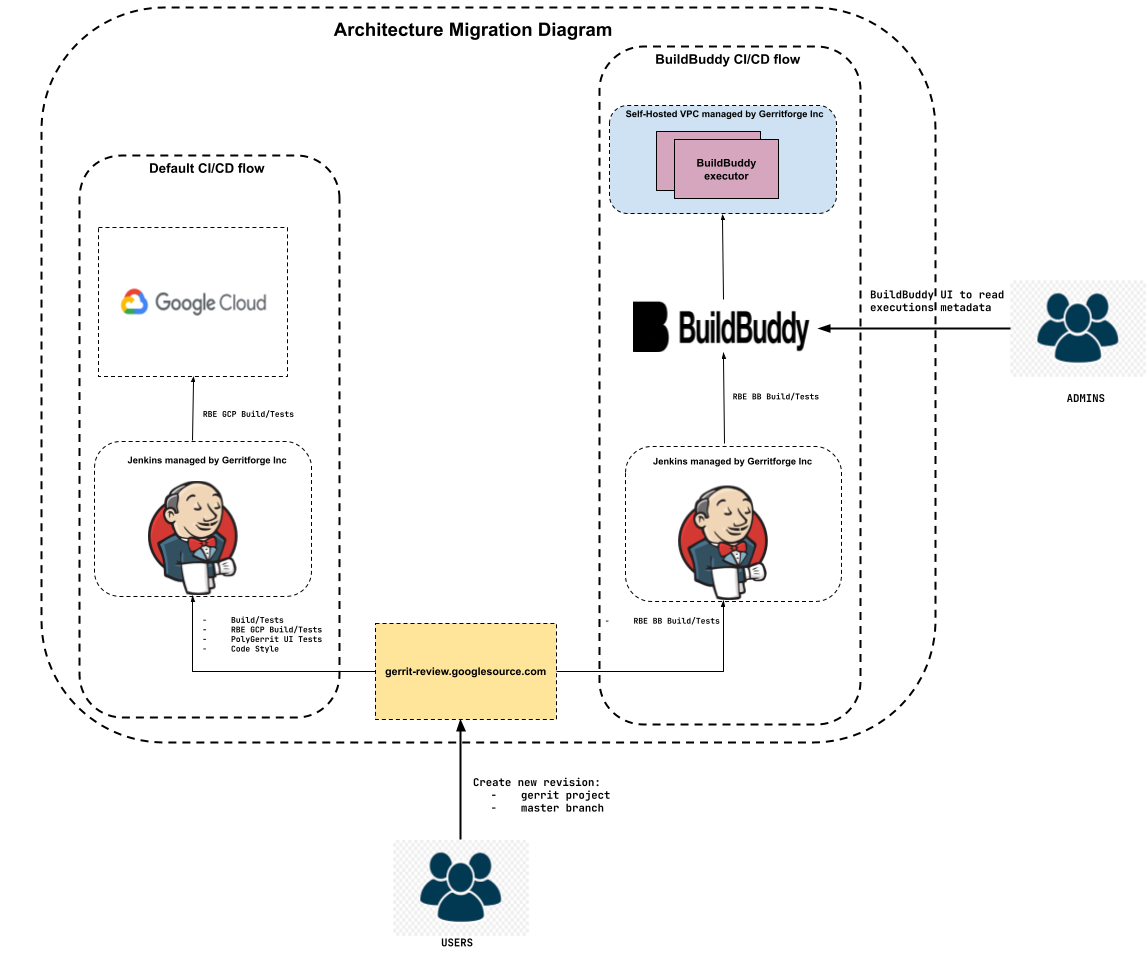
Figure 1: Architecture Migration diagram with default CI flow and new BuildBuddy CI flow:

How is the new CI/CD flow?

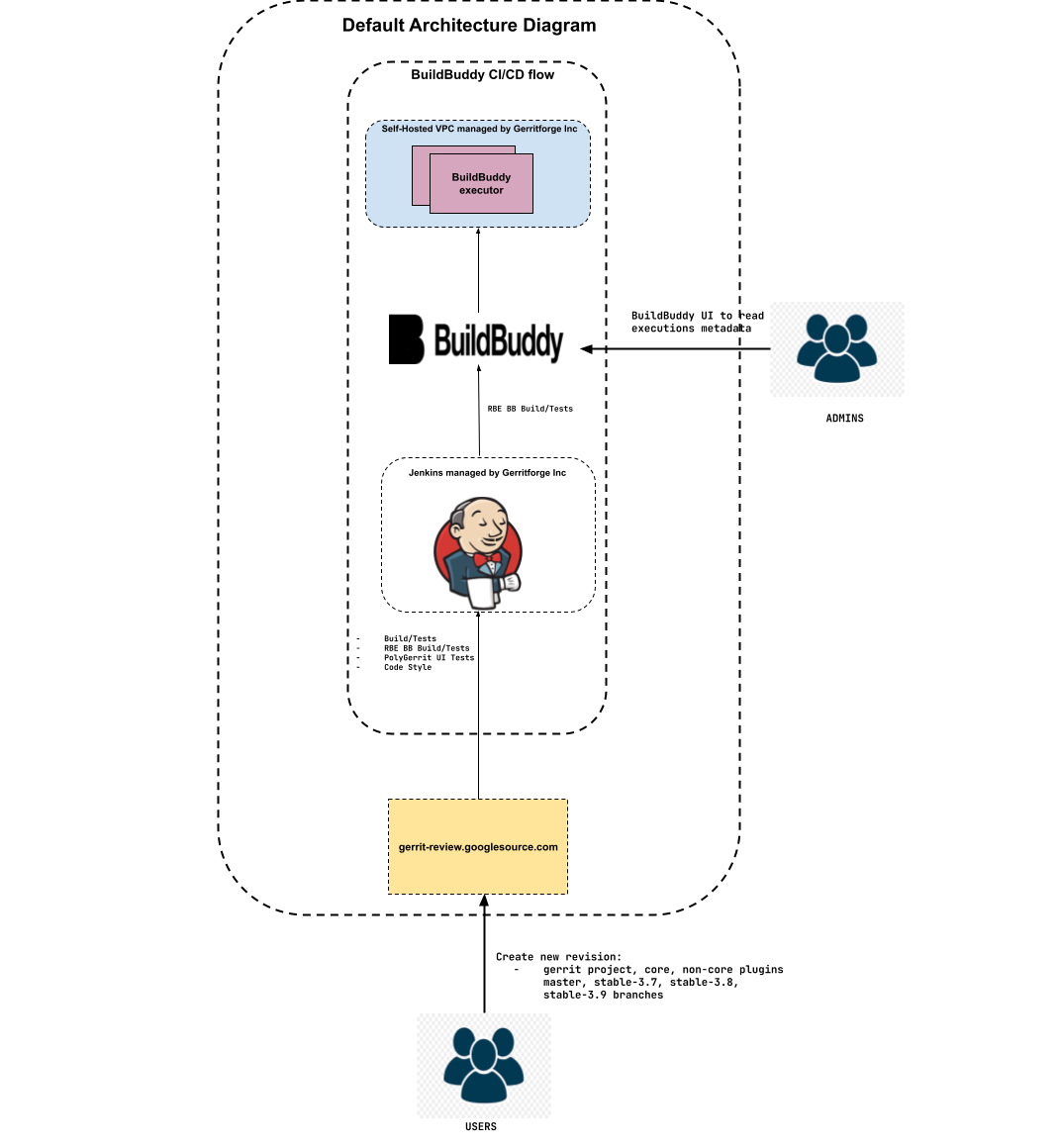
In the default CI flow, when a user creates a new revision (patch set) in Gerrit master, or stable-3.7 or stable-3.8 or stable-3.9 branches, a set of verification jobs trigger Jenkins jobs. These verification jobs include:

  • RBE GCP Build/Tests: Builds the codebase and executes all the unit/integration tests on GCP RBE.
  • Code Style: Checks Java and Bazel formatting, and JavaScript lint.
  • Build/Tests: Builds the codebase and executes one single no-op test.
  • PolyGerrit UI Tests: Executes unit/integration tests for PolyGerrit UI.

If any of the verification jobs fail, the verification status of the revision is marked with a -1.

As mentioned earlier, the intention when testing the reliability and stability of BuildBuddy RBE was to avoid interfering with the default CI/CD flow. To achieve this, a new verification job called RBE BB Build/Tests was added. This verification triggers a Jenkins job on the new Gerrit CI, which builds the codebase and executes unit/integration tests on BuildBuddy RBE. This setup allowed the default flow and the BuildBuddy RBE flow to coexist without affecting each other.

It is important to note two things:

  • Only revisions in the master branch of Gerrit project triggered this new verification job. The data collected from the master branch is sufficient to draw conclusions.
  • The status of this new verification job does not affect the overall verification status of the revision.

Figure 2: Verification jobs, default ones and the BuildBuddy RBE, triggered in a Gerrit master branch revision:

Once the first phase concluded, it was important to analyze the data to determine if BuildBuddy RBE was reliable and stable enough to proceed to the next phase. In the second phase, the plan was to evaluate the performance of BuildBuddy RBE against GCP RBE. Architecturally, the CI/CD process remained the same as in the first phase, with one key difference: the verification job RBE BB Build/Tests would be triggered when revisions were created for the Gerrit repo on the master, stable-3.7, stable-3.8, and stable-3.9 branches. This was necessary to ensure that BuildBuddy RBE handled the same number of jobs as GCP RBE, allowing for a fair performance comparison.

Data Collection

Before analysing the data, it’s imperative to elucidate our data collection methodology. To procure the build data (build number, execution time in GCP RBE and BB RBE and status), we developed a script in python that employed two APIs:

Notes:

  • Build number is a unique number represented by the tuple: (change number, revision number).
  • All the graphs show builds in chronological order.
  • The build numbers are not shown in the graphs for readable purposes.
  • Builds labelled as “RUNNING” or those lacking specification according to the API have been excluded from the calculations.

Key Performance Indicators

  • Average Build Time: Calculate the average build time for each platform (GCP RBE and BuildBuddy RBE) to understand the typical time it takes to complete a build on each platform.
  • Percentage of Builds Faster: Determine the percentage of builds that are completed faster on BuildBuddy RBE compared to GCP RBE. This helps assess which platform is more efficient in terms of build time.
  • Overall Success Rate / Failure Rate: Calculate the overall success and failing rate of builds on BuildBuddy RBE. This considers both successful and failed builds to provide a comprehensive view of platform reliability.
  • Outliers (>60 minutes): Identify the percentage of builds that exceed a certain threshold, such as 60 minutes in BuildBuddy RBE. This helps pinpoint builds that take exceptionally long and may require investigation or optimization.
  • Average Build Time Reduction: Determine the average reduction in build time when using BuildBuddy RBE compared to GCP RBE. This quantifies the efficiency improvement gained by using the BuildBuddy platform.

PHASES

As we mentioned above, the migration has been segmented into two distinct phases:

Phase 1: Spanning from December 28th, 2023, to February 9th, 2024, during which RBE BuildBuddy operated against the Gerrit master branch.
Phase 2: Commencing from February 10th, 2024, to February 26th, during which RBE BuildBuddy operated against the Gerrit master, stable-3.7, stable-3.8, and stable-3.9 branches.

Phase 1: Evaluate if BuildBuddy RBE offers stability and low latency

To make the data more readable and understandable, I have split the data into 2 graphs:

Figure 3: RBE Successful Build time for Gerrit master between 28th December 2023 to 18th January 2024:

Figure 4: RBE Successful Build time for Gerrit master between 19th January 2024 to 9th February 2024:

Total number of builds:

master
GCP Builds489
BB Builds489

Build status:

BB SuccessfulBB failed
GCP Successful39017
GCP Failed082

Initially, 3.47% of BuildBuddy RBE builds failed due to CPU exhaustion caused by running 100 BuildBuddy executors simultaneously. This problem was addressed by reducing the number of executors to 3. BuildBuddy engineers advise running only one executor container per host/node, with each executor capable of handling multiple RBE Actions concurrently. For each action, an executor initiates an isolated runner to execute it. We plan to reassess our configuration in due course.

Average build time when GCP and BuildBuddy builds were successful:

Minutes
GCP Average18.69
BB Average10.2

Where the average build time reduction is 8.49 minutes and 96.4% (376 out of 390 builds) of BuildBuddy builds are faster than GCP builds.

We discovered that 1.5% of BuildBuddy successful builds were outliers. This was due to the need for a restart of the new Gerrit CI server, which caused temporary disruptions.

change_numberREVISION_NUMBERGCP RBE MINUTESBB RBE MINUTES
40039816.7868.68
3996571113.71293.55
3996571421.45137.47
400958214.52154.3
247812726.6267.17
406597114.1879.55

Average time when GCP and BB Failed:

Minutes
GCP Average17.68
BB Average23.29

Conclusions:

Assessing performance and stability, the results were promising, with the BuildBuddy platform showcasing superior performance, as highlighted in the table “Average build time when GCP and BB Successful”. Additionally, issues with BuildBuddy failing builds during successful GCP builds were addressed, primarily stemming from resolved configuration problems. Although outliers represented a mere 1.5%, their significance was negligible. However, despite these favourable outcomes, caution was warranted due to the higher volume of builds in GCP compared to BuildBuddy, attributed to GCP’s operation across stable branches.

Phase 2: Compare BuildBuddy RBE with GCP RBE based on performance

To make the data more readable and understandable, The data has been splitted into 4 graphs:

Figure 5: RBE Successful Build time for Gerrit master:

Figure 6: RBE Successful Build time for Gerrit stable-3.9:

Figure 7: RBE Successful Build time for Gerrit stable-3.8:

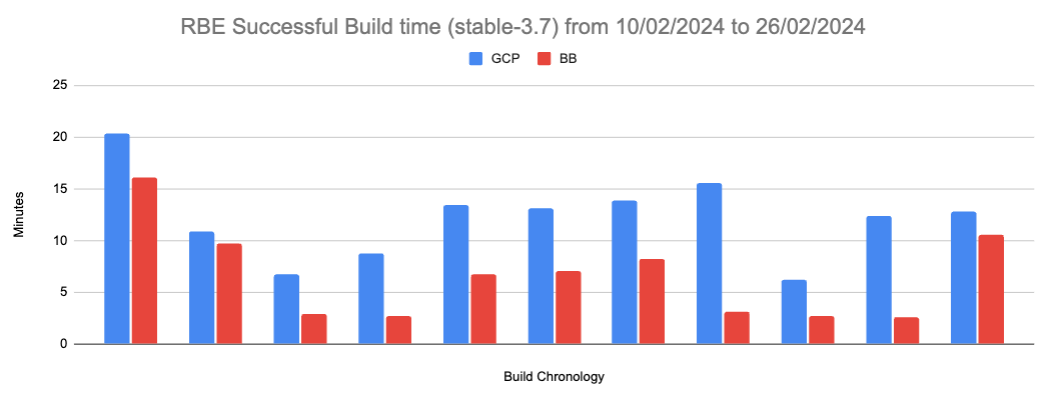
Figure 8: RBE Successful Build time for Gerrit stable-3.7:

Successful BB Build status / Successful GCP Build status:

masterstable-3.9stable-3.8stable-3.7Total
Builds11926611162

Average time when GCP and BB Successful:

Minutes
GCP Average13.91
BB Average8.45

Where the average build time reduction is 5.46 minutes and 90.74% (147 out of 162 builds) of BuildBuddy builds are faster than GCP builds.

Failed BB Build states / Failed GCP Build status:

masterstable-3.9stable-3.8stable-3.7Total
Builds30121144

Failed BB Build status / Successful GCP Build status:

masterstable-3.9stable-3.8stable-3.7Total
Builds12003

It is worth noting that 1.14% of BuildBuddy builds failed.

Average time when GCP and BB builds failed

Minutes
GCP Average10.96
BB Average9.43

Conclusions:

The findings indicated that the BuildBuddy scenario demonstrated a more consistent performance, due to the on-premises allocated resources, as emphasised in the table “Average build time when GCP and BB Successful,” with comparable volumes of builds. Moreover, the stability remained highly consistent, evident from the table “Failed BB Build status / Successful GCP Build status,” alongside the absence of outliers.

Gerrit code review community decision

On February 27, 2024, the collected data was shared with the Gerrit code review open-source community. After careful consideration and thorough analysis, BuildBuddy was found to demonstrate remarkable stability. While it cannot be definitively stated that BuildBuddy surpasses GCP in all aspects, it notably outperforms GCP in terms of latency. Given its superior latency performance and strong stability, the decision was made to adopt BuildBuddy to replace GCP in the CI/CD pipeline.

Final migration phase

On March 29, 2024, the new Gerrit CI was established as the default CI using BuildBuddy RBE, and the following actions were taken:

  • Decommissioned the old Gerrit CI server.
  • Configured Gerrit CI to support both core and non-core plugin jobs, ensuring external visibility.
  • Unregistered the Gerrit verification RBE GCP Build/Tests on gerrit-review.googlesource.com.

Figure 9: Default Architecture diagram with BuildBuddy CI/CD flow as default CI/CD flow:

Final Conclusions

Following the completion of the migration, data on BuildBuddy RBE was collected from May 1, 2024, to June 24, 2024, to validate all assumptions. Subsequent statistical analysis yielded the following results:

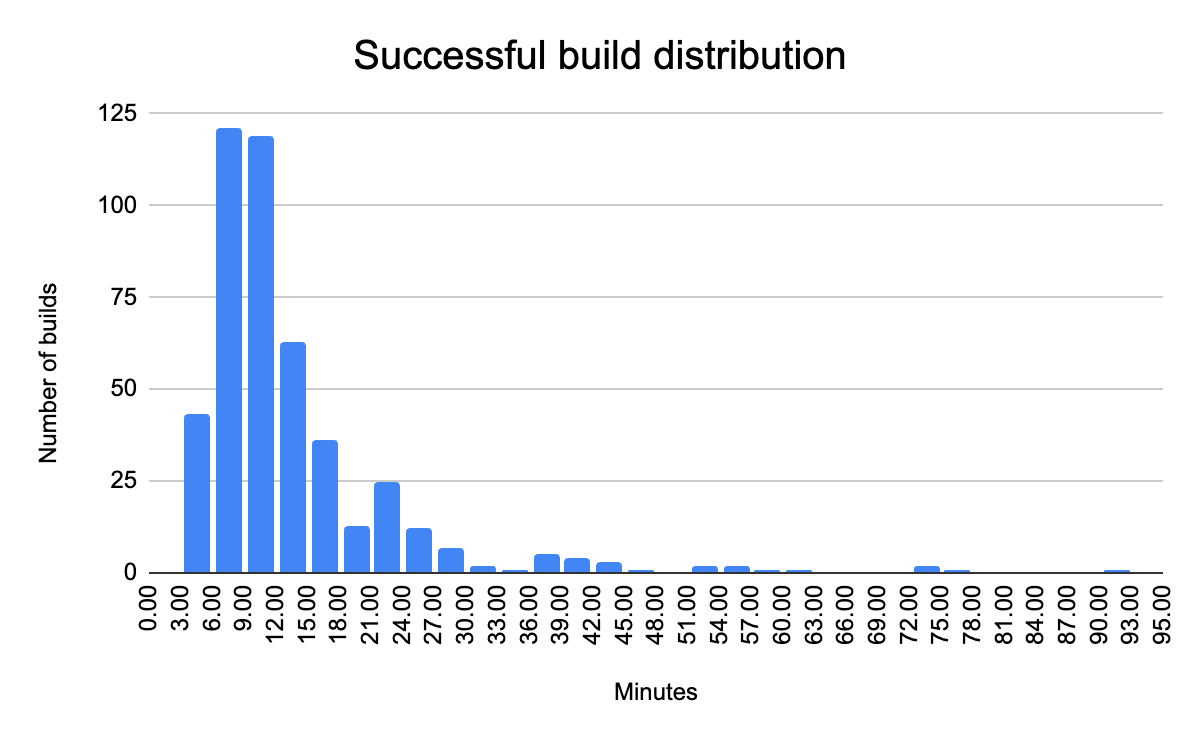
Figure 10: Successful Builds:

Builds465
Mean13.62 min
Median10.47 min
Standard dev10.79 minA higher standard deviation indicates that the build times are spread out over a wide range, meaning there is a lot of variability in the times
Q315.23 min75% of builds are completed in less than 15.23 minutes.

Figure 11: Failed Builds:

Builds105
Mean7.72 min
Median6.22 min
Standard dev7.56 min
Q37.7 min75% of builds are completed in less than 7.7 minutes.

While we are satisfied with our current results, we recognize the need for improvements in our successful builds. Our next step will be to analyze all the build data provided by the BuildBuddy dashboard, including target-level metrics, timing, artifacts, cache, and executions. This analysis will help us enhance the Bazel configuration and improve build performance.

Figure 12: BuildBuddy dashboard


Alvaro Vilaplana-Garcia – Gerrit Code Review Contributor
Luca Milanesio – Gerrit Code Review Maintainer and Release Manager

GerritForge looks at a bright AI future in 2024

Looking back at 2023 in numbers

It has been an outstanding year for GerritForge and Gerrit Code Review in 2023, with excellent achievements on our 2023 GOALS.

The numbers show the GerritForge commitment throughout the past 12 months:

  • 853 changes merged (26% of the whole project contributions)
  • 47 projects, including Gerrit, JGit and major core and non-core plugins
  • 12 contributors
  • 4 maintainers, including the Gerrit Code Review release manager
  • 4 Gerrit community events, including the Gerrit User Summit 2023 and GerritMeets

Top #5 projects’ contributions

GerritForge has confirmed over 2023 its commitment to the Gerrit Code Review platforming, helping deliver two major releases: Gerrit v3.8 and v3.9.

The major contributions combined are focused on the plugins for extending the reach of the Gerrit platform, first and foremost the pull-replication and multi-site, as shown by the split of the 853 contributions across the projects, weighted by the number of changes and average modifications per change.

  1. Pull replication plugin
    This is where GerritForge excelled in providing an unprecedented level of performance over anything that has been built so far in terms of Git replication for Gerrit. Roughly one-third of the Team efforts have contributed to the pull replication plugin, which provided over 2022/23 a 1000x speedup factor compared to Gerrit tradition factor. GerritForge has further improved its stability, resilience and self-healing capabilities thanks to a fully distributed and pluggable message broker system.
  2. Gerrit v3.8 and v3.9
    GerritForge helped release two major versions of Gerrit Code Review, contributing noteworthy features like Java 17 support, cross-plugin communication, importing of projects across instances and the migration to Bazel 7.
  3. Owners plugin
    Jacek has completely revamped the engine of the owners plugin, boosting it with an unprecedented level of performance, hundreds of times faster than in the previous release, and bringing it to the modernity of submit requirements without the need to write any Prolog rules.
  4. Multi-site plugin
    The whole team helped provide more stability and bug fixes across multiple versions of Gerrit, from v3.4 up to the latest v3.9.
  5. JGit
    GerritForge kept its promises in stepping up its efforts in getting important fixes merged, including the optimisation of the refs scanning in Git Protocol v2 and the fix for bitmap processing with incoming Git receive-pack concurrency that we promised to fix at the beginning of 2023.

Migration of Eclipse JGit/EGit to GerritHub.io

The 2023 has also seen a major improvement in GerritHub stability and availability, halving the total outage in a 12-month period from 19 to 10 minutes, with a total uptime of 99.998% (source: PIngdom.com)

With the increased stability plus the new features of projects imports since v3.7, the Eclipse JGit and EGit projects have decided and completed their migration to GerritHub.io on the 21st of November, 2023. Since then, hundreds of changes have continued their reviews, and 62 of them have been merged on GerritHub.

The whole process was completed without any downtime and a reduced read-only window on the legacy Eclipse’s instance git.eclipse.org, which was needed because of the lack of multi-site support on the Eclipse side.

What we did achieve from our goals of 2023

  • JGit changes: we did merge 22 changes in 2023, most of them within the list of our targets for the year. One related to the packed-refs loading optimisation was abandoned (doesn’t get much traction from the rest of the community), and the last major one left is the priority queue refactoring still in progress on stable-6.6. Also, thanks to the migration of JGit/EGit to GerritHub.io, David Ostrovsky managed to get hold of its committer status and will now be able to provide more help in support in getting changes reviewed and merged.
  • JGit multi-pack index support: we did not have the bandwidth and focus to tackle this major improvement. The task is still open for anyone willing to help implement it.
  • Git repository optimiser: we kick-started the activity and researched the topic, with Ponch presenting the current status at the Gerrit User Summit 2023 in Sunnyvale CA.
  • Gerrit v3.8 and project-specific change numbers: the design document has been abandoned because of the need of rethinking its end-to-end user goals. However, we found and fixed many use cases where Gerrit wasn’t using the project/change-number pair for identifying changes, which is a pre-requisite for implementing any future project-specific change number use-case.
  • Gerrit Certified Binaries: the Platinum Enterprise Support for Gerrit has been enriched in 2023 with the certified binaries programme, with enhanced Gatling tests and E2E validation using AWS-Gerrit. Many bugs have been found and fixed in all the active versions of Gerrit; some of them were very critical and surprisingly undiscovered for months.
  • GerritForge Inc. revenue targets in the USA: the revenues increased by 50% in 2023, which was slightly below the initial expectations but still remarkable, despite the latest economic downturn of the past 12 months. 100% of the business has been transferred to the USA, including the GerritForge trademark and logo and we are now ready to start a new robust growth cycle in 2024 and beyond.

Looking at the future with AI in 2024

The recent economic news in the past 6 months has highlighted a difficult moment after the COVID-19 pandemic: the conjunction of the cost of living crisis, rising interest rates and two new major wars across the globe have pushed major tech companies to revise their small to medium-term growth figures, resulting in a series of waves of lay offs in the tech sector and beyond.

Whilst the layoffs are not immediately related to a lack of profitability of the companies involved, it highlights that in the medium term there will be a lot fewer engineers looking after the production systems across the company, including SCM.

SCM and Code Review are at the heart of the software lifecycle of tech companies and, therefore, represent the most critical part of the business that would need to be protected at all costs. GerritForge sees this change as a pivotal moment for stepping up its efforts in serving the community and helping companies to thrive with Gerrit and its Git SCM projects.

How do we maintain SCM stability with fewer people?

Gerrit Code Review has become more and more stable and reliable over the years, which should sound reassuring for all of those companies that are looking at a reduced staff and the challenge of keeping the lights on of the SCM. However, the major cause of disruption is represented by what is not linked to the SCM code but rather its data.

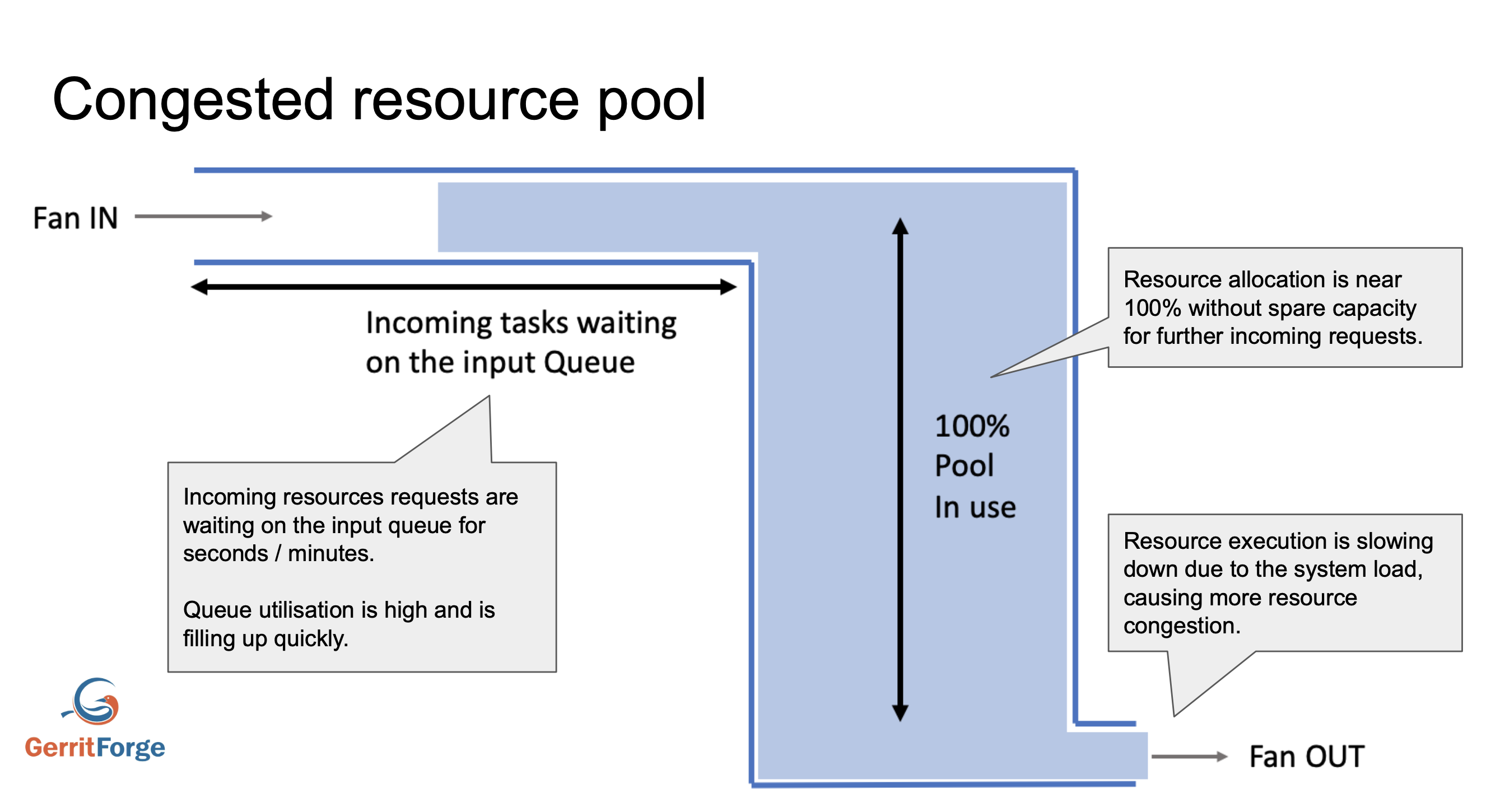
The Git repositories and their status are nowadays responsible for 80% of the stability issues with Gerrit and possibly with other Git servers as well. Imagine a system that is receiving a high rate of Git traffic (e.g. Git clone) of 100 operations per minute, and the system is able to cope thanks to a very optimised repository and bitmaps. However, things may change quickly and some of the user actions (e.g. a user performing a force-push on a feature branch) could invalidate the effectiveness of the Git bitmap and the server will start accumulating a backlog of traffic.

In a fully staffed team of SCM administrators and with all the necessary metrics and alerts in place, the above condition would trigger a specific alert that can be noticed, analysed, and actioned swiftly before anyone notices any service degradation.

However, when there is a shortage of Git SCM admins, the number of metrics and alerts to keep under control could be overwhelming, and the trade-offs could leave the system congestion classified as a lower-priority problem.

When a system congestion lasts too long, the incoming tasks queueing could reach its limits, and the users may start noticing issues. If the resource pools are too congested, the system could also start a catastrophic failure loop where the workload further reduces the fan out of the execution pool and causing soon a global outage.

The above condition is only one example of what could happen to a Git SCM system, but not the only one. There are many variables to take into account for preventing a system from failing; the knowledge and experience of managing them is embedded in the many of the engineers that are potentially laid off, with the potential of serious consequences for the tech companies.

GerritForge brings AI to the rescue of Git SCM stability

GerritForge has been active in the past 14 years in making the Git SCM system more suitable for enterprises from its very first inception: that’s the reason why this blog is named “GitEnterprise” after all.

We have been investing over 2022 and 2023 in analysing, gathering and exporting all the metrics of the Git repositories to the eyes and minds of the SCM administrators, thanks to open-source products like Git repo-metrics plugin. However, the recent economic downturn could leave all the knowledge and value of this data into a black hole if left in its current form.

When the work of analysing, monitoring and taking action on the data becomes too overwhelming for the size of the SCM Team left after the layoffs, there are other AI-based tools that can come to the rescue. However, none of them is available “out of the box” and their setup, maintenance and operation could also become an impediment.

GerritForge has a historic know-how on knowledge-based systems and has been lecturing the community about data collection and analysis for many years in the Gerrit Code Review community, for example the Gerrit DevOps Analytics initiative back in 2017. It is now the right time to push on these technologies and package them in a form that could be directly usable for all those companies who need it now.

Introducing GHS – GerritForge-AI Health Service

As part of our 2024 goals, GerritForge will release a brand-new service called GHS, directly addressing the needs of all companies that need to have a fully automated intelligent system for collecting, analysing and acting on the Git repository metrics.

The high-level description of the service has already been anticipated at the Gerrit User Summit 2023 in Sunnyvale by Ponch and the first release of the product is due in Q1 of 2024.

How does GHS work?

GHS is a multi-stage system composed of four basic processes:

  1. Collect the metrics of your Gerrit or other Git repositories automatically and publish them on your registry of choice (e.g. Prometheus)
  2. Combine the repository metrics with the other metrics of the system, including the CPU, memory and system load, automatically.
  3. Detect dangerous situations where the repository or the system is starting to struggle and suggest a series of remediation policies, using the knowledge base and experience of GerritForge’s Team encoded as part of the AI engine.
  4. Define a direct remediation plan with suggested priorities and, if requested, act on them automatically, assessing the results.

Stage 4, the automatic execution of the suggested remediation, can be also performed in cooperation with the SCM Administrators’ Team as it may need to go through the company procedures for its execution, such as change-management process or communication with the business.

However, if needed, point 4. can also be fully automated to allow GHS to act in case the SCM admins do not provide negative feedback on the proposed actions.

What the benefits of GHS for the SCM Team?

GHS is the natural evolution of GerritForge’s services, which have historically been proactive in the analysis of the Git SCM data and the proposal of an action plan. The GerritForge’s Health Check is a service that we have been successfully providing for years to our customers; the GerritForge Health Service is the completion of the End-to-End stability that the SCM Team needs now more than ever, to survive with a reduced workforce.

  • To the SCM Administrator, GHS provides the metrics, analysis and tailored recommendations in real-time.
  • To the Head of SCM and Release Management Team, GHS gives the peace of mind of keeping the system stable with a reduced workforce.
  • To the SCM users and developers, GHS provides a stable and responsive system throughout the day, without slowdowns or outages
  • To the Head of IT, GHS allows to satisfy the company’s needs of costs and head count reduction without sacrificing the overall productivity of the Teams involved.

GerritForge’s pledges to Gerrit Code Review quality and Open-Source

GerritForge has provided Enterprise Support and free contributions to Gerrit Code Review for 14 years, pretty much since the beginning of the project. We pledged in the past to be always 100% Open-Source and do commit to our promises.

For 2024, GerritForge will focus on delivering its promising Open-Source contributions to the stability and reliability of Gerrit Code Review, with:

  • Support for the Gerrit Code Review platform releases, Gerrit v3.10 and v3.11
  • Free support and development of the Gerrit CI validation process, in collaboration with all the other Gerrit Code Review contributors and maintainers
  • Free Open-Source fixes for all critical problems raised by any of its Enterprise Support Customers, available to everyone in the Gerrit Code Review community
  • Free Open-Source code base for the main four components of the new GHS product, following the Open-Core methodology for developing the service.

With regards to the initiatives that we started in the past few years, including pull-replication and multi-site, we believe they have reached a maturity level that would not need further major refactoring and extensions in 2024. We will continue to support and improve them over the years, based on the feedback and support requests coming from the Enterprise Support Customers and the wider Gerrit Open-Source community.

GHS AI engine and dogfooding on GerritHub.io.

GHS will have a rule-based AI system that will drive all the main decisions on the selection and prioritisation of the corrective actions on the system. As with all AI systems, the engine will need to start with a baseline knowledge and intelligence and evolve based on the experience made on real-life systems.

GerritForge’s commitment to quality is based on the base principle of dogfooding, where we use the system we develop every single day and learn from it. The paradigm is on the basis of our 14 years of success and we are committed to using it also for the development of GHS.

GerritForge has been hosting GerritHub.io since 2013, and tens of thousands of people and hundreds of companies are using it for their private and Open-Source projects every single day. The system is fully self-serviced; however, still relies on manual maintenance from our Gerrit and Git SCM admins.

We are committed to starting using GHS on GerritHub.io from day 1 and use the metrics and learning of the systems to improve its AI rule engine continuously. All customers of GerritForge’s GHS service will therefore benefit from historic knowledge and experience induced by the the learnings and optimisations made on GerritHub.io for the months and years to come.

GHS = Git SCM admins humans and AI-robots working together

GHS will revolutionise the way Git SCM admins are managing the system today: they will not be alone anymore, juggling a series of tools to understand what’s going on, but they will have an intelligent and expert robot at their service, driven by the wisdom and continuous learnings made by GerritForge, at their service every single day.

We expect a different future way of working in front of us: we are embracing this radical change in how people and companies work and making GHS serve them effectively and in line with our Open-Source pledges.

The future is bright with GerritForge-AI Health Service, Git and Gerrit Code Review at your service !


Luca Milanesio
GerritForge CEO
Gerrit Code Review Release Manager and member of the Engineering Steering Committee

Accelerate with Gerrit DevOps Analytics, in one click!


Accelerating your time to market while delivering high-quality products is vital for any company of any size. This fast pacing and always evolving world relies on getting quicker and better in the production pipeline of the products. The whole DevOps and Lean methodologies help to achieve the speed and quality needed by continuously improving the process in a so-called feedback loop. The faster the cycle, the quicker is the ability to achieve the competitive advantage to outperform and beat the competition.

It is fundamental to have a scientific approach and put metrics in place to measure and monitor the progress of the different actors in the whole software lifecycle and delivery pipeline.

Gerrit DevOps Analytics (GDA) to the rescue

We need data to build metrics to design our continuous improvement lifecycle around it. We need to juice information from all the components we use, directly or indirectly, on a daily basis:

  • SCM/VCS (Source and Configuration Management, Version Control System)
    how many commits are going through the pipeline?
  • Code Review
    what’s the lead time for a piece of code to get validated?
    How are people interacting and cooperating around the code?
  • Issue tracker (e.g. Jira)
    how long does it take the end-to-end lifecycle outside the development, from idea to production?

Getting logs from these sources and understanding what they are telling us is fundamental to anticipate delays in deliveries, evaluate the risk of a product release and make changes in the organization to accelerate the teams’ productivity. That is not an easy task.

Gerrit DevOps Analytics (aka GDA) is an OpenSource solution for collecting data, aggregating them based on different dimensions and expose meaningful metrics in a timely fashion.

GDA is part of the Gerrit Code Review ecosystem and has been presented during the last Gerrit User Summit 2018 at Cloudera HQ in Palo Alto. However, GDA is not limited to Gerrit and is aiming at integrating and processing any information coming from other version control and code-review systems, including GitLab, GitHub and BitBucket.

Case study: GDA applied to the Gerrit Code Review project

One of the golden rules of Lean and DevOps is continuous improvement: “eating your dog food” is the perfect way to measure the progress of the solution by using its outcome in our daily life of developing GDA.

As part of the Gerrit project, I have been working with GerritForge to create Open Source tools to develop the GDA dashboards. These are based on events coming from Gerrit and Git, but we also extract data coming from the CI system, the Issue tracker. These tools include the ETL, for the data extraction and the presentation of the data.

As you will see in the examples Gerrit is not just the code review tool itself, but also its plugins ecosystem, hence you might want to include them as well into any collection and processing of analytics data.

Wanna try GDA? You are just one click away.

We made the GDA more accessible to everybody, so more people can play with it and understand its potentials. We create the Gerrit Analytics Wizard plugin so you can have some insights in your data with just one click.

What you can do

With the Gerrit Analytics Wizard you can get started quickly and with only one click you can get:

  • Initial setup with an Analytics playground with some defaults charts
  • Populate the Dashboard with data coming from one or more projects of your choice

The full GDA experience

When using the full GDA experience, you have the full control of your data:

  • Schedule recurring data imports. It is just meant to run a one-off import of the data
  • Create a production ready environment. It is meant to build a playground to explore the potentials of GDA

What components are needed?

To run the Gerrit Analytics Wizard you need:

You can find here more detailed information about the installation.

One click to crunch loads of data

Once you have Gerrit and the GDA Analytics and Wizard plugins installed, chose the top menu item Analytics Wizard > Configure Dashboard.

You land on the Analytics Wizard and can configure the following parameters:

  • Dashboard name (mandatory): name of the dashboard to create
  • Projects prefix (optional): prefix of the projects to import, i.e.: “gerrit” will match all the projects that are starting with the prefix “gerrit”. NOTE: The prefix does not support wildcards or regular expressions.
  • Date time-frame (optional): date and time interval of the data to import. If not specified the whole history will be imported without restrictions of date or time.
  • Username/Password (optional): credentials for Gerrit API, if basic auth is needed to access the project’s data.

Sample dashboard analytics wizard page:

wizard.pngOnce you are done with the configuration, press the “Create Dashboard” button and wait for the Dashboard, tailored to your data, to be created (beware this operation will take a while since it requires to download several Docker images and run an ETL job to collect and aggregate the data).

At the end of the data crunching you will be presented with a Dashboard with some initial Analytics graphs like the one below:

dashboard-e1549490575330.png

You can now navigate among the different charts from different dimensions, through time, projects, people and Teams, uncovering the potentials of your data thanks to GDA!

What has just happened behind the scenes?

When you press the “Create Dashboard” button, loads of magic happens behind the scenes. Several Docker images will be downloaded to run an ElasticSearch and Kibana instance locally, to set up the Dashboard and run the ETL job to import the data. Here a sequence workflow to illustrate the chain of events is happening:

components.png

Conclusion

Getting insights into your data is so important and has never been so simple. GDA is an OpenSource and SaaS (Software as a Service) solution designed, implemented and operated by GerritForge. GDA allows setting up the extraction flows and gives you the “out-of-the-box” solution for accelerating your company’s business right now.

Contact us if you need any help with setting up a Data Analytics pipeline or if you have any feedback about Gerrit DevOps Analytics.

Fabio Ponciroli – Gerrit Code Review Contributor – GerritForge Ltd.

Gerrit User Summit 2017, 2-3 Oct, London

GerritUserSummit2017-logo.png

New and exciting features are coming for this year Gerrit User Summit, with the launch of Ver. 2.15, NoteDb, high-availability, multi-master and much more.

The Summit will take place for the very first time in Europe, London, the location chosen by the community after a public consultation, the 2nd and 3rd of October at CodeNode (Skills Matter).

There are still a few places available but hurry up and register now at https://gerritusersummit.eventbrite.com.

See below an overview of the topics that will be presented and discussed during the User Summit.

What’s new in Gerrit 2.14.x.

Gerrit v2.14 was released during the last Hackathon in April and has gone through three patch releases. David Pursehouse from CollabNet will give an overview of the new features introduced which would be highly beneficial for all of those who haven’t migrated yet.

Gerrit at Google: Multi-master, Mutli-tenant.

Google is the founder, main contributor and possibly the most advanced user of the Gerrit Code Review: learning from their experience is a unique opportunity to learn and being able to leverage and use the tool at its best.

Patrick Hiesel from Google will go through the insights of their Gerrit Code Review architecture and will provide some of their metrics of scale. In addition to that, he will present some findings from the recent switch of their load-balancing infrastructure and the associated pitfalls encountered.

Google is possibly the only one in the world using Gerrit in a multi-tenant setup, having a unique multi-master installation that serves a constellation of domains and projects, including huge and familiar ones like Android and Chromium.

Standing “on the shoulders of giants” like Google helps a lot in preventing scalability issues as the audience and adoption of Gerrit Code Review grows in large companies: being part of the audience in the talk is a unique opportunity to learn and ask questions directly to the maintainers of their infrastructure.

PolyGerrit: a new UX experience for Gerrit Code Review

Google has invested a lot in reinventing and reengineering the user interface of Gerrit Code Review, which remained mostly unchanged for almost a decade. A new team has been put together in their San Francisco offices with experienced UX developers that leveraged the new Polymer framework of web components.

The result is PolyGerrit, a modern web UX which provides an unprecedented browsing speed and flexible rendering across different devices, including mobile and tablets.

The PolyGerrit Team will be presenting the findings of their user-experience research and show some of the features and insights of the new UX.

Gerrit CI and keeping logs forever.

Gerrit Code Review itself is a large project, involving over 300 developers across the globe and using the most advanced DevOps practices. The CI/CD pipeline has been provided and managed by GerritForge on the https://gerrit-ci.gerritforge.com and Luca Milanesio from GerritForge will present the latest improvements in the pipeline plus an interesting way of collecting and reusing the logs.

Leveraging the logs for identifying the bottlenecks of the CI/CD pipeline is the way to drive improvement. GerritForge leveraged the expertise of his engineers to harvest and organize data and will give it back to the community as powerful dashboards.

Beyond Gerrit.

Gerrit is great. However, it is also quite an important part of a bigger ALM process. Jacek Centkowski from CollabNet will describe how multiple tools can be unified under a single TeamForge umbrella and what are the immediate benefits of it.

What’s coming in Gerrit 2.15

After only four months, we are already close to the v2.15 of Gerrit Code Review, which would be possibly the last one before the step to the v3.0.

Dave Borowitz from Google, principal maintainer of the Gerrit Code Review project, will go through the new features of v2.15 and possibly give a glimpse in what to expect from v3.0.

Mining Gerrit Data to Study Contentious Reviews and Community Evolution

Gerrit Code Review is much more than a tool, it is a way for people working together in companies that are large and mostly distributed across the globe.

Shane McIntosh from McGill University has been running a research lab on this topic. The Software REBELs—a research lab at McGill University—mine code review data to study topics like the impact that code review practices have on software release and design quality. Our more recent work mines code review data to study the reviewing process itself. In this talk, I will describe the results of two empirical studies of data that we collected from the Gerrit instances of the OpenStack project. The first study aims to understand the reviews where reviewers disagree about a patch. The second study follows how the concerns that reviewers raise evolve as the OpenStack community ages and individual reviews accrue experience.

Gerrit Analytics: dashboards, networks, KPI

Gerrit has always been lacking major code analytics features compared to other Git Server tools like GitBlit or GitLab. GerritForge Ltd is filling the gap and adds one important asset to the Gerrit Code Review platform: code review analytics.

We need to harvest and unify the logs and events coming from the different components of the CI/CD pipeline by putting at the center of it the people and teams that are building and discussing the code on Gerrit. The resulting data-lake of information can be later analyzed and correlated to calculate the cycle time of the entire pipeline.

Luca Milanesio from GerritForge will show the new analytics dashboards that are going to be published and provided back to the Team that is developing the Gerrit Code Review project as a precious contribution to the community.

How to extend Gerrit using Scripting Plugins

Gerrit Code Review has a robust set of API that can be used to extend its functionalities and provide a more integrated development workflow for the Teams.

Luca Milanesio from GerritForge will present how to use different scripting tools to extend the capabilities of Gerrit without the need of developing and building a plugin, using Jython, Groovy and Scala.

A new simpler but powerful Gerrit Jenkins plugin

Gerrit Code Review is an essential part of a larger CI/CD pipeline. Most of the times it is used in conjunction with Jenkins, the most popular OpenSource Continuous Integration and Delivery tool.

The integration between Gerrit and Jenkins (Gerrit Trigger Plugin) was developed back in 2010 at Sony and since then has been extended and adopted in thousands of Jenkins installations. However, Jenkins has evolved too and has now a brand new concept and definition of multi-branch pipeline which struggles to be seamlessly integrated with the current Gerrit Trigger Plugin.

Luca Milanesio from GerritForge will present a brand new plugin based on the new Jenkins branch discovery API which works seamlessly with Jenkins multi-branch pipelines and provides a simpler interface with Gerrit by leveraging the new WebHooks.

Diffy with enterprise grade

Since 2012 CollabNet has been working on improving Gerrit integration with TeamForge. Many features have been created to satisfy the needs of enterprise customers. Eryk Szymanski from CollabNet will present features like RBAC, history protection, Git style notifications, quality gates, pull request and code browser which have been implemented on top of vanilla Gerrit.

Q&A with the maintainers

Have you ever wondered why something is working in a certain way? Have you ever wanted to explain any complaint about some parts of Gerrit? Would you give your congratulation to the people that made this project? Would you like to make a feature request or propose new ideas?

This is the moment where you can speak directly face-to-face to the people that are building this project every single day, the Gerrit maintainers.


The event is free for everyone, thanks to the contribution of our sponsors, CollabNet Inc, GerritForge Ltd and Skills Matter Ltd.

SponsorsBanner.png