First, a huge thank you to the OpenInfra Foundation for hosting this event in Paris. Their invitation to have the Gerrit User Summit join the rest of the community set the stage for a truly collaborative and impactful gathering.
Paris last weekend wasn’t just a conference; it was a reunion. Fourteen years after the last GitTogether at Google’s Mountain View HQ, the “Git and Gerrit, together again” spirit was electric.
On October 18-19, luminaries from the early days (Scott, Martin, Luca, and many others) reconvened, sharing the floor with the new generation of innovators. The atmosphere was intense, filled with the same collaborative energy of 2011, but focused on a new set of challenges. The core question: how to evolve Git and Gerrit for the next decade of software development, a future dominated by AI, massive scale, and an urgent demand for smarter workflows.
Here are the key dispatches from the summit floor.
A Historic Reunion, A Shared Future
This event was a powerful reminder that the open-source spirit of cross-pollination is alive and well. The discussions were invigorated by the “fresh air” from new-school tools like GitButler and Jujutsu (JJ), which are fundamentally rethinking the developer experience.
In a significant show of industry-wide collaboration, we were delighted to have GitLab actively participating. Patrick’s technical presentation on the status of reftable was a highlight, but his engagement in discussions on collaborative solutions moving forward with the Gerrit community truly set the tone. It’s clear that the challenges ahead are shared by all platforms, and the solutions will be too.
Scaling Git in the Age of AI
The central theme was scale. In this rapidly accelerating AI era, software repositories are growing at an unprecedented rate across all platforms—Gerrit, GitHub, and GitLab alike. This isn’t a linear increase; it’s an explosion, and it’s pushing SCM systems to their breaking point.
The consensus was clear: traditional vertical and horizontal scaling is no longer enough. The community is now in a race to explore new techniques—from the metal up—to improve performance, slash memory usage, and make core Git operations efficient at a scale we’ve never seen before. This summit was a rare chance for maintainers from different ecosystems to align on these shared problems and forge collaborative paths to solutions.
Dispatches from the Front Lines: NVIDIA and Qualcomm
This challenge isn’t theoretical. We heard powerful testimonials from industry giants NVIDIA and Qualcomm, who are on the front lines of the AI revolution.
They shared fascinating and sobering insights into the repository explosion they are actively managing. Their AI workflows—encompassing massive datasets, huge model binaries, and unprecedented CI/CD activity—are generating data on a scale that is stressing even the most robust SCM systems. Their presentations detailed the unique challenges and innovative approaches they are pioneering to tackle this data gravity, providing invaluable real-world context that fueled the summit’s technical deep dives.
Beyond the Pull Request: The Quest for a ‘Commit-First’ World
One of the most passionate debates centered on the developer workflow itself. The wider Git community increasingly recognizes that the traditional, monolithic “pull request” model is ill-suited to the “change-focused” code review that platforms like Gerrit have championed for years.
The benefits of a change-based workflow, cleaner history, better hygiene, and higher-quality atomic changes—are driving a growing interest in standardizing a persistent Change-ID for each commit. This would make structured, atomic reviews a first-class citizen in Git itself. The collaboration at the summit between the Gerrit community, GitButler, JJ, and other Git contributors on defining this standard was a major breakthrough.
This shift is being powered by tools like GitButler and JJ, which are built on a core philosophy: Workflow Over Plumbing. Modifying commits, rebasing, and resolving conflicts remain intimidating hurdles for many developers. The Git command line can be complex and unintuitive. These new tools abstract that complexity away, guiding users through commit management in a way that feels natural. The result is faster iteration, higher confidence, and a far better developer experience.
AI and the Evolving Craft of Code Review
Finally, no technical summit in 2025 would be complete without a deep dive into AI. The arrival of AI-assisted coding is fundamentally shifting the dynamic between author and reviewer.
Engineers at the summit expressed a cautious optimism. On one hand, AI is a powerful tool to accelerate reviews, improve consistency, and bolster safety. On the other, everyone is aware of the trade-offs. Carelessly used, AI-generated code can weaken knowledge sharing, blur IP boundaries, and erode a team’s deep, institutional understanding of its own codebase.
The challenge going forward is not to replace the human in the loop, but to strengthen the craft of collaborative review by integrating AI as a true co-pilot.
A Path to 100x Scale: The GHS Initiative
The most forward-looking discussions at the summit centered on how to achieve the massive scale required. One of the most promising solutions presented was GHS (Git-at-High-Speed). This innovative approach is not just an incremental improvement; it’s a strategic initiative designed to increase SCM throughput by as much as 100x.
The project’s vision is to enable platforms like Gerrit, GitLab, and GitHub Enterprise to handle the explosive repository growth and build traffic generated by modern AI workflows. By re-architecting key components for hyper-scalability, GHS represents a concrete path forward, ensuring that the industry’s most critical SCMs can meet the unprecedented demands of the AI-driven future.
The Road from Paris
The Gerrit User Summit 2025 was more than a look back at the “glorious days.” It was a statement. The Git and Gerrit communities are unified, energized, and actively building the next generation of SCM. The spirit of GItTogether 2011 is back, but this time it’s armed with 14 years of experience and a clear-eyed view of the challenges and opportunities ahead.
21 November 2023 (Sunnyvale, CA) – GerritForge Inc. the leader in Gerrit Code Review Enterprise Support, has successfully re-hosted the Eclipse JGit/EGit projects on GerritHub.io, preserving 14 years of the repository history, including all changes, reviews and comments. Everything that has been produced and was historically available on the https://git.eclipse.org/r website is now fully available on https://eclipse.gerrithub.io.
The Eclipse Foundation started to encourage all of its projects to adopt Gerrit Code Review, which became the main hub where all the other Open-Source components and contributors were uploading their code and collaborating.
Today, the https://git.eclipse.org/r site hosts over 1300 repositories and tens of thousands of contributors and reviewers.
The risks of the announced shutdown
The Eclipse Foundation started looking at more comprehensive hosting solutions well beyond pure Git hosting and associated Code Review, including GitHub and GitLab and started using them side-by-side with their existing https://git.eclipse.org/r. In November 2021, the organisation decided to shut down the Gerrit Code Review instance giving as alternatives to migrate the projects to either GitHub or GitLab.
Although both GitHub and GitLab would have offered to keep the code history of all projects, the review information would have been completely lost. Gerrit Code Review has a JSON format (code-named NoteDb) for storing all the review comments together with the repository so that code and review meta-data can be kept safe in the same place. However, GitHub and GitLab have a more traditional relational DBMS approach and would have been unable to render Gerrit’s NoteDb.
If the project would have migrated to GitHub or GitLab, they could have created three main issues:
All the review history would have been formally accessible in the repository but not visible on the GitHub or GitLab UI
All associations between the NoteDb data and the committers’ identity would have been lost.
New reviews of the code developed on GitHub or GitLab UI would have been stored on a server-side relational DBMS.
GerritForge offers to rescue 14 years of review data
The main goal of GerritHub.io was to enable anyone who has a public or private repository on GitHub to use Gerrit Code Review on top of their existing data. All the authentication, authorisation and publishing of the repository stay on GitHub, whilst GerritHub.io provides the Code Review and collaboration experience.
The projects’ win: all their repositories would have been moved to GitHub, and all existing 14 years of review history and new reviews would be accessible through GerritHub.io
The migration project from git.eclipse.org/r to eclipse.gerrithub.io
The project was made possible thanks to the introduction of the “importing feature” in Gerrit v3.7, where projects can be moved between Gerrit instances by keeping their change numbers, accounts identities mapping and all associated review data.
Using existing GitHub projects on GerritHub.io is straightforward, and anyone can get started in a matter of minutes; however, the Eclipse Foundation case was more complex because of multiple additional requirements:
Custom validation of incoming Git commits authors against the Eclipse ECA policies. The Foundation had developed a custom plugin on Gerrit Code Review that needed to be amended to be suitable for a shared-hosting platform like GerritHub.io.
The Eclipse Foundation needed the configuration of specific OAuth scopes and permission tailored to the roles of the Eclipse Foundation contributors and reviewers.
Last but not least, the migration from https://git.eclipse.org/r to https://eclipse.gerrithub.io needed to be completed with zero downtime and minimal disruption for the existing committers and contributors to the project. Therefore, a classic “big-bang” migration with a planned outage was not an option.
Gerrit multi-site and the enablement of smooth migration paths
Being multi-site means that the “logical domain” (e.g. eclipse.gerrithub.io), instead of being served by a set of hosts in a single data centre, it can point to different locations across the globe, all active at the same time and accept read/write operations, such as Git push, clone, fetch and code-reviews. The full design of the solution is available on the multi-site plugin repository
When two users are pushing code at the same time to two different sites, Gerrit will check the destination refs against the SHA1 stored in the global-refdb and will coordinate the transactions to avoid ending up in a split-brain situation. Synchronisation between sites is achieved using the pull-replication plugin.
Gerrit Code Review is designed to be future-proof, thanks to a clear separation and contract between the front end and the backend REST-API. That allows a smooth blue-green migration between releases because every release of Gerrit is forward and backwards compatible with its next release +1. For example, GerritHub.io is running two different versions of Gerrit Code Review on different sites as we speak: v3.8.2 in the US and Canada (https://review-am.gerrithub.io) and v3.9.0-rc5 in Europe (https://review-eu.gerrithub.io), without anyone noticing any disruption. Each site progresses towards newer releases bi-weekly whilst the overall service remains active.
Project-based migration from git.eclipse.org to eclipse.gerrithub.io
Gerrit projects include all the commits and meta-data in the same repository and, therefore, have the perfect design to allow an easy migration between servers. However, there are some gotchas:
Every Gerrit server has a server-id associated with it, which is used to “tag” every change. That prevents Gerrit from parsing and indexing data that does not necessarily belong to the server.
Every NoteDb meta-data record is strictly decoupled from any Personal Identifiable Information (aka PII), including the full name and e-mails of the authors, committers, owners and reviewers of the changes under review. The lookup between the anonymised identity (aka account-id) and the PII is contained in a centralised repository called ‘All-Users.git’, which isn’t accessible.
Every change has a unique incremental number associated with it, the change number. The numbering sequence is unique per Gerrit server, but when moving projects between different servers, you may have numbering conflicts.
GerritForge has configured the server ID of git.eclipse.org as an “external imported server ID” so that every project coming from the Eclipse Foundation can be parsed and indexed. Its review metadata is rendered on the UI.
The identities are mapped using the public REST-API https://git.eclipse.org/r/accounts/NN/detail, which allows the association of GerritHub users with the legacy Eclipse Foundation account IDs matched by e-mail address.
The Open-Source version does not have support for multi-tenancy in the Gerrit core. However, I developed a minimalistic solution six years ago that would give the “user experience” of virtual hosting on Gerrit. The idea behind the solution is quite simple: hide unwanted projects based on the full domain name, pretty much like the virtual hosts work on the HTTP Servers world.
For example, you could define eclipse.gerrithub.io as follows:
Shawn himself was stunned when he saw the source code of the virtual-host libmodule back in 2017, with the comment “how did I end up writing so much code, if you did everything in just 7 Java classes?”
To be fair, the solution Shawn implemented on review-*.googlesource.com was a lot more comprehensive than the virtual-host libmodule, because it also included the ability to have different gerrit.config per tenant, whilst the solution implemented on GerritHub.io is a simple extra permission filter applied based on the domain name.
That means that all the Eclipse repositories are effectively available on any of the GerritHub.io sites and also accessible with the main domain URL https://review.gerrithub.io; the filtering on the virtual-host is a pure visibility setting for avoiding the users coming from the Eclipse Foundation from being overwhelmed by the other 50k projects hosted on GerritHub.io.
The advantage is that all the current GerritHub.io sites replicate the Eclipse Foundations repositories, providing, therefore, additional redundancy to the overall setup. All commits pushed to any of the repositories on eclipse.gerrithub.io will also be replicated to all sites, including the ones NOT starting with eclipse.gerrithub.io. Thanks to this redundancy, all the projects hosted on GerritHub.io can benefit from an astonishing 99.997% availability, well above any other free Git hosting sites for Open-Source available right now.
What’s next for the other 1,300 repositories on git.eclipse.org?
The work done for migrating the JGit and EGit projects to https://eclipse.gerrithub.io is the ground needed for the reuse of the same path for many more repositories and projects that want to keep their review history before the legacy git.eclipse.org site is going to be shut down by the Eclipse Foundation. The scope definition, the user accounts association, and the provision of the users and projects are going to be exactly the same for any other project that wants to move to keep its history.
Migrating projects between Gerrit instances was declared impossible just a few years ago; however, that was the end goal of the whole Gerrit NoteDb project. Shawn Pearce used to say that he “would like to make all his reviews locally on his laptops and just push code and reviews once they landed“, making the Code Review an integral part of the Git data format.
The success of this migration project is the demonstration that Shawn’s vision was really innovative and, thanks to the cooperation of the community, projects can last and persevere well beyond the boundaries and lifetime of the people who initially founded them.
Migrating projects and consolidating Gerrit Servers is not something that is only applicable to this example of the Eclipse Foundation server shutdown, but can be further applied to other domains and use cases. Companies are constantly changing, splitting and merging; projects need to follow the organisation and also move between Gerrit Servers and domains.
All the innovations introduced in Gerrit v3.7 and beyond can serve as an example of the implementation of a different migration path compared to the traditional big-bang approach.
One important lesson from the Eclipse Foundation’s experience is that every migration comes with many little but important details: all of them need accurate evaluation, implementation and testing. Upfront planning is needed; however, many times, many more details are found along the migration path, making it difficult to estimate correctly all the efforts and costs associated. Migrating is like doing daily exercising, the first round sounds quite lengthy and challenging, however, the following rounds can reuse the tools and experience earned in the previous migrations.
Lastly, this exercise has shown how important it is to keep the project’s history for planning its future. It would have been unthinkable for the JGit/EGit projets to continue developing without being able to leverage the learnings, discussions and experience from the past.
“The Code Review history is our legacy; learning from our past gives us direction for our future.”
Luca Milanesio GerritForge, Inc. – CEO and CTO Gerrit Code Review Maintainer Gerrit Release Manager Member of the Gerrit Engineering Steering Committee
TL;DR: GerritForge has been dedicating its efforts to organising and managing the Gerrit User Summit in London back in November 2022, in conjunction with the release of Gerrit v3.7. The event has been a great success, with a significant presence on-site and record-breaking attendees on the GerritForge TV youtube channel. It has also committed to its promises to research and improve the JGit and Gerrit scalability to large mono-repos, with tens of millions of objects and refs. 2023 will see the finalisation of these efforts with an increase in development efforts and a new JGit Committer for pushing the platform to a new level of performance and scalability and a new innovating system for collecting and optimising the repository metrics automatically. Stay tuned.
Read the full story here below (9 mins read).
2022 has been a critical year for turning the Gerrit Code Review community and development back on track after the COVID-19 pandemic. At GerritForge, we’ve been working hard to make sure that the development, support, and innovation of Gerrit Code Review continue on its main objectives.
Gerrit Code Review v3.6 and v3.7
We have continued to deliver on the development and release of Gerrit Code Review and its plugins, helping the testing and releasing of versions v3.6.0 (May) and v3.7.0 (November).
3,627 Changes have been merged on 76 projects related to the Gerrit Code Review platform, including JGit
113 committers from 42 different organisations
A special mention to the top #10 contributors: Google (Ben Rohlfs, Edwin Kempin, Chris Pouchet, Dhruv Srivastava, Frank Borden, Milutin Kristofic), GerritForge (Luca Milanesio), Wikimedia (Paladox) and SAP (Matthias Sohn and Thomas Dräbing).
In comparison with 2021, we had 25% fewer changes merged but with more contributors coming from more companies, which is a symptom to a very healthy and thriving ecosystem of maintainers.
GerritForge has committed to resuming the face-to-face user summits, which were suspended since 2020.
It was a glorious success, with record-breaking attendance from all around the globe:
50 people registered to attend on-site, 26 of them managed to arrive despite the London tube strike, whilst the others attended remotely
235 people viewed the summit on YouTube with an average view time of 40 mins (one talk)
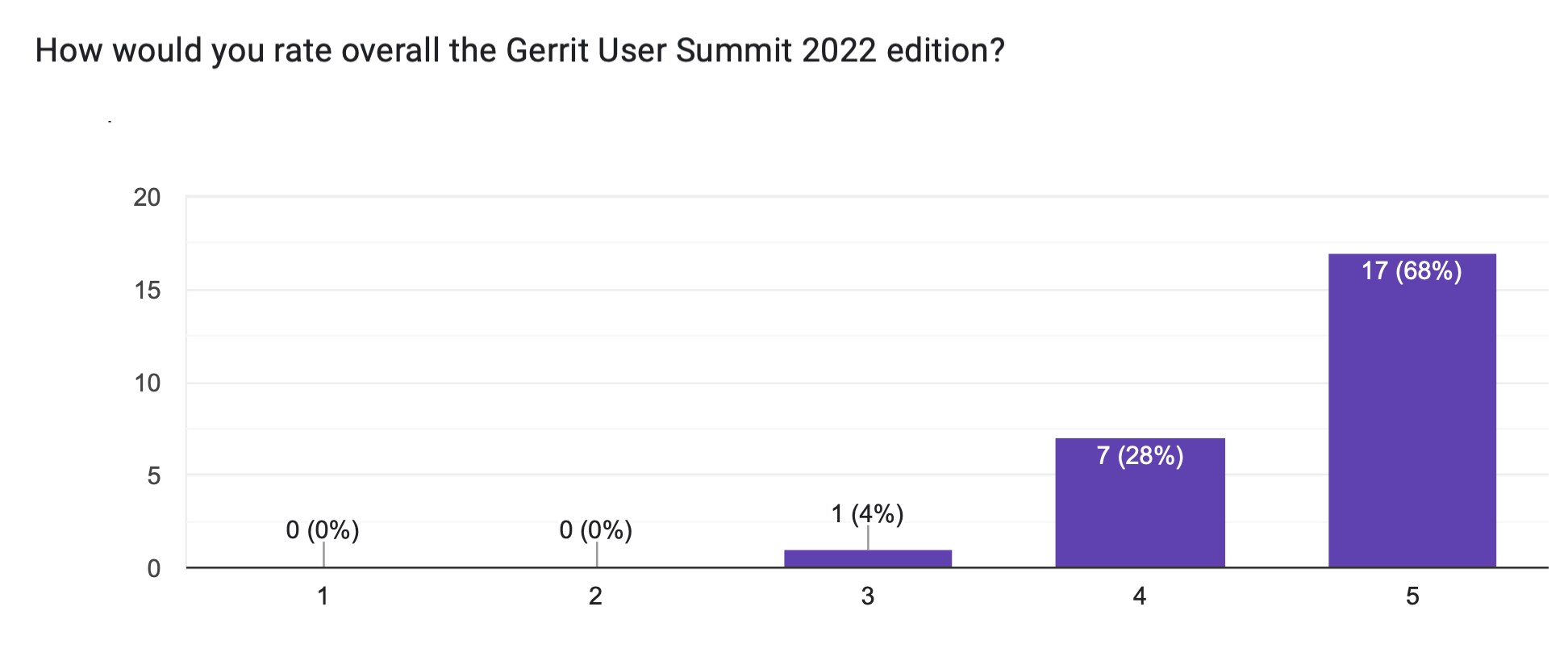
The summit survey had an outstanding report showing a huge acceptance and appreciation of the event:
82% rated the remote video streaming as “good” or “outstanding”
96% rated the quality of the summit as “good” or “outstanding.”
100% would recommend the summit to a colleague, with 83% strongly recommending it
GerritHub.io SLA gets closer to five-nines.
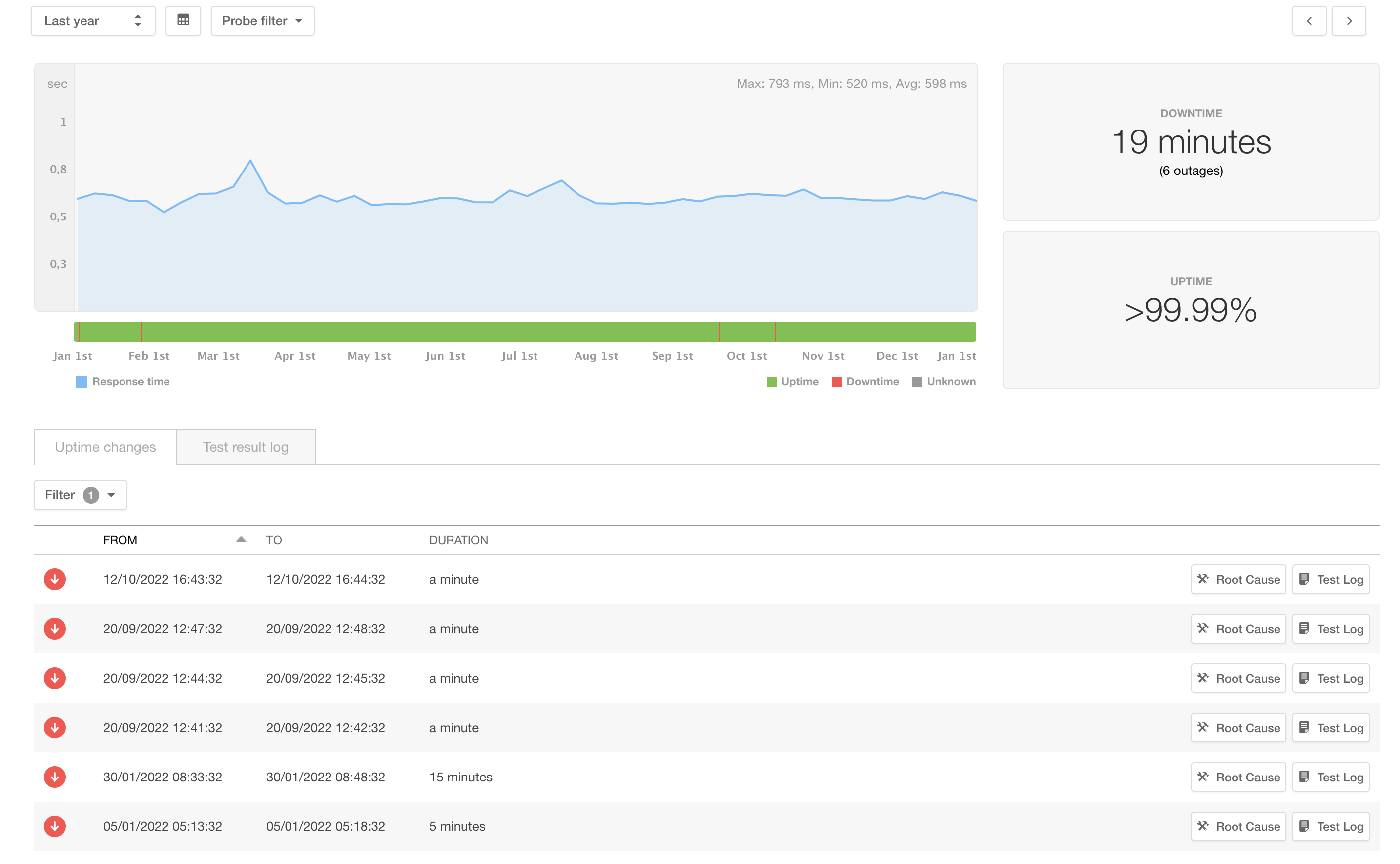
We have been working hard to make Gerrit more stable and resilient throughout 2022, discovering and fixing many issues in the code base and on the multi-site software architecture. In 2022, GerritHub.io had only six small hiccups for a total of 19 mins of downtime (SLA = 99.997%) over a 12-month period, a 75% reliability improvement compared to 2021.
We have run extensive RCAs on the causes of the downtime and identified two leading issues, which are explained in the details below.
The “anonymous unlimited query” hole in Gerrit GerritHub.io has been subject to a 15 mins outage because of anonymous users being able to bring offline all the sites before the system could auto-recover. Gerrit allows bypassing of all limits set in the ACLs for running queries by simply adding the “no-limit” parameter. Returning an arbitrary payload without limits could allow a single user to generate a server-side workload for collecting and building a GBytes-sized JSON payload; unfortunately, that option was available to everyone, including anonymous users making any publicly faced Gerrit Code Review installation subject to deny-of-service attacks. We have identified the issue, reported and fixed it in Gerrit with Change 333304, which has been included in Gerrit v3.3.10, v3.4.4, v3.5.1, and all v3.6.0 or later releases.
More granular monitoring and alerting We have lowered the threshold of uptime checks on GerritHub.io to 1 minute, giving us the ability to detect and react immediately to 4 smaller hiccups. We have detected a lack of scalability for some specific higher-load projects. Those hiccups have been responsible for 2 mins of downtime over the 2nd part of 2022. Many more projects are also planning to be onboarded on GerritHub.io; hence we do need to address this project-specific capacity needs.
Scaling Gerrit Code Review and JGit beyond its limits
We have been investing a massive effort in building a test environment designed to stress Gerrit and JGit to its limits and identify all the limitations and bottlenecks that prevented us from scaling further.
Scaling the test repository We have created over the months some test repositories that increased in every dimension:
Tens of millions of refs as both refs/changes and refs/heads
Millions of delta-chains
Tens of millions of Git objects
Packfiles of tens of Giga-bytes and packed refs of hundreds of megabytes
For generating a significant load on both client and server side, we have invested more into the aws-gerrit cloud setups and gatling-git performance loading tool.
There were some “well-known” issues and additional surprising ones.
SHA1 complexity and CPU utilization for large entities JGit has been used SHA1 for identifying uniqueness not just for Git objects but also for other large entities. However, computing SHA1 has become increasingly CPU intensive because of the relatively recent findings about collisions on shattered.io. We have highlighted two major potential improvements in cooperation with Matthias Sohn (SAP) on the raw SHA1 performance and its application for detecting packed-refs changes on the filesystem.
Commit priority queues JGit has a custom implementation of priority queues which are intensively used in RevWalk, which has almost quadratic complexity. That isn’t a problem for small to medium chains of commits; however, when the number of commits reaches millions, the performance degradation becomes unbearable. We have replaced the JGit’s custom implementation with the one provided by the Java JVM library, which has a logarithmic complexity that massively improves its performance with large commit chains.
Unwanted reachability checks JGit needs to perform a full reachability check whenever a remote unknown client is advertising refs, which makes sense when serving a remote client. However, the cost of full reachability of millions of advertised refs can be a daunting task that may be alleviated if the remote end can be considered trusted.
Fixing JGit bitmaps Since the introduction of Git bitmap, the whole community has learned how key they are in speeding up the counting and selection during the clone phase. However, large and unoptimized bitmaps could be so unhelpful for Git that instead of speeding up, they could represent a massive overhead for the system, causing CPU spikes and, eventually, lowering the throughput of the server. Git bitmaps are compressed using the JavaEWAH library, which is good for memory consumption but evil for CPU utilization: that is the reason why the smaller is best for performance. We have discovered and fixed a critical issue with the JGit bitmap generation that was causing the inclusion of all commits and BLOBs pointed by annotated tags. Also, we have introduced the ability to inform JGit about the heads that can be excluded from the bitmap, allowing to shorten the creation tens of thousands times (5h generation time for a 2k refs to as little as 60s) and increase its effectiveness by 200%.
Millions of unneeded ref logs When performing a clone of a repository with millions of heads, JGit created one local reflog file for every remote ref, including the ones there were not actually cloned but just fetched as remote references. This was creating a significant performance gap between JGit and Git, which would instead lazily create the reflog files once they are effectively checked out the first time. Cloning a single branch of a repository with millions of remote refs took around 1h, compared to a few minutes of Git.
All of the findings were included in multiple updates on the following components:
aws-gerrit is going through upgrades for making use of pull-replication plugin, including the support for the bearer token which allows to replicate virtually any repository, including All-Users.git
gatling-git: we have upgraded the Gatling version and JGit to the latest stable-5.13 to include the latest performance improvements.
git-repo-metrics: we have introduced a brand-new plugin that allows us to keep under control the major dimensions of a repository and therefore graph their increase over time.
GerritForge goals for 2023
We are definitely not done yet with the performance improvements on Gerrit and JGit: there are still significant improvements to be made, and JGit changes to get merged into the mainstream branches. We believe we are on track to finalize the job and allow a stable and scalable platform for large Git repositories in 2023.
Finalise what we cooked in 2022 for JGit JGit has a new maintainer, David Ostrovsky, awarded in 2022 as Git committer of the project. GerritForge’s devs are focused to get more reviews and attention to the JGit performance improvements. We are committed to finalising all the open changes related to large repositories.
JGit multi-pack indexes support There is still a major gap between JGit and Git when dealing with very active repositories: multi-pack indexes. The proliferation of packfiles would eventually lead to a long and painful search-for-reuse phase for BLOBs which could be cut down 100s of times with a multi-pack index.
Git repository optimiser for Gerrit We have been working on tracking the live information on the Git repository, thanks to the git-repo-metrics plugin. Wouldn’t it be nice to have a tool that can do something with it and automatically? We would be doing R&D on how to correlate the repository metrics, the Git audit trail, and the performance data for making AI-based decisions on what needs to be improved on the repository. This work stream is going to be useful for any Git repository, not just the ones powered by Gerrit Code Review. The ‘git-repo-metrics’ and the repository optimiser would also apply to other products, including GitHub and GitLab.
Gerrit v3.8 and projects-specific change numbers We will finalise the design document for the transition to project-specific change numbers in Gerrit v3.8. That would allow the seamless migration of projects across Gerrit setups without having to worry about changes renumbering anymore.
Gerrit Code Review testing and GerritForge-certified binaries GerritForge is spending a tremendous amount of time developing test environments and tools for serving the Gerrit community with more stable releases and improving the quality of its code. We want to intensify the effort and also offer our platinum support customers a unique service that includes the GerritForge digital signature and rubber stamp on the binaries of Gerrit Code Review and its plugins that have been successfully tested and validated for being production-ready. Stay tuned; more details are coming soon …
GerritForge company forecast in 2023
GerritForge Inc. will finalise its roll-out to the USA, and all contracts and services will be run from Sunnyvale, CA and Europe. Over 2022, 60% of the customers and businesses have already been moved, and the operation will be completed over the course of 2023.
We are looking forward to doubling our revenue figures in 2023 and also our contributions to the open-source community, with a main focus on JGit as the driver of performance growth for Gerrit Code Review.









 GerritForge Blog