Slow Git isn’t just annoying – it’s expensive for everyone: developers wait for a CI/CD validation of their changes, SCM admins are wasting their time in fire-fighting SCM slowdown and broken pipelines, IT managers are wasting millions of dollars in CPU and Disk hosting costs.What if your Git operations could be up to 100x faster, and keep up with the new AI-vibe coding landslide of PR and changes?
100x Faster Git, Powered by AI
GHS is an AI-based accelerator for Git SCM that redefines performance:
Up to 100x faster clones and fetches.
CI/CD pipelines that run without SCM barriers.
Adapt automatically to your repository shape and make it faster.
Scale without slowdown even under heavy loads
This isn’t traditional “tuning.” GHS learns your repos and access patterns, then continuously optimises them so your Git server is always running at maximum speed.
How Does GHS Deliver 100x Faster Git?
Measure Everything It collects detailed metrics in realtime on your repositories.
Spot Bottlenecks GHS AI model is trained on recognizing the bottlenecks and take immediate action, before they become a problem
Stay Fast Your Git stays consistently accelerated, not just temporarily boosted.
Why Speed Matters
Developers stop wasting hours on slow fetches and builds.
Release managers push features out faster.
IT leaders reduce infra costs by doing more with less.
Admins no longer fire-fight performance issues.
Every 1% of time saved in Git can add up to days of productivity across a large team. Imagine saving 100x that.
Who Needs 100x Faster Git?
Repositories of all sizes: AI-driven code generation and “vibe-coding” have dramatically accelerated the pace of software delivery.
Enterprises that have adopted the AI-pipeline want that value delivered faster to production.
Any team frustrated with slow CI/CD pipelines.
The GHS Advantage
Transformative speed: not just 2x or 5x faster, but up to 100x
SCM expertise: GerritForge’s decades of enterprise SCM know-how built in.
Proven reliability: Stability and uptime as performance scales.
Get Started Today
You can try GHS free for 30 days and experience the difference for yourself.
First, a huge thank you to the OpenInfra Foundation for hosting this event in Paris. Their invitation to have the Gerrit User Summit join the rest of the community set the stage for a truly collaborative and impactful gathering.
Paris last weekend wasn’t just a conference; it was a reunion. Fourteen years after the last GitTogether at Google’s Mountain View HQ, the “Git and Gerrit, together again” spirit was electric.
On October 18-19, luminaries from the early days (Scott, Martin, Luca, and many others) reconvened, sharing the floor with the new generation of innovators. The atmosphere was intense, filled with the same collaborative energy of 2011, but focused on a new set of challenges. The core question: how to evolve Git and Gerrit for the next decade of software development, a future dominated by AI, massive scale, and an urgent demand for smarter workflows.
Here are the key dispatches from the summit floor.
A Historic Reunion, A Shared Future
This event was a powerful reminder that the open-source spirit of cross-pollination is alive and well. The discussions were invigorated by the “fresh air” from new-school tools like GitButler and Jujutsu (JJ), which are fundamentally rethinking the developer experience.
In a significant show of industry-wide collaboration, we were delighted to have GitLab actively participating. Patrick’s technical presentation on the status of reftable was a highlight, but his engagement in discussions on collaborative solutions moving forward with the Gerrit community truly set the tone. It’s clear that the challenges ahead are shared by all platforms, and the solutions will be too.
Scaling Git in the Age of AI
The central theme was scale. In this rapidly accelerating AI era, software repositories are growing at an unprecedented rate across all platforms—Gerrit, GitHub, and GitLab alike. This isn’t a linear increase; it’s an explosion, and it’s pushing SCM systems to their breaking point.
The consensus was clear: traditional vertical and horizontal scaling is no longer enough. The community is now in a race to explore new techniques—from the metal up—to improve performance, slash memory usage, and make core Git operations efficient at a scale we’ve never seen before. This summit was a rare chance for maintainers from different ecosystems to align on these shared problems and forge collaborative paths to solutions.
Dispatches from the Front Lines: NVIDIA and Qualcomm
This challenge isn’t theoretical. We heard powerful testimonials from industry giants NVIDIA and Qualcomm, who are on the front lines of the AI revolution.
They shared fascinating and sobering insights into the repository explosion they are actively managing. Their AI workflows—encompassing massive datasets, huge model binaries, and unprecedented CI/CD activity—are generating data on a scale that is stressing even the most robust SCM systems. Their presentations detailed the unique challenges and innovative approaches they are pioneering to tackle this data gravity, providing invaluable real-world context that fueled the summit’s technical deep dives.
Beyond the Pull Request: The Quest for a ‘Commit-First’ World
One of the most passionate debates centered on the developer workflow itself. The wider Git community increasingly recognizes that the traditional, monolithic “pull request” model is ill-suited to the “change-focused” code review that platforms like Gerrit have championed for years.
The benefits of a change-based workflow, cleaner history, better hygiene, and higher-quality atomic changes—are driving a growing interest in standardizing a persistent Change-ID for each commit. This would make structured, atomic reviews a first-class citizen in Git itself. The collaboration at the summit between the Gerrit community, GitButler, JJ, and other Git contributors on defining this standard was a major breakthrough.
This shift is being powered by tools like GitButler and JJ, which are built on a core philosophy: Workflow Over Plumbing. Modifying commits, rebasing, and resolving conflicts remain intimidating hurdles for many developers. The Git command line can be complex and unintuitive. These new tools abstract that complexity away, guiding users through commit management in a way that feels natural. The result is faster iteration, higher confidence, and a far better developer experience.
AI and the Evolving Craft of Code Review
Finally, no technical summit in 2025 would be complete without a deep dive into AI. The arrival of AI-assisted coding is fundamentally shifting the dynamic between author and reviewer.
Engineers at the summit expressed a cautious optimism. On one hand, AI is a powerful tool to accelerate reviews, improve consistency, and bolster safety. On the other, everyone is aware of the trade-offs. Carelessly used, AI-generated code can weaken knowledge sharing, blur IP boundaries, and erode a team’s deep, institutional understanding of its own codebase.
The challenge going forward is not to replace the human in the loop, but to strengthen the craft of collaborative review by integrating AI as a true co-pilot.
A Path to 100x Scale: The GHS Initiative
The most forward-looking discussions at the summit centered on how to achieve the massive scale required. One of the most promising solutions presented was GHS (Git-at-High-Speed). This innovative approach is not just an incremental improvement; it’s a strategic initiative designed to increase SCM throughput by as much as 100x.
The project’s vision is to enable platforms like Gerrit, GitLab, and GitHub Enterprise to handle the explosive repository growth and build traffic generated by modern AI workflows. By re-architecting key components for hyper-scalability, GHS represents a concrete path forward, ensuring that the industry’s most critical SCMs can meet the unprecedented demands of the AI-driven future.
The Road from Paris
The Gerrit User Summit 2025 was more than a look back at the “glorious days.” It was a statement. The Git and Gerrit communities are unified, energized, and actively building the next generation of SCM. The spirit of GItTogether 2011 is back, but this time it’s armed with 14 years of experience and a clear-eyed view of the challenges and opportunities ahead.
(TL;DR) The Gerrit Code Review project has an ambitious roadmap for 2025 and beyond. Gerrit 3.12 (H1 2025) will focus on JGit performance improvements, X.509 signed commit support, and enhanced Owners and Analytics plugins. Gerrit 3.13 (H2 2025) aims to further optimize push performance, UI usability, and plugin updates, including Kafka and Zookeeper integrations.
The k8s-Gerrit initiative will improve Gerrit’s deployment on Kubernetes, ensuring better scalability and resilience. Looking ahead, Gerrit 4.0 (2026/2027) plans to decouple the review UI from the JGit server, enabling alternative review interfaces and improved flexibility.
The development team is prioritizing significant performance enhancements in JGit, the Java implementation of Git used by Gerrit. Key objectives include:
Speeding Up Conflicting Ref Names on Push: This aims to reduce delays during push operations when ref name conflicts occur.
Enhancing SearchForReuse Latency for Large Monorepos: The goal is to improve latency by at least an order of magnitude, facilitating more efficient operations in extensive monorepositories.
Improving Object Lookup Across Multiple Packfiles: Efforts are underway to accelerate object lookup times by at least tenfold, enhancing performance in repositories with numerous packfiles.
Parallelizing Bitmap Generation: By enabling bitmap generation across multiple cores, the team aims to expedite this process, contributing to overall performance gains.
Gerrit Core Experience Enhancements
A notable feature planned for this release is the support for X.509 signed commits, which will bolster security and authenticity in the code review process.
Owners Plugin Improvements
Enhancements to the Owners Plugin are set to provide clearer insights and streamlined interactions:
Action Requirements Display: Explicitly showing required actions by each owner at the file level.
Detailed Pending Reviews: Offering more comprehensive information on pending reviews by owners.
Easier Contact with File Owners: Facilitating more straightforward communication with file owners.
Analytics Plugin Optimization
The analytics plugin is slated for improvements to enhance speed and usability:
Repo Manifest Discovery: Native support for discovering repository manifests.
Faster Metrics Extraction: Accelerated extraction of metrics for branches, aiding in quicker data analysis.
Gerrit 3.13 (Target: H2 2025)
JGit Performance and Concurrency Enhancements
Building upon previous improvements, version 3.13 aims to further optimize performance:
Optional Connectivity and Collision Checks: Improving push performance by allowing the skipping of certain checks when appropriate.
Customizable Lock-Interval Retries: Providing flexibility in managing lock intervals to enhance concurrency handling.
Read-Only Multi-Pack Index Support: Introducing support for read-only multi-pack indexes to improve repository access efficiency.
Gerrit Core and UI Experience Enhancements
User experience remains a focal point with planned features such as:
File List Filtering: Allowing users to filter the file list in the change review screen for more efficient navigation.
Headless Gerrit Packaging: Offering a version of Gerrit that serves only read/write Git protocols, catering to users seeking a streamlined experience.
Plugin Updates
The roadmap includes updates to key plugins:
Kafka Events-Broker: Upgrading to support Kafka 3.9.0, enhancing event handling capabilities.
Zookeeper Global-Refdb: Updating to support Zookeeper 3.9.3, improving global reference database management.
Replication Plugin Enhancements
Efforts to simplify configuration and improve performance include:
Dynamic Endpoint Management: Introducing APIs for creating and updating replication endpoints dynamically.
UI Integration: Displaying replication status within the user interface for better visibility.
Reduced Latency on Force-Push: Improving replication latency during force-push operations by applying objects with prerequisites.
k8s-Gerrit
The k8s-Gerrit initiative focuses on deploying Gerrit within Kubernetes environments, aiming to enhance scalability, resilience, and ease of management. This approach leverages Kubernetes’ orchestration capabilities to provide automated deployment, scaling, and management of Gerrit instances, facilitating more efficient resource utilization and operational consistency.
Gerrit 4.0 (Target: 2026/2027)
Looking ahead, Gerrit 4.0 is set to introduce significant architectural changes:
Decoupling Gerrit Review UI and JGit Server: This separation will allow the Gerrit UI and JGit server to operate as independent services, providing greater flexibility in deployment and scaling.
Enabling Alternative Review UIs: By decoupling components, the platform will support the integration of other review interfaces, such as pull-request systems, offering users a broader range of tools tailored to their workflows.
The Gerrit community is encouraged to stay engaged with these developments, as the roadmap is subject to change. Contributors planning to work on features not listed are advised to inform the Engineering Steering Committee (ESC) to ensure alignment with the project’s goals.
We’re thrilled to announce that our team will be speaking about our advancements with GerritForge AI Health Service (GHS) at several prestigious conferences in the coming months. These events provide an incredible opportunity to share our innovative AI solutions with a broader audience, engage with industry experts, and showcase how GHS is revolutionizing the way organizations maintain the health and stability of their Gerrit and Git systems.
Our journey begins at the Linux Open Source Summit in Vienna, from the 16th to the 18th of September. This summit is a cornerstone event for the open-source community, and we couldn’t be more excited to discuss how GHS leverages AI to ensure the seamless performance of Git and Gerrit systems, even in the most demanding environments.
Next, we’ll be in Berlin for Git Merge on the 19th and 20th of September. Git Merge is the go-to event for Git enthusiasts and professionals alike, and we’re eager to dive deep into the technical aspects of GHS, sharing insights on how our AI solution optimizes system performance, reduces downtime, and empowers development teams to focus on what they do best—creating great software.
In October, we’re particularly excited about the Gerrit User Summit in San Diego, on the 10th and 11th. This event is especially important to us as it brings together the Gerrit community to discuss the latest developments and best practices. We’ll be showcasing how GHS is enhancing Gerrit environments by providing intelligent and automated health monitoring and ensuring peak performance.
Following that, we’ll speak at the OCX conference in Mainz, from the 22nd to the 24th of October. OCX is known for bringing together top minds in DevOps and open-source technology, making it the perfect venue to highlight how GHS is transforming the management of code review and source control systems with intelligent, automated health monitoring and remediation.
Finally, we’re thrilled to wrap up our conference tour at KubeCon in Salt Lake City, from the 12th to the 15th of November. As one of the most anticipated events in the cloud-native ecosystem, KubeCon offers an unparalleled platform to demonstrate how GHS integrates with Kubernetes environments, ensuring that your SCM systems are always running at peak performance.
These conferences represent more than just speaking engagements for us—they are an opportunity to engage with the community, learn from our peers, and continue pushing the boundaries of what’s possible with AI in software development. We can’t wait to connect with you at these events and share how GHS can make a tangible difference in your organization’s success.
Stay tuned for more updates as we approach these dates, and be sure to catch our sessions if you’re attending any of these events!
Daniele Sassoli GerritForge Engineering Manager Gerrit Code Review Community Manager and Contributor
TL;DR: GerritForge has been dedicating its efforts to organising and managing the Gerrit User Summit in London back in November 2022, in conjunction with the release of Gerrit v3.7. The event has been a great success, with a significant presence on-site and record-breaking attendees on the GerritForge TV youtube channel. It has also committed to its promises to research and improve the JGit and Gerrit scalability to large mono-repos, with tens of millions of objects and refs. 2023 will see the finalisation of these efforts with an increase in development efforts and a new JGit Committer for pushing the platform to a new level of performance and scalability and a new innovating system for collecting and optimising the repository metrics automatically. Stay tuned.
Read the full story here below (9 mins read).
2022 has been a critical year for turning the Gerrit Code Review community and development back on track after the COVID-19 pandemic. At GerritForge, we’ve been working hard to make sure that the development, support, and innovation of Gerrit Code Review continue on its main objectives.
Gerrit Code Review v3.6 and v3.7
We have continued to deliver on the development and release of Gerrit Code Review and its plugins, helping the testing and releasing of versions v3.6.0 (May) and v3.7.0 (November).
3,627 Changes have been merged on 76 projects related to the Gerrit Code Review platform, including JGit
113 committers from 42 different organisations
A special mention to the top #10 contributors: Google (Ben Rohlfs, Edwin Kempin, Chris Pouchet, Dhruv Srivastava, Frank Borden, Milutin Kristofic), GerritForge (Luca Milanesio), Wikimedia (Paladox) and SAP (Matthias Sohn and Thomas Dräbing).
In comparison with 2021, we had 25% fewer changes merged but with more contributors coming from more companies, which is a symptom to a very healthy and thriving ecosystem of maintainers.
GerritForge has committed to resuming the face-to-face user summits, which were suspended since 2020.
It was a glorious success, with record-breaking attendance from all around the globe:
50 people registered to attend on-site, 26 of them managed to arrive despite the London tube strike, whilst the others attended remotely
235 people viewed the summit on YouTube with an average view time of 40 mins (one talk)
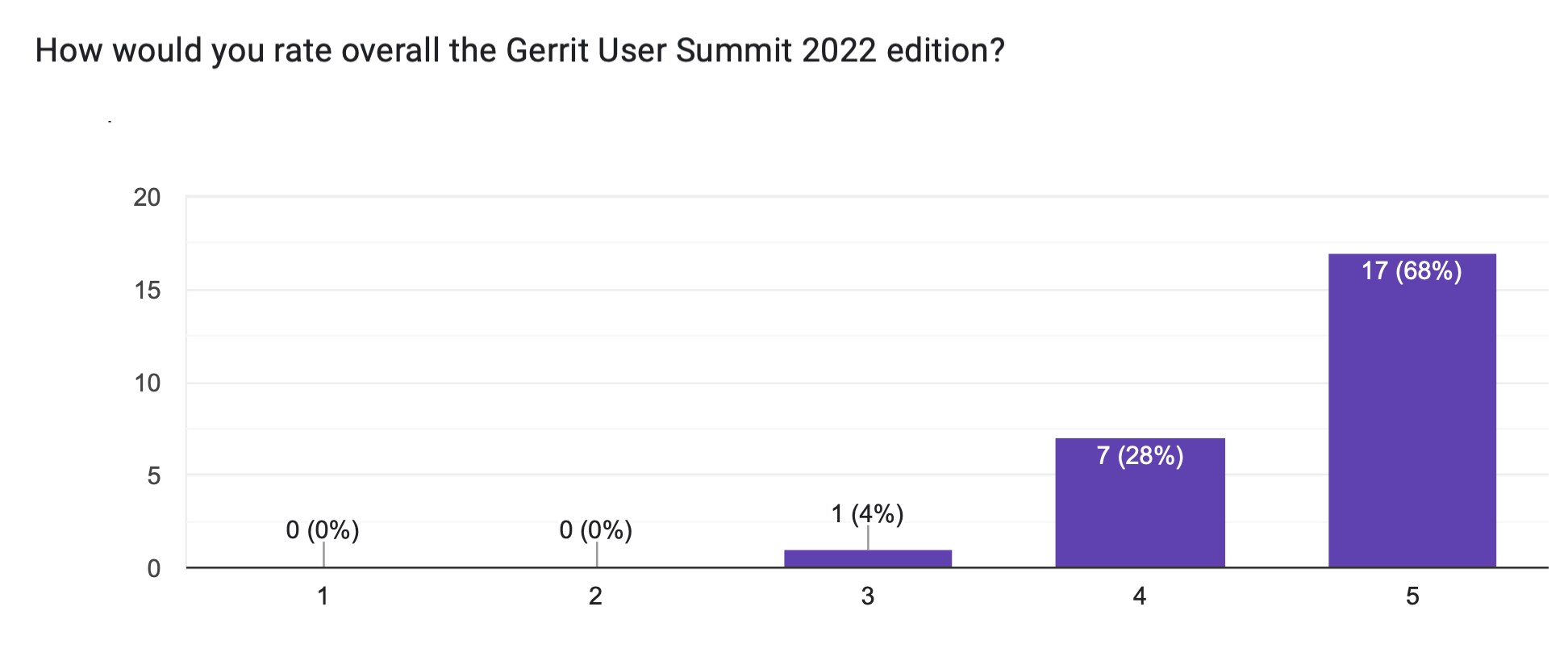
The summit survey had an outstanding report showing a huge acceptance and appreciation of the event:
82% rated the remote video streaming as “good” or “outstanding”
96% rated the quality of the summit as “good” or “outstanding.”
100% would recommend the summit to a colleague, with 83% strongly recommending it
GerritHub.io SLA gets closer to five-nines.
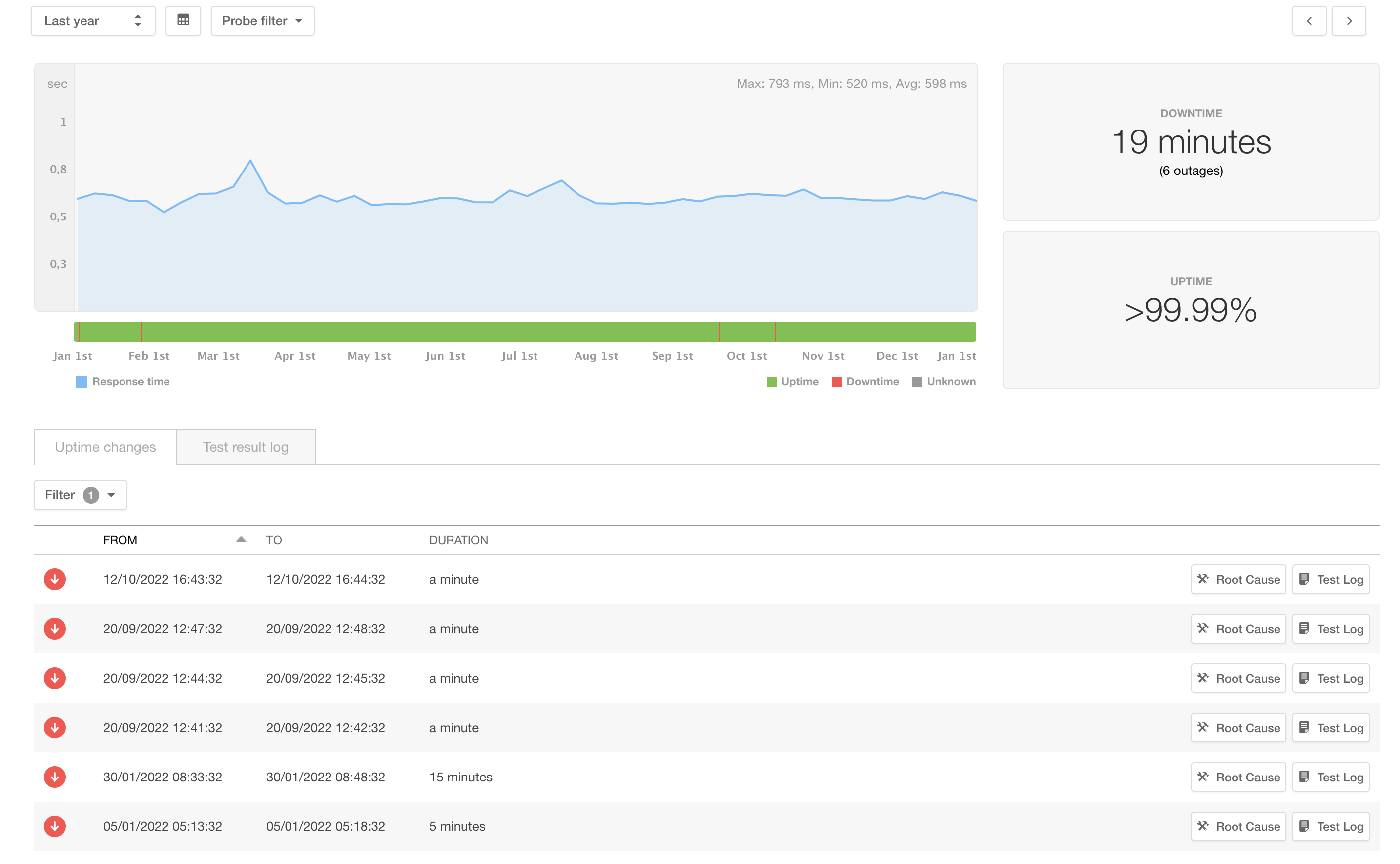
We have been working hard to make Gerrit more stable and resilient throughout 2022, discovering and fixing many issues in the code base and on the multi-site software architecture. In 2022, GerritHub.io had only six small hiccups for a total of 19 mins of downtime (SLA = 99.997%) over a 12-month period, a 75% reliability improvement compared to 2021.
We have run extensive RCAs on the causes of the downtime and identified two leading issues, which are explained in the details below.
The “anonymous unlimited query” hole in Gerrit GerritHub.io has been subject to a 15 mins outage because of anonymous users being able to bring offline all the sites before the system could auto-recover. Gerrit allows bypassing of all limits set in the ACLs for running queries by simply adding the “no-limit” parameter. Returning an arbitrary payload without limits could allow a single user to generate a server-side workload for collecting and building a GBytes-sized JSON payload; unfortunately, that option was available to everyone, including anonymous users making any publicly faced Gerrit Code Review installation subject to deny-of-service attacks. We have identified the issue, reported and fixed it in Gerrit with Change 333304, which has been included in Gerrit v3.3.10, v3.4.4, v3.5.1, and all v3.6.0 or later releases.
More granular monitoring and alerting We have lowered the threshold of uptime checks on GerritHub.io to 1 minute, giving us the ability to detect and react immediately to 4 smaller hiccups. We have detected a lack of scalability for some specific higher-load projects. Those hiccups have been responsible for 2 mins of downtime over the 2nd part of 2022. Many more projects are also planning to be onboarded on GerritHub.io; hence we do need to address this project-specific capacity needs.
Scaling Gerrit Code Review and JGit beyond its limits
We have been investing a massive effort in building a test environment designed to stress Gerrit and JGit to its limits and identify all the limitations and bottlenecks that prevented us from scaling further.
Scaling the test repository We have created over the months some test repositories that increased in every dimension:
Tens of millions of refs as both refs/changes and refs/heads
Millions of delta-chains
Tens of millions of Git objects
Packfiles of tens of Giga-bytes and packed refs of hundreds of megabytes
For generating a significant load on both client and server side, we have invested more into the aws-gerrit cloud setups and gatling-git performance loading tool.
There were some “well-known” issues and additional surprising ones.
SHA1 complexity and CPU utilization for large entities JGit has been used SHA1 for identifying uniqueness not just for Git objects but also for other large entities. However, computing SHA1 has become increasingly CPU intensive because of the relatively recent findings about collisions on shattered.io. We have highlighted two major potential improvements in cooperation with Matthias Sohn (SAP) on the raw SHA1 performance and its application for detecting packed-refs changes on the filesystem.
Commit priority queues JGit has a custom implementation of priority queues which are intensively used in RevWalk, which has almost quadratic complexity. That isn’t a problem for small to medium chains of commits; however, when the number of commits reaches millions, the performance degradation becomes unbearable. We have replaced the JGit’s custom implementation with the one provided by the Java JVM library, which has a logarithmic complexity that massively improves its performance with large commit chains.
Unwanted reachability checks JGit needs to perform a full reachability check whenever a remote unknown client is advertising refs, which makes sense when serving a remote client. However, the cost of full reachability of millions of advertised refs can be a daunting task that may be alleviated if the remote end can be considered trusted.
Fixing JGit bitmaps Since the introduction of Git bitmap, the whole community has learned how key they are in speeding up the counting and selection during the clone phase. However, large and unoptimized bitmaps could be so unhelpful for Git that instead of speeding up, they could represent a massive overhead for the system, causing CPU spikes and, eventually, lowering the throughput of the server. Git bitmaps are compressed using the JavaEWAH library, which is good for memory consumption but evil for CPU utilization: that is the reason why the smaller is best for performance. We have discovered and fixed a critical issue with the JGit bitmap generation that was causing the inclusion of all commits and BLOBs pointed by annotated tags. Also, we have introduced the ability to inform JGit about the heads that can be excluded from the bitmap, allowing to shorten the creation tens of thousands times (5h generation time for a 2k refs to as little as 60s) and increase its effectiveness by 200%.
Millions of unneeded ref logs When performing a clone of a repository with millions of heads, JGit created one local reflog file for every remote ref, including the ones there were not actually cloned but just fetched as remote references. This was creating a significant performance gap between JGit and Git, which would instead lazily create the reflog files once they are effectively checked out the first time. Cloning a single branch of a repository with millions of remote refs took around 1h, compared to a few minutes of Git.
All of the findings were included in multiple updates on the following components:
aws-gerrit is going through upgrades for making use of pull-replication plugin, including the support for the bearer token which allows to replicate virtually any repository, including All-Users.git
gatling-git: we have upgraded the Gatling version and JGit to the latest stable-5.13 to include the latest performance improvements.
git-repo-metrics: we have introduced a brand-new plugin that allows us to keep under control the major dimensions of a repository and therefore graph their increase over time.
GerritForge goals for 2023
We are definitely not done yet with the performance improvements on Gerrit and JGit: there are still significant improvements to be made, and JGit changes to get merged into the mainstream branches. We believe we are on track to finalize the job and allow a stable and scalable platform for large Git repositories in 2023.
Finalise what we cooked in 2022 for JGit JGit has a new maintainer, David Ostrovsky, awarded in 2022 as Git committer of the project. GerritForge’s devs are focused to get more reviews and attention to the JGit performance improvements. We are committed to finalising all the open changes related to large repositories.
JGit multi-pack indexes support There is still a major gap between JGit and Git when dealing with very active repositories: multi-pack indexes. The proliferation of packfiles would eventually lead to a long and painful search-for-reuse phase for BLOBs which could be cut down 100s of times with a multi-pack index.
Git repository optimiser for Gerrit We have been working on tracking the live information on the Git repository, thanks to the git-repo-metrics plugin. Wouldn’t it be nice to have a tool that can do something with it and automatically? We would be doing R&D on how to correlate the repository metrics, the Git audit trail, and the performance data for making AI-based decisions on what needs to be improved on the repository. This work stream is going to be useful for any Git repository, not just the ones powered by Gerrit Code Review. The ‘git-repo-metrics’ and the repository optimiser would also apply to other products, including GitHub and GitLab.
Gerrit v3.8 and projects-specific change numbers We will finalise the design document for the transition to project-specific change numbers in Gerrit v3.8. That would allow the seamless migration of projects across Gerrit setups without having to worry about changes renumbering anymore.
Gerrit Code Review testing and GerritForge-certified binaries GerritForge is spending a tremendous amount of time developing test environments and tools for serving the Gerrit community with more stable releases and improving the quality of its code. We want to intensify the effort and also offer our platinum support customers a unique service that includes the GerritForge digital signature and rubber stamp on the binaries of Gerrit Code Review and its plugins that have been successfully tested and validated for being production-ready. Stay tuned; more details are coming soon …
GerritForge company forecast in 2023
GerritForge Inc. will finalise its roll-out to the USA, and all contracts and services will be run from Sunnyvale, CA and Europe. Over 2022, 60% of the customers and businesses have already been moved, and the operation will be completed over the course of 2023.
We are looking forward to doubling our revenue figures in 2023 and also our contributions to the open-source community, with a main focus on JGit as the driver of performance growth for Gerrit Code Review.
Dear fellow Gerrit User, We are pleased to announce that GerritForge will be organizing this year’s Gerrit User Summit and Hackathon in hybrid mode: face-to-face and online.
Gerrit User Summit is the event that brings together Gerrit admins, developers, practitioners, and the whole community, in one place, providing attendees with the opportunity to learn, explore, network face-to-face, and help shape the future of Gerrit development and solutions.
After two years of remote meetings and virtual conferences, this year, we are back face-to-face at CodeNode in the heart of the vibrant City of London.
The dates will be: Nov 7th to 9th – Hackathon Nov 10th to 11th – User Summit
Shortly we will be publishing the full schedule and logistics for the event. I look forward to meeting all the community’s friends, face-to-face or virtually, again during the Hackathon & Summit.
Thanks for being a part of the Gerrit community, and we look forward to seeing you in November.
Luca Milanesio Maintainer, member of the Engineering Steering Committee, and Gerrit Code Review Release Manager
After two years of remote events and three COVID-19 waves, we are finally back for a new face-to-face hackathon, talking about the future of Gerrit Code Review and coding new and innovative solutions for making Gerrit better, faster and more scalable.
Dates and schedule
The Gerrit hackathon will start on the 9th of May at 9:00 AM for five consecutive days, and will have a daily schedule from 9:00 AM to 7:00 PM BST, with networking and catch-up in the evenings.
For the remote attendees on the US/Pacific time-zone, the schedule will be daily between 7:00 AM to 11:00 AM PDT, which allows 4h of remote interaction with the hackathon in London.
Who is invited to attend the hackathon?
As with every Gerrit hackathon, we have a restricted audience: Gerrit maintainers and contributors are invited to join. We have 10 seats available on-site and 15 seats available remotely, which would allow plenty of people to collaborate and discuss.
The “Alphabet” meeting room of the hackathon
To register to the Gerrit hackathon, add your name and role (“Gerrit Contributor” or “Gerrit Maintainer”) to the attendees sheet. All Gerrit maintainers have edit permissions to the document whilst all other contributors can request permission to edit if they are willing to attend.
Where is the hackathon taking place?
GerritForge will host the Gerrit Hackathon at Huckletree West, Mediaworks, 191 Wood Ln, London W12 7FP. We will be staying at the “Alphabet” meeting room, with a dedicated 10-seats and roundtable, a full-size wall-mounted whiteboard and a permanent online connection and wall-attached screen to interact with all the other remote attendees.
Huckletree West
Huckletree is a creative workspace in West London, based in the heart of White City Place, a thriving new business and cultural district. Alongside the neighboring BBC Studios, Net A Porter Group, and RCA School of Communication, Huckletree West is part of a bold new chapter in the rich creative history of the neighborhood.
For all remote attendees, there will be the ability to connect remotely and interact with the rest of the team on-site during the hackathon hours.
White City and local accommodations
Huckletree West is close to the WestField Shopping Centre in White City, which includes 289 stores, 95 restaurants and Cinemas with 20 screens and almost 3,000 seats.
White City has excellent connections to all parts of London through the London Underground network (Central, Hammersmith&City and Circle lines) and Overground trains, which allow to reach all other parts of the city.
WestField shopping centre – White City
You can look for any Hotel or other accommodation (B&B or Hostels) in other part of London which is covered by the London Underground connections. However, if you are willing to stay local, there are many choices of Hotels and B&B starting from £80/night. See below a list of accommodations nearby White City:
The UK has left the European Union the 1st of January 2021, all travellers from EU needs to follow the new rules for business trips. You can check if you need a VISA using the UK Government site and what is the required documentation and insurance required to show at the UK Border.
COVID-19 restrictions
The UK is set to end all COVID-19 restrictions by March 2022, which means there aren’t any vaccination or testing requirements for the attendees to the hackathon. We advise everyone attending face-to-face to take extra precautions and take a lateral-flow test (LFT) or antigen test before traveling to the hackathon, even though it is not required by law or regulations.
Please note that face covering are still mandatory whilst travelling by airplane, train or underground and during taxi rides.
We are excited to meet again the community of Gerrit Code Review maintainers and contributors after so many months. Come and join us in London this year and we can innovate again and help shaping the future of the Gerrit project, together.
Luca Milanesio, GerritForge Gerrit Code Review Maintainer Gerrit Code Review Release Manager Member of the Engineering Steering Committee of the Gerrit Code Review Open-Source project
Join the Gerrit Community tomorrow and Friday from 8 am PST for everything related to the Gerrit Code Review Community.
Gerrit provides web based code review and repository management for the Git version control system. Whether you are experienced or new to Gerrit, you should know that it provides a framework you and your teams can use to review code before it becomes part of the code base. Come and take this chance to join and learn about Gerrit Code Review.
Find here the full schedule of the sessions you will have access to.
We have already discussed in previous posts how important it is to speedup the feedback loop in your Software Development Lifecycle. Having early feedbacks gives you the chance of evaluating your hypothesis and eventually change direction if needed.
The more information you have, the smarter can be your decisions.
We recently added in our Gerrit DevOps Analytics the possibility of extracting data coming from Code Reviews’ metadata to extend the knowledge we can get out of Gerrit.
Furthermore, it is possible to extract meta-data from repositories not necessarily hosted on the Gerrit instance running the analytics processing. This is a big improvement since it allows to fully analyse repositories coming from any Gerrit server.
One important type of meta-data contained in the Code Reviews is the hashtag.
Hashtags are freeform strings associated with a change, like on social media platforms. In Gerrit, you explicitly associate hashtags with changes using a dedicated area of the UI; they are not parsed from commit messages or comments.
Similar to topics, hashtags can be used to group related changes together and to search using the hashtag: operator. Unlike topics, a change can have multiple hashtags, and they are only used for informational grouping; changes with the same hashtags are not necessarily submitted together.
You can use them, for example, to mark and easily search all the changes blocking a particular release:
Hashtags can also be used to aggregate all the changes people have been working on during a particular event, for example, the Gerrit User Summit 2019 hackathon:
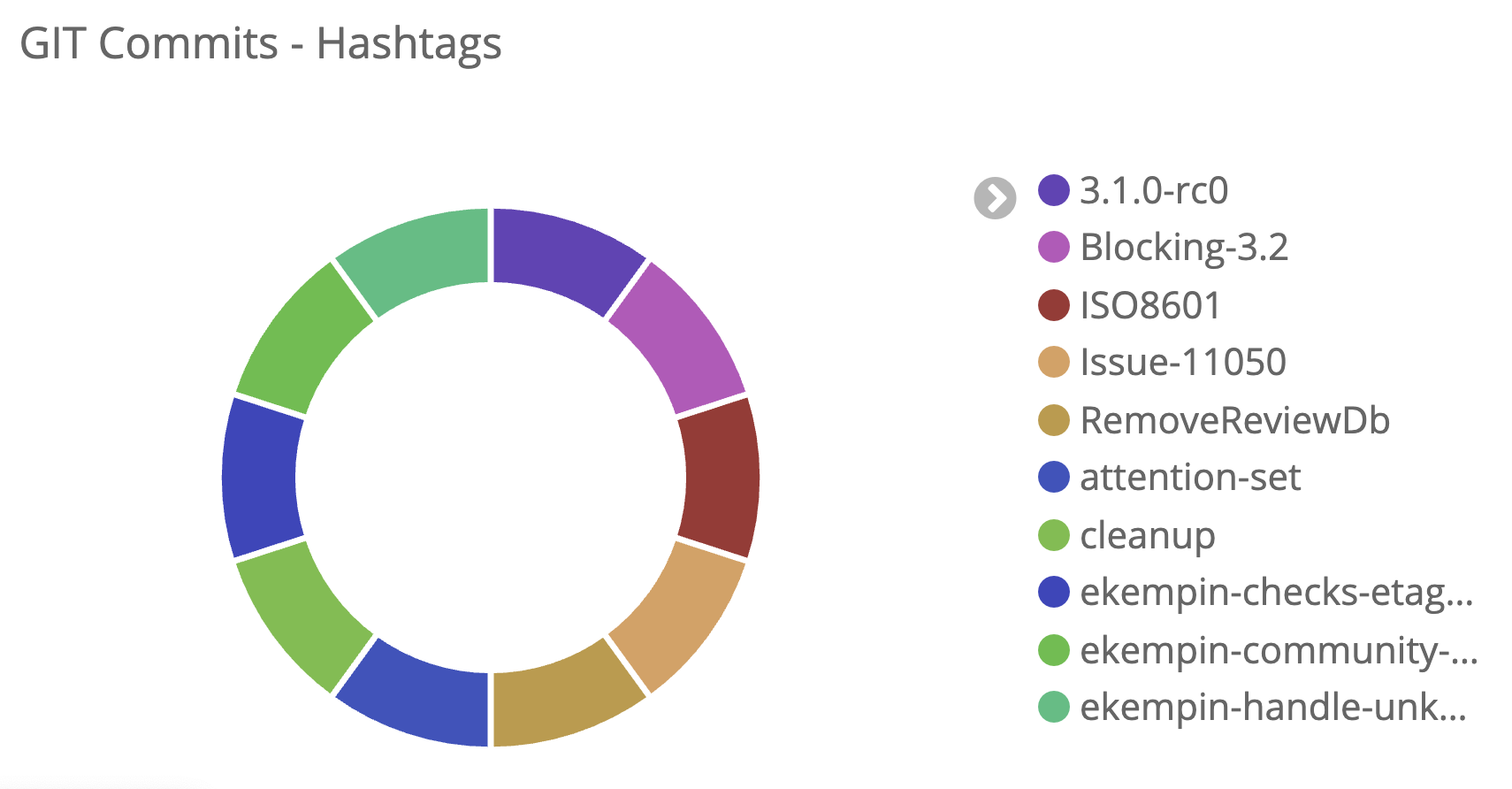
The latest version of the Gerrit Analytics plugin exposes the hashtags attached to their respecting Git commit data. Let’s explore together some use cases:
The most popular Gerrit Code Review hashtags over the last 12 months
Throughput of changes created during an event
see for example the Palo alto hackathon (#palo-alto-2018). We can see at the end of the week the spike of changes to release Gerrit 2.16.
The extend of time for a feature
Removing GWT was an extensive effort which started in 2017 and ended in 2019. It took several hackathons to tackle the removal as shown by the hashtags distribution. Some changes were started in one hackathon and finalised in the next one.
Those were some example of useful information on how to leverage the power of GDA.
The above examples are taken from the GDA dashboardprovided and hosted by GerritForge on https://analytics.gerrithub.io which mirror commits and reviews on a regular basis from the Gerrit project and its plugin ecosystem.
How to setup GDA on Gerrit
Hashtag extraction is currently available from Gerrit 3.1 onwards. You can download the latest version released from the Gerrit CI.
To enable hashtag extraction you need to enable the feature extraction in the plugin config file as follow:
For more information on how to configure and run the plugin, look at the analytics plugin documentation.
Conclusion
Data is the goldmine of your company. You need more and more of it for making smarter decision. The latest version of the GDA allows you to leverage even more data produced during the code review process.
You can explore the potential of the information held in Gerrit on the analytics dashboard provided by GerritForge on analytics.gerrithub.io.
This week we have published the recording of David Pursehouse (CollabNet) talk about Gerrit v2.14 and v2.15. Even though the releases are not new, there are many improvements were made recently, especially regarding the support for Elasticsearch as an engine to store the Gerrit secondary indexes.
Introduction
Hello, I am David Pursehouse, Gerrit Maintainer and release manager.
So, I’m going to talk about 2.14. Actually, this is the same presentation as I already gave last year. So, some of you may have seen it already. Although, I have made … how do I just … I have made some changes.
Basically, 2.14 isn’t new anymore. it’s already 18 months old, but even last year when I presented this, it was already six months old. And it has been in constant development since then. Even until this month we’ve been adding new stuff or making new releases.
And I’ll also touch a bit on 2.15 because yesterday evening we realized that there isn’t a 2.15 talk in the schedule today or tomorrow. So, I will briefly cover 2.15.
What’s new in v2.14
A number of new features in 2.14. I won’t read them all out because I’ve got separate slides for them, but there are some new features as well, which I’ll talk a bit more about later, which were not in 2.14 last year.
Some notes on important things about upgrading to 2.14, and actually the same things apply if you are upgrading to 2.15, 2.16. We require Java 8, so I assume most of you are already on Java 8 at least, so that shouldn’t be an issue, but these things are things that people run into when they’re doing the upgrades on the mailing list and issue tracker. So, these are the things that people have stumbled on that you should know about.
There’s no more HTTP digest authentication. This was basically because of moving to the accounts to NoteDb and not being able to store them in NoteDb. If you upgrade, it will get migrated. I think there were some issues with this initially, but they’ve been fixed in the bug fix releases. And the main thing for users here is that you can’t see your password in the UI anymore. It doesn’t display it. If you want a new password, you have to reset it, and then it disappears.
Also, there’s a new secondary index for groups, and you need to reindex that before you start the server. Otherwise your groups don’t work, and basically, Gerrit doesn’t work. And there are more details about this in the release notes.
Speaking of which, probably you have already seen this already because we’ve been sending out emails with the links, but we’ve moved the release notes to the new homepage, which is on www.gerritcodereview.com. When I wrote this last year, it was the case that the change would go live immediately after we submit them, but we’ve changed the hosting, and that isn’t the case anymore. Luca was going to fix that, but I don’t think he has. No. That will get fixed soon I hope.
New features in v2.14.
We move onto the actual new features. These are not in any particular order. It’s just a brain dump of the new stuff. Changes can now be assigned to people, and you can search for them with the new operators and make it highlighted. And that’s basically it. There’s no workflow around this. Gerrit doesn’t enforce any workflow for assigned changes. You can use it as you like, although I think there’s been some discussion about changing that to make it a more defined workflow so that people are more aware of what assignable changes are. There’s confusion among people about what does it mean when a change gets assigned to somebody. And right now it means nothing. There’s no enforcement of that in Gerrit.
Changes can now be deleted if they’re open or abandoned. This is kind of similar to previously with draft changes. You could delete a draft change, but now you can delete any change that’s basically not merged. And that can be done by the administrator or the owner of the change, assuming they’ve been given the capability. And this basically deletes the change completely. It deletes the ref. It deletes the metadata. And you can’t delete merged changes for obvious reasons.
The next one is reviewer suggestions. If you click on the box to add a new review, it will suggest based on previous users who have already reviewed your changes. And it can also be filtered. Also, there’s an extension point. Plugins can inject suggestions, although I’m not sure if any plugins actually implement that, but it’s there.
New email templates. Now we’re using a different framework for templating. It supports HTML, and the previous templating engine is going to be removed, actually is removed in 2.16. Still present in 2.14, 2.15, but deprecated.
Inbound email. This is a feature that was implemented by Patrick at Google. If you get a notification of a review from Gerrit, you can reply to that, and it will add the comments on the change. And if you click this link, you get more details about that.
Tagged comments. This is a way that enables you to filter the comments in the UI according to whether they’re by humans or robots, in this case meaning CI. So, for example, on the example here, you can see that all the CI comments are not shown on the right side. I think this only works in the new UI. I’m not … Is that right? I don’t know. Maybe it works in both UIs. I’m not sure.
So, in the new UI in 2.14 there’s been a lot of improvements compared to previously, and it’s basically usable for most of the common things that you want to do like reviewing changes, but there’s still a lot missing. A lot of the admin pages are missing. And you can switch between the two. So, if anything’s missing in PolyGerrit, you go to GWT and do it there. And if you look at this talk that’s linked here, it will give you an overview of the development of PolyGerrit, the idea behind it and so on.
The merge list is a dynamically generated list of commits that are going to be included by a merge commit, and it appears in the UI as a file that you can review, which is really useful if the commit author didn’t use a log option on the merge, so you can see what really is coming in by that merge and you can maybe catch if someone’s done it against the wrong parent or something. This isn’t actually a real file. It doesn’t get included in your commit. It’s just generated on the fly by the server.
Support for Elasticsearch as a secondary index
This is new since the last time I did this talk. And I want to thank Marco and David, who are the guys that really made this work. A lot of work went in by these guys to get Elasticsearch working. This is included since 2.14.8 with minimal support for Version 2 of Elasticsearch. And then there are a few maintenance releases which add support for five and six. If you look at this link here, you’ll see the more detailed list of compatibility between Gerrit and Elasticsearch. There actually was this week a new version of Elasticsearch, which will not be supported in 2.14 as far as planned. I’ve got a change up for review that will support that in 2.15.8, whatever the next one is. And I know Elasticsearch 7 is coming soon, but we haven’t started working on that yet. If we do, it’ll be in 2.15.whatever.
This is another new one since the last presentation. This object size limit is an option in Gerrit that’s been there for a long time. It allows you to prevent people uploading big files, but the problem with that was it was kind of weird to configure it. You couldn’t configure it on a project and have it inherited to the children projects. It was either global or per project. So, now you can configure this and have it inherited, but we made it so it’s disabled by default, so it doesn’t mess up anyone’s existing configurations.
And there was one minor update of LFS in 2.14.1. Actually, we added LFS in 2.13, but then we added support for the file locking. And the support for the Amazon S3 and File-system isn’t new, but previously there were separate plugins, and now we’ve rolled them together into the one single LFS plugin.
Overview of new features in v2.15
And now finally just a brief overview of what’s in 2.15. I’ve taken this from Dave’s talk from last year, but he had a lot of details about NoteDb, which I’m not really qualified to talk about, so I’ll kind of gloss over it a bit. There is a lot more PolyGerrit UI functionality, but it’s still not equal with GWT. You need to wait for 2.16 to get that. The support for NoteDb allows having some things that were not available before. The separation of reviewer and CC in the changes with a history of adding reviewers. Hashtags, actually, were introduced a long time ago, I think in 2.13, but required NoteDb, so it couldn’t really be used. The robot comments, which is basically CI can inject comments into the changes and suggest changes. You can also ignore a change, which means it will just not appear in your dashboard. You can mark it as reviewed, so that it will not be highlighted. There is also a really improved experience in diff between rebased patch sets, and again, in Dave’s presentation from last year, there is a lot more detail about that. So, if you want to know more, you can look at that.
We have a new change workflow. The draft changes are removed and replaced by private and work in progress, and David will talk about that this morning. And there’s a lot of other stuff that I kind of missed, but if you want to see that, you can look at Dave’s talk from last year, which is linked here.
Q&A
Q: We recently migrated to 2.14, and we often see the index and losing the indexing being really slow. How do we diagnose those issues, the indexing issues? I don’t see very good documentation on this.
A: If you have specific problems or issues and you have data to support that, you can submit a bug report or you can submit any questions to the mailing list. I don’t really know if there’s any way you can tweak that to make it perform better, but if you have specific questions, we can take them on the mailing list or in the issue tracker.
Q: Gerrit indexing works very badly when we have close to 2000 open changes. Is there a specific configuration to improve the performance? We are using v2.14.10.
A: I don’t know if there are any improvements from 10 up to the latest patch release. One thing about this 2.14 is we have made a much larger number of maintenance releases than previous releases, mainly because of the Elasticsearch support, but also there have been some pretty serious things fixed in these releases, so you probably should check the release notes and see if anything related to your issue is mentioned after 2.14.10.
Q: You mentioned Java 8. I was wondering if any later Java would also work, or does it specifically have to be Java 8? And generally, what’s the thinking about newer versions of Java support?
A: Yeah. There is work ongoing to support later versions of Java, and David Ostrovsky will tell you about that in his presentation.
David Pursehouse (CollabNet) – Gerrit Maintainer and Release Manager.















 We have already discussed in



 GerritForge Blog