Gerrit User Summit: Gerrit at Google

Starting from this week, we are going to share one video per week of the amazing talks that were presented at the Gerrit User Summit 2017 in London.

In addition to the YouTube recording, we are during the extraction of the text and publishing it together with the relevant pictures taken from the presenter’s slides, so that people can start digesting the content at small bites.

This week talk is Patrick Hiesel’s presentation on how Gerrit multi-tenant and multi-master setup has been implemented in Google.

Gerrit@Google – Patrick Hiesel, Google

My name is Patrick, and I am going to talk about the setup of Gerrit we are running at Google. I wanted to take you on a journey starting with Gerrit that you all know and making it the system we run at Google, step-by-step; and at the end will have a multi-master and multi-tenant system.

Multi-what?

Multi-tenant is the ability to serve multiple hosts from the same single Java process. Imagine like the same JVM task serving gerrit-review.googlesource.com and gerrit-chromium.googlesource.com.

Multi-master is the ability to have multiple Gerrit servers all over the world. You can contact any one of them for reads and writes.
Most systems have read replicas, which is straightforward, but write replicas is where the juicy meat is.

Multi-tenant

We have gerrit-review.googlesource.com, based on OpenSource Gerrit that you can download right now and have it running hopefully under ten minutes. That is core-Gerrit, and it depends on three things:

  1. JGit: for all the Git stuff
  2. Multiple indexes for the accounts, changes, and other stuff
  3. Caches

All these three components are based on the filesystem in one way or the other.

Now you have a friend that is accessing go-review.googlesource.com, what are you going to do?
The most natural solution is to start another Gerrit instance for it. You can have all of them on one machine, you can give them different ports, very easy, and in the end, they’ll be all based on the filesystem.
All those Gerrit instances do not need to talk to each other; they can just be separate instances operating on separate ports. This is not a multi-tenant system, but only different Gerrit instances on the same host.

Screen Shot 2017-10-10 at 15.35.08.png

You can add another layer on top of it: a servlet engine which receives all the traffic, check which host the traffic is for, and just delegate to the individual host.
To take one step further, have that selection filter doing that for you. Gerrit has a daemon that runs all the functionalities. You can integrate that daemon into the incoming servlet filter. When you can get a request for go-review.googlesource.com and I do not have where to allocate it, you can just launch it, instantiate all the objects and then run the traffic from there. Also, unload instances would work in the same way.
The Gerrit server engine and the selection filter can run in a single JVM.

How Gerrit can conquer the world

So you have a master here in Europe, and you have got one friend on the west coast in the US. He says: “Oh your Gerrit is so slow I have no idea why and I wish I could move to GitHub.” You say: “Hold on, I can do better than that!” and so you put a new master for the person on West coast.

So the key to that is the replication and comes in two sets:

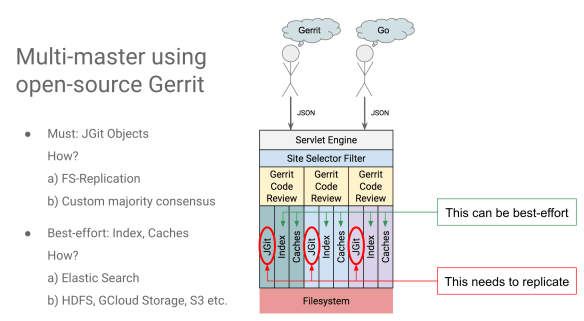
  • Objects that you have to replicate related to all the Git data. JGit is putting objects into the disk, and these are the data you need to replicate correctly and fast.
  • Other stuff that should replicate and fast to provide a pleasant user experience but it really can be best-effort. That is the indexes and the caches.

If it is okay for your master having a 200/600 msec additional latency, then do not replicate the caches. You can have a cold cache in Singapore or the US, and you can reread them without problems.
Screen Shot 2017-10-10 at 15.37.31.png

For the index, replication can be best-effort, but you should make an effort to replicate them. It is still nonetheless a mandatory requirement. One way to achieve that is to use ElasticSearch, but other index implementations that give indexes replication can be used as well.

Multi-tenant and Multi-master together

We talked about a multi-tenant system and then replicate them globally, so we have now a multi-tenant and multi-master system, actually pretty close to what we run at Google.

That is the stack that we run in total. We have a selection filter and two other filters to decide what the traffic is directed. We are also based on JGit, no magic there, we have index and caches we replicate, all our systems are based on filesystem and BigTable.

Some “magic” happens at the Git layer at Google because that is where all the majority consensus across all the cells. When you are pushing anything that is Git and, with NoteDb, anything that is a review is in the repository as well, the system tries to reach the majority of the cells and write the objects to them. When that is acknowledged, you get a green light on the push.
Majority consensus also means that you have it only in so many cells, but don’t have it on all the cells all the times. Some of the replication is happening in the long tail, by replication events eventually get acknowledged by the cells, and then they get written to all the masters.

Our indexes and caches are also replicated, but some of them are just in-memory and a component that gets replicated on top of BigTable.

Redundancy everywhere.

We run five data-centers across three continents (Americas, Europe, Asia-Pacific), with precisely the stack we just saw which gives us a good latency for most of our users worldwide.

Let’s talk about load balancing. We have a system that is multi-master and multi-tenant, and any of the tasks can serve any requests, but just because it can, doesn’t mean that it should.
Maybe it has in cold memory caches, or it is in Singapore, and you are in the US; so the question is what if the biggest machine is not big enough and we want to optimize it?

Screen Shot 2017-10-10 at 15.39.02.png

The idea is that we want to reduce latency that comes out of cold caches and minimize the time the site takes to load.
So you have a request for gerrit-review.googlesource.com, and your instance has a cold cache, and you need to read from disk to memory to serve the request.
You have a fleet of 300 tasks available but you want to serve gerrit-review.googlesource.com from only just five of them. If you serve 300 requests from 300 tasks in a round-robin manner, you pay the latency to load data from disk to memory for every single request. And the second motivation is that you want to distribute the load.

We want a system that can dynamically scale with changing load patterns. We want a system that can optimise the caches, to send a request for a site/repo to the few number of servers and tasks based on two conditions:

  1. serve from one machine as long as it fits on it
  2. server from more machines if you really have to

Level-1 load balancer

In the stack at Google, you saw two load balancing levels. What you see down in the picture is the Gerrit tasks, that contains all the software layers we talked about. We have a user that triggers JSON calls from the browser, with PolyGerrit. The first thing that the JSON request is hitting is the L1 load balancer. The primary routing of your request is by geographic proximity. We have five datacentres at Google; the L1 load balancer picks the one with the lowest latency. When the request goes into the data-center, we have another load balancer which is the one I’ll talk about more, because this is the one where the Gerrit specifics happen.

One thing that L1 is doing as well is managing the spillover of traffic. When a datacentre says “I can handle up to 100 QPS” the L1 load balancer starts redirecting traffic to other datacentres should that threshold be reached.

Level 2 load balancer

Let’s dive into L2 load balancer, we want to know how much traffic we are getting into each Gerrit task, and we want to know in the load balancer where the single request should go, and we want to know that fast!

We added three new components to the architecture:

  • An element to redirect tasks and provide functionality and can report the load we are handling right now. When I mean load it can be anything: QPS (Queries Per Second), metrics, we just want to know from the tasks: what is your current load? We have a system called slicer, which I am going to talk about in a second and it’s added there in the picture.
  • A second component we are adding to the load balancer, with a query interface that responds to the following question: “we have a request for gerrit-googlesource.com, where should it go?”. All of that should be done in memory and should be regularly updated with the new elements in the background so that we don’t add another component of latency by having another RPC.
  • A third part is coordinating everything and is called the assigner, and it takes all the load metrics that we reported generates new assignments and gives them to the query interface.

Introducing the slicer

We have a system that is called slicer. There is a very nice paper that I can recommend, published last fall, that talks about that. It is a load balancer that works on custom keys and can do automatic re-sharding based on new traffic patterns. When your nodes receive more traffic, the slicer will automatically distribute the load or re-shard the whole system. That is a suitable method for local sharding that happens within the data center; we do not use it for inter-datacentre because that is all done via geographic proximity.

Screen Shot 2017-10-10 at 15.40.13.png

The system works with 64-bit keys and gives you a lot of combinations. You can slice the keyspace, for instance, in 400 slices. That gives you 400 ranges, and you can take any of them and assign to one or more tasks. The hostname is my key for instance, and then you hash it, and you end up in the first slice that gets assigned to a single task with an index zero.

What can we do if the load changes? Let’s say that you have key zero that gets assigned to the first range and then the traffic changes. We have two options.

  1. The first option is to assign more tasks, let’s say task 6, and then you round-robin between task 0 and task 6.
  2. The second option is splitting into 600 or 800 slides to get a better grip on each of the keys.

Screen Shot 2017-10-10 at 15.41.20

We can also do that, and then we factor our the load for gerrit-review.googlesource.com and go-review.googlesource.com, and we put them into different hosts.

We do that for Gerrit, and one of the things we want for Gerrit is when we have to split per-host traffic with the affinity on the repository. Caches are based on the project, and because gerrit-android.googlesource.com is a massive host served from a lot of tasks, we don’t want all these tasks just to serve all general traffic for android. We want tasks serving android/project1 from here and android/project2 from there so that we optimise the second layer of caches.

What we do is to mangle these keys together based on both host and project. Before, all these chromium keyspace was served from a single host; when the load increases we just split the keys into Chromium source and the rest of metadata. This is the graph that we obtained after we implemented the load balancer. The load we have on each of the tasks in a single data center is represented by a line with a different color. What you can see is that are all nicely aligned, so that each task is serving precisely the same amount of traffic which is what you want.

Screen Shot 2017-10-10 at 15.42.21.png

What if one project is 100 times the size of the others and we are optimizing on queries per second? The system will just burn resources fast. We had that situation in May, we saw the graphs, and we said “all good, looks nice”; however, people were sending e-mails and raising bugs wondering if the system were serving any traffic at all or if it were down completely.
It turned out that Android had a lot of large repositories, regarding the number of references, and the objects. We were just optimizing the queries per second, but some of the tasks were doing just CPU intensive work, where others were happy with it. Some of them were burning CPU in flames, and others were fine.

So we moved out of the per-request affinity, and we modified the per-repository sharding to optimise all of this.

Warm vs. Cold Cache

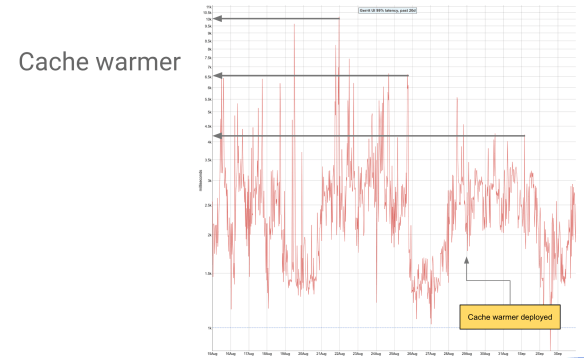
There is an extra in the system that is pre-warming caches. What the load balancer can do for you is to tell you that traffic is changing and I need to reconsider how to split the load on the system. For each of the tasks is going to tell “I’m going to give you traffic for gerrit-review.googlesource.com” with a notice of 30 seconds. That time you can use for pre-warm caches.

That is especially nice if you restart your tasks because all the associated in-memory cache gets flushed. The load balancer tells you “oh, this is the list of the tasks I need” and then you can get them all and pre-warm their caches. This graph shows the impact of the cache warmer on our system, on the 99.9% requests latency, really on the long tail of requests latency. That looks nice because we brought the latency down by a third.
Screen Shot 2017-10-10 at 15.43.15.png

What is a task start dying during peak traffic? Imagine that the load balancer is saying “You’re going to handle this” and two seconds later says “I have to reconsider, you’re going to handle that instead”. Again you’re going to watch your system burning on fire, because you’re serving peak traffic and then you’re running close to 100% CPU. That situation causes the load balancer loading and unloading tasks all the time, which is inconvenient. The way we work around this is to make this cache warming a best-effort activity. You can do it if you’re below 50% CPU when you have time to do fancy things, but when you receive peak traffic, you just handle peak traffic without any optimisation made.

Multi-master and multi-tenant outside of Google

The question is: how do we do that in a non-Google setup?
There are plenty of options.

With the new Gerrit release in 2.15, we introduced to a new URL scheme, which includes the project name in the URL. Previously you had gerrit-review.googlesource.com/c/NNN and there was no way to directly know which project this is for and no way to do that load balancing that we just saw.

What we did in 2.15 is just add the project before that, so that extraction for both host and project can be made in a simpler way. You could do the same even before v2.15 but you needed a secondary index lookup, which most opensource load-balancers such as HAProxy or NGINX did not support. And of course, there are lots of products like Google Cloud load balancer, and others that you can use to achieve the same thing.

Wrap-up

We went through a journey where we took OpenSource Gerrit, we added sites selection and got a multi-tenant Gerrit.
Then we took this multi-tenant Gerrit, added replication and obtained multi-master Gerrit.
And then we took that with load balancing and lots of failures and lots of fixes, and we got pretty much the Gerrit that we run at Google, which brings me to the end of this talk 🙂

Q&A

Q: How strategic is Gerrit@Google? Do you have any other code-review systems? If yes, how is used Gerrit vs. the others?

We have another code-review system for internal use only, and Gerrit is used whenever we are doing OpenSource stuff, so for GoLang, Chromium, Android, Gerrit, and whenever the Google Team wants to collaborate with other OpenSource users, or in general with users that are not sitting at Google.

Historically the source at Google was developed in Perforce, and we ported from that to a home-based system called Piper. Around that, we have a tooling ecosystem which is internal. In parallel to that, Google started to do a lot of projects that have nothing to do with the internal search engine and available outside. What we see is that a lot of projects started at Google from scratch were thinking about “what system should we use?”. Many people said: “well, we’re going just to use Git because that’s what we know and we like, ” and when they needed code-review for Git they ended up with us. Gerrit and Git are very popular inside Google.

Q. You have two levels of load balancer. The first one is the location, and the second one is to decide what to do inside the data-center. What about if a location is off? Maybe is not fully off-line but has big problems, or has a very low-percentage of consensus, and some of the locations have not the “latest and greatest” of the repo. Possibly a location that should be “inconvenient for me” actually has the data I want.

You’re talking about replication layer where you have the objects in one location but not in the other. Our replication latency is in the order of seconds, but it may happen that one location is just really slow in getting the objects. That happens from time to time, and we have metrics that says what the replication lag is accounted for. When it exceeds a threshold we just shut the data-center off, which means cut-off the traffic, the data-center will not receive user-traffic anymore but it will still be able to get the replication done, and when the decrease the objects we need to replicate we can send the traffic again.

Cutting off the traffic is happing at the L1 load balancer where we said “don’t send anything there”.

Q. Do all the tasks have the same setup? Or do have a sort of micro-service architecture inside where some of the tasks are more dedicated to this type of operations and other for another type. Serving data from memory in one thing, but calculating diff change is a different type of task.

Not in general. All of our tasks are the same, except for checking access control permissions. We do not go through the whole Gerrit stack but we have only this little task that knows how the project config works and is going to tell us yes or no.


Gerrit User Summit 2017 – Sold Out

GerritUserSummit-London-Splash.jpg

The Gerrit User Summit 2017 this year is entirely SOLD OUT, a fantastic result and huge audience increment from last year, coming from 14 different countries.

It is essential for a healthy OpenSource project having a diverse and growing community of users that assures longevity and organic growth of features and ideas.

See you at CodeNode on Monday 2nd of October 8:00 AM and help shape the future of Gerrit Code Review, growing and thriving in the ecosystem of Git Code Review tools.

PolyGerrit User Experience at Gerrit User Summit in London

Google.GerritUX_Banner_200X85_cc.jpg

With only seven days to go, the Gerrit User Summit is approaching fast! There has been a lot of discussion on the Gerrit usability on a recent discussion thread on the GoLang project. More and more the focus of OpenSource communities is the ease of adoption and contribution, after of course the solidity and efficiency of the review process. A usable interface, clear and self-explanatory even for newbies, could contribute to the success of a project.

PolyGerrit, a fresh start from the Chromium project

In July, the entire Chromium project moved from Rietveld to PolyGerrit: this event has brought a lot more users to the Gerrit platform and triggered a creative and open debate on the future of Gerrit UX. Chromium’s unique workflow has been the driver of lots of improvements, some of which will be landing in Gerrit 2.15.

Logan Hanks from Google will present at the forthcoming Gerrit User Summit in London the discoveries and developments of the v2.15 PolyGerrit UX, mainly driven by the same people that are using it every day on the Chromium project.

A new visual design for the PolyGerrit project

There is a new visual design for the change view to present. You may have already seen some elements of this design rolling out to googlesource.com. Arnab Banerjee from Google will take us through the complete design and show us where it’s going in the coming weeks.

A PolyGerrit booth has been set up at the conference to allow anyone to experiment the new UX and go through some research trials to provide meaningful feedback for the evolution of the user interface.

Only ten seats left, it’s never too late

The Gerrit User Summit 2017 is almost entirely booked: HURRY UP AND REGISTER TODAY so that you can see and be part of the evolution of the Gerrit UX. Your user-journey and requirements can be part of the next version of Gerrit, be part of the change and part of the Community.

Beyond PolyGerrit, many more talks are coming

More exciting talks to come as well, including multi-master, a brand-new Jenkins integration and an exclusive Q&A face-to-face with the Gerrit maintainers. See the full schedule at the Gerrit User Summit 2017 site.

Gerrit User Summit 2017, 2-3 Oct, London

GerritUserSummit2017-logo.png

New and exciting features are coming for this year Gerrit User Summit, with the launch of Ver. 2.15, NoteDb, high-availability, multi-master and much more.

The Summit will take place for the very first time in Europe, London, the location chosen by the community after a public consultation, the 2nd and 3rd of October at CodeNode (Skills Matter).

There are still a few places available but hurry up and register now at https://gerritusersummit.eventbrite.com.

See below an overview of the topics that will be presented and discussed during the User Summit.

What’s new in Gerrit 2.14.x.

Gerrit v2.14 was released during the last Hackathon in April and has gone through three patch releases. David Pursehouse from CollabNet will give an overview of the new features introduced which would be highly beneficial for all of those who haven’t migrated yet.

Gerrit at Google: Multi-master, Mutli-tenant.

Google is the founder, main contributor and possibly the most advanced user of the Gerrit Code Review: learning from their experience is a unique opportunity to learn and being able to leverage and use the tool at its best.

Patrick Hiesel from Google will go through the insights of their Gerrit Code Review architecture and will provide some of their metrics of scale. In addition to that, he will present some findings from the recent switch of their load-balancing infrastructure and the associated pitfalls encountered.

Google is possibly the only one in the world using Gerrit in a multi-tenant setup, having a unique multi-master installation that serves a constellation of domains and projects, including huge and familiar ones like Android and Chromium.

Standing “on the shoulders of giants” like Google helps a lot in preventing scalability issues as the audience and adoption of Gerrit Code Review grows in large companies: being part of the audience in the talk is a unique opportunity to learn and ask questions directly to the maintainers of their infrastructure.

PolyGerrit: a new UX experience for Gerrit Code Review

Google has invested a lot in reinventing and reengineering the user interface of Gerrit Code Review, which remained mostly unchanged for almost a decade. A new team has been put together in their San Francisco offices with experienced UX developers that leveraged the new Polymer framework of web components.

The result is PolyGerrit, a modern web UX which provides an unprecedented browsing speed and flexible rendering across different devices, including mobile and tablets.

The PolyGerrit Team will be presenting the findings of their user-experience research and show some of the features and insights of the new UX.

Gerrit CI and keeping logs forever.

Gerrit Code Review itself is a large project, involving over 300 developers across the globe and using the most advanced DevOps practices. The CI/CD pipeline has been provided and managed by GerritForge on the https://gerrit-ci.gerritforge.com and Luca Milanesio from GerritForge will present the latest improvements in the pipeline plus an interesting way of collecting and reusing the logs.

Leveraging the logs for identifying the bottlenecks of the CI/CD pipeline is the way to drive improvement. GerritForge leveraged the expertise of his engineers to harvest and organize data and will give it back to the community as powerful dashboards.

Beyond Gerrit.

Gerrit is great. However, it is also quite an important part of a bigger ALM process. Jacek Centkowski from CollabNet will describe how multiple tools can be unified under a single TeamForge umbrella and what are the immediate benefits of it.

What’s coming in Gerrit 2.15

After only four months, we are already close to the v2.15 of Gerrit Code Review, which would be possibly the last one before the step to the v3.0.

Dave Borowitz from Google, principal maintainer of the Gerrit Code Review project, will go through the new features of v2.15 and possibly give a glimpse in what to expect from v3.0.

Mining Gerrit Data to Study Contentious Reviews and Community Evolution

Gerrit Code Review is much more than a tool, it is a way for people working together in companies that are large and mostly distributed across the globe.

Shane McIntosh from McGill University has been running a research lab on this topic. The Software REBELs—a research lab at McGill University—mine code review data to study topics like the impact that code review practices have on software release and design quality. Our more recent work mines code review data to study the reviewing process itself. In this talk, I will describe the results of two empirical studies of data that we collected from the Gerrit instances of the OpenStack project. The first study aims to understand the reviews where reviewers disagree about a patch. The second study follows how the concerns that reviewers raise evolve as the OpenStack community ages and individual reviews accrue experience.

Gerrit Analytics: dashboards, networks, KPI

Gerrit has always been lacking major code analytics features compared to other Git Server tools like GitBlit or GitLab. GerritForge Ltd is filling the gap and adds one important asset to the Gerrit Code Review platform: code review analytics.

We need to harvest and unify the logs and events coming from the different components of the CI/CD pipeline by putting at the center of it the people and teams that are building and discussing the code on Gerrit. The resulting data-lake of information can be later analyzed and correlated to calculate the cycle time of the entire pipeline.

Luca Milanesio from GerritForge will show the new analytics dashboards that are going to be published and provided back to the Team that is developing the Gerrit Code Review project as a precious contribution to the community.

How to extend Gerrit using Scripting Plugins

Gerrit Code Review has a robust set of API that can be used to extend its functionalities and provide a more integrated development workflow for the Teams.

Luca Milanesio from GerritForge will present how to use different scripting tools to extend the capabilities of Gerrit without the need of developing and building a plugin, using Jython, Groovy and Scala.

A new simpler but powerful Gerrit Jenkins plugin

Gerrit Code Review is an essential part of a larger CI/CD pipeline. Most of the times it is used in conjunction with Jenkins, the most popular OpenSource Continuous Integration and Delivery tool.

The integration between Gerrit and Jenkins (Gerrit Trigger Plugin) was developed back in 2010 at Sony and since then has been extended and adopted in thousands of Jenkins installations. However, Jenkins has evolved too and has now a brand new concept and definition of multi-branch pipeline which struggles to be seamlessly integrated with the current Gerrit Trigger Plugin.

Luca Milanesio from GerritForge will present a brand new plugin based on the new Jenkins branch discovery API which works seamlessly with Jenkins multi-branch pipelines and provides a simpler interface with Gerrit by leveraging the new WebHooks.

Diffy with enterprise grade

Since 2012 CollabNet has been working on improving Gerrit integration with TeamForge. Many features have been created to satisfy the needs of enterprise customers. Eryk Szymanski from CollabNet will present features like RBAC, history protection, Git style notifications, quality gates, pull request and code browser which have been implemented on top of vanilla Gerrit.

Q&A with the maintainers

Have you ever wondered why something is working in a certain way? Have you ever wanted to explain any complaint about some parts of Gerrit? Would you give your congratulation to the people that made this project? Would you like to make a feature request or propose new ideas?

This is the moment where you can speak directly face-to-face to the people that are building this project every single day, the Gerrit maintainers.


The event is free for everyone, thanks to the contribution of our sponsors, CollabNet Inc, GerritForge Ltd and Skills Matter Ltd.

SponsorsBanner.png

Gerrit v2.14 brings new features and UX

A brand new version of Gerrit is out, but the increment of the minor version number to 14 uncovers a set of unique innovations that this release provides.

Gerrit Ver. 2.14 is most likely the last 2.x version before the introduction of Gerrit 3.0, which would change forever the way we look and interact with code-reviews. That means that even though 3.0 isn’t ready yet, some experimental features have already been introduced in Gerrit 2.14. Those will be tagged with the [exp] prefix in this article, but don’t be scared by the wording: all Gerrit features, including the experimental ones, are heavily used on a daily basis by large installations like Google’s and GerritHub.io

Java 8

For the first time, Java 8 is a mandatory requirement to run Gerrit. It was previously a strongly recommended option, but both Java 7 and 8 were equally supported. The switch to Java 8 comes with the incompatibilities with all the operating systems that do not support its latest version and updates, such as Ubuntu 15.x or CentOS 5.x to name some of them.

PolyGerrit and review by e-mail [exp]

Gerrit includes a richer user experience with two major improvements: new redesigned HTML5 with WebComponents UX (code-named PolyGerrit) and a fully featured bi-directional HTML e-mails. Interacting with Gerrit is becoming easier and more intuitive.

With PolyGerrit the changes diffs are included into the main screen and are as simple as expanding a div section. The page loading is much faster thanks to the browser caching to the core building blocks of the UX. Even though the UX isn’t complete yet, a lot of Google’s teams use it already on a daily basis, including the Chromium and Go-Lang projects.

The redesigned and richer HTML emails are now bidirectional and include all the information you need to perform an off-line review using your e-mail client. If you are on the move, just reply to the e-mail with your comments and Gerrit will pick them up and include in the change review as messages, amazing isn’t it?

ElasticSearch [exp]

It is now possible to use an alternative Indexing engine, ElasticSearch, which allows having a clustered setup of distributed nodes of index data. That is a major stepping stone towards the full implementation of Gerrit multi-master, giving the possibility of multiple Gerrit masters to share the index data with replication over the network.

Out of the box UX and Plugin Manager [exp]

Installing Gerrit with the associated plugins is so much easier: there is no need to clone the code or googling around for a compatible plugin build: everything is included in Gerrit with an intuitive and user-friendly user-experience. Just use the search box to find the plugins compatible with Gerrit v2.14 and install them with a single click.

This new feature is provided by the new native packages (RPMs, Debian and Docker) which benefit from two new plugins (out-of-the-box and plugin-manager) that are included by default and executed as the first action after a new fresh installation.

What’s next?

A lot more is coming, as the NoteDb support become more mature every day. Google has announced to have switched off the ReviewDb in production and is using NoteDb as “unique source of truth” for all its projects. Gerrit 3.0 with 100% NoteDb support is coming very soon and will change the way you think and interoperate with your code review forever.

Stay tuned; more innovation is coming! – Luca Milanesio – GerritForge


London to host Gerrit User Summit 2017

gerritusersummit-2017-poll-results.png

… and the winner is … Europe/London!

Despite the future Brexit plans, London will still be this year the beating heart of Code Review innovation by hosting the Gerrit User Summit 2017.

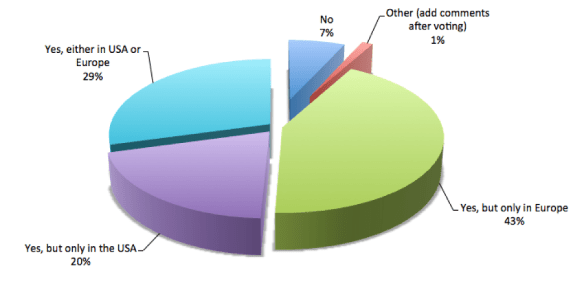
Here are the numbers in detail:

  • 157 people visited the poll page (goo.gl/M7X6rp)
  • 75 people from 14 countries expressed their vote in the past two weeks
  • Summit in Europe (only Europe + USA/Europe) received 54 votes
  • Summit in USA (only USA + USA/Europe) received 37 votes

Countries

GerritUserSummit2017-countries.png

The audience is very diverse, with the most votes coming from West and East Coast of the USA, the British Isles, and Germany. There was some interest in the Summit as well from Israel, India, and Japan.

It will be excellent to see new faces at this year Gerrit User Summit, to exchange ideas and capture new and essential requirements for the next versions to come.

The London Venue and Dates

SkillsMatter.png

SkillsMatter offered the CodeNode venue in London (10 South Place, London, EC2M 7EB, GB) which is entirely dedicated to hosting events, meetups and user groups from the global OpenSource Community.

The new venue can record every session, open policy about taking pictures and share content and the possibility of streaming the event to allow remote attendees to watch and interact.

The proposed dates for the event are:

  • Saturday 30/09 to Sunday 01/10 – Pre-summit and Gerrit+Plugins Hackathon
  • Monday 02/10 to Tuesday 03/10 – Gerrit User Summit

New location, same community, and format

Even though this year the country and location will be different from the past User Summits hosted by Google in Mountain View – CA, we want to keep the organization and format of the Summit exactly as it was before:

  • User-driven: focussed on sharing experiences and networking between the users of Gerrit Code Review
  • Self-organized by the Community: no calls for papers, sponsored talks or products presentations. All has to come from the users and voted by the users.
  • No commercials: even though the supporters of the event are business entities (SkillsMatter, eSynergy, GerritForge and many others) we will be very careful in keeping the spotlight on the users and not interfere with them.

Costs and sponsorships

Historically Google has paid for all the costs involved in the Summits (venue, catering, marketing, etc.). For this year, a lot of companies who are using Gerrit Code Review and contributing to it have already provided their interest in contributing to cover the costs and make this European event successful.

We want to keep the list of sponsors small and tightly coupled with the Gerrit Community. If you are a company and you want to sponsor the event, please contact Luca Milanesio (luca@gerritforge.com) or post your offer to the Gerrit Code Review mailing list https://groups.google.com/forum/#!forum/repo-discuss.

Next steps

We will work together with the Gerrit Community to organize this event and make it fruitful and profitable for the future of this amazing OpenSource project.

Thanks again for your vote and your interest in the 2017 Summit.

Luca Milanesio – GerritForge

[Poll] Gerrit User Summit 2017

user-group-crowd.jpg

At the last  User Summit in Mountain View, it has been announced that the Gerrit User Summit 2017 could be hosted in Europe/London rather than the traditional US West Coast location.
The primary rationale behind the proposal is to engage with a wider and more diverse community, who can bring new requirements and needs from of the European Gerrit Community. It would be an opportunity to see more faces and get new ideas.

While the adoption of Gerrit Code Review has been historically high in the USA, the European companies have started using it as the standard tool for their development lifecycle. More and more people from Europe began to participate actively in the mailing list and contributing new ideas and code.

Here is a poll to have your say and express your intention to participate:
https://goo.gl/M7X6rp

The poll will stay open for the next two weeks and then we’ll publish the results.

Thank you in advance for taking the time to respond to the poll and hoping to see you soon at the next Gerrit User Summit 2017.

Luca Milanesio – GerritForge.

GerritHub.io powered by Polymer

polymer-logo

You can now use the Gerrit Code Review interface on GerritHub.io using the new Polymer-based UX. The code-name of the project is PolyGerrit.

Enabling Polymer is easy, just add “?polygerrit=1” to the regular GerritHub.io URL. or alternatively you can click on the  “PolyGerrit” link at the bottom of the GerritHub.io footer.

https://gerrithub.io/?polygerrit=1

Alternatively you can click on the  “PolyGerrit” link at the bottom of the GerritHub.io footer.

polygerrit-footer

What is Polymer and why it matters?

Polymer is a new type of library for the web, built on top of Web Components, and designed to leverage the evolving web platform on modern browsers. Differently from the traditional Gerrit GWT UX, Polymer is developed using  HTML and JavaScript and is supported and cached natively from your web browser.

Why is Gerrit moving away from GWT? Well, there are many reasons for steering direction:

  • Speed.
    With Web Components, the core building blocks of the UX are transferred once and then cached by the browser, giving a much faster and fluid user experience.
  • Multi-sized screen support.
    Web Components are “instructed” to be rendered differently on different devices, giving the best user experience and accessibility of the device’s form factor and native interactions.
  • Branding.
    By using native HTML and CSS rendering, it becomes much easier to control and customize the look and feel of Gerrit.
  • Stability.
    Web Components development allow focusing on basic building blocks that are straightforward and testable. It becomes much easier to develop much more stable and robust components.
  • Skills-set.
    Typically, web developers find themselves more comfortable in using a front-end language and have much more control of what gets generated, understood and rendered by the web browser.

GerritHub.io on mobile

One interesting feature of PolyGerrit is the mobile view of Gerrit UX.

polygerrit-on-mobile

Gerrit’s GWT interface has always been quite a challenge on small-screen devices, mainly because of the inability of being sensitive to the reorganization fo the page real estate based on the device’s form factor.

Additionally, the buttons did not have enough real estate needed for “big thumbs”.

The ability to use Polymer has opened up a wide range of possibilities of interactions and, for the first time, a real fully featured review experience “on the road”.

Big thumbs up for the new Gerrit Mobile UX !

What and when?

What is currently implemented in the new Gerrit Polymer-UX? Not much in terms of screens, but a lot of the core functionality of the Code Review: the changes list and the review panels. What is missing? All the other Gerrit screens more dedicated to the management of the platform and the account, the projects and groups listing, and all the support for the UX plugins.

The PolyGerrit project announced at the Gerrit User Summit 2016 last year that they are making good progress and expect to have the first “production-ready” release by Feb/Mar 2017. In the meantime, all the code is stable and the current screens are good enough to be used on a daily basis.

Do I still need the GWT UX?

Yes, at least for the functionality that isn’t available yet in PolyGerrit. To switch back to GWT, simply add “?polygerrit=0” to the target URL.

https://gerrithub.io/?polygerrit=0

Credits

Many thanks to the Google’s PolyGerrit Team, lead by Andrew Bonventre, which started the Polymer support for Gerrit UX. A special thank to David Ostrovsky, who implemented the Gerrit switcher support to enable to use both GWT-UI and PolyGerrit-UI at the same time.

Gerrit User Summit 2016 Report

gerritusersummit-2016-google

The 9th edition of the Gerrit User Summit has ended today: a lot of new features and ideas have been presented and experimented in those four days.
Here is a summary of what happened and a description of the main innovations and presentations at the Summit and Hackathon at GooglePlex in Mountain View – CA.

12th-13th of November – The Summit

Gerrit v2.13

David Pursehouse from CollabNet presented what is coming in Gerrit v2.12 and v2.13.
Gerrit v2.13 has been the biggest version of Gerrit ever, with over 2,600 commits from 83 different contributors. That shows that Gerrit is an OpenSource project with a growing Contributors’ Community, getting more diverse over time.

There have been a lot of new features and improvements introduced. The most significant and noteworthy features are …

Git LFS

Ability to store large files outside the Git repository to an externally pluggable repository, such as HDFS or AWS S3.

Gerrit Metrics

New extension point to extract in real-time the performance data of Gerrit’s internal activity and publish them externally to Graphite, ElasticSearch, JConsole or other similar graphing and monitoring tool.

Hooks

There is now the ability to replace the dated hook system with much more powerful in-process-plugins. Existing hooks are then still supported using the “hooks” core plugin. Gerrit is getting more modular and extensible.

Improved review of Merge Commits.

Gerrit can implement effective “merge-requests” lifecycle on top of regular code review. You can now create feature branches exactly as you do with GitHub or GitLab and then submit only the “merge request” as change for reconsideration.

What’s cooking in Gerrit v2.14

PolyGerrit

After eight years, Gerrit GUI needed a complete revamp and modernisation, to compete with all the other web-based Code-Review systems such as GitHub, GitLab, and BitBucket.

Google has allocated a brand new front-end Team, located in San Francisco, to redesign and implement a brand-new user experience. It is much more than a simple rewrite; it is a complete rethinking of how to get the most of your code review functionality with the optimal utilization of space.
The new UX will be more fluid and adaptable to different sized screens, including tablets and even smartphones. It will be then possible to give a usable GUI even when accessing Gerrit “on-the-road.”

Suggested Reviewers

Gerrit is getting smarter and, by using sophisticated heuristics, it can now understand and sort the suggestions of which are the people that are most likely to be interested in reviewing a change. Gerrit allows saving time in browsing for individuals and contributes to the accuracy of the reviews.

New HTML e-mails interaction with Code Reviews

Say goodbye to long ugly diffs in e-mails, and now you can generate nice and tidy e-mails where all the details are carefully formatted for achieving maximum clarity. Additionally, you will be even able to reply in-line to the comments received via e-mail and Gerrit will be able to capture the message back and insert the feedback as code-review messages into the code carefully.

Robot comments

CI and automated systems can contribute comments to the code, without spamming the overall review discussion flow. That contributes to a much cleaner user-interface.
Google uses automated code analysis tools such as Tricium and ShipShape to capture the most common mistakes in coding and event providing the corresponding suggested fixes. All this feedback will be captured and integrated with Gerrit in the change comments GUI. The Change’s author will then be able to review the suggested fix and apply it with a simple click.

The management of robot commits will be fully operational with the new PolyGerrit GUI.

ElasticSearch Indexes

Instead of using the local Lucene Index, Gerrit would use an external ElasticSearch cluster to achieve maximum scalability and share the index across multiple nodes. That is one of the cornerstone feature needed for a multi-master setup.

A lot of time has been spent in making sure that the ElasticSearch support was aligned with the current Lucene implementation, but unfortunately, it took until v2.14 to fill the gap. Still, there are parts of the index not yet implemented in ElasticSearch, such as the on-line reindexing. Hopefully, the v2.14 will see all those gaps resolved and enable a real multi-master shared index setup.

Atomicity with Change-Sets

Basavaraj Karadakal from Juniper Networks presented a real-life implementation of the “submit whole topic” into his organization. We always said that “topics” require some company-wide naming policy to avoid conflicts and unexpected behaviors: Juniper found the solution by introducing a new concept, the “changeset.”

The name isn’t new to people that have been in the SCM long enough to remember IBM Rational ClearCase. Interestingly Basavaraj used that term, possibly to facilitate the understanding and adoption into the company.

The idea behind change set is to have a single change review “leading” the topic submission, stored in a “tracking repository”. One can understand the list of changesets and their status by querying the “tracking repository”. This feature is fascinating because it allows obtaining a full list of “open topics” inside Gerrit, which isn’t currently available as “out of the box” feature.

The overall implementation of change sets is composed of a set of client wrapper scripts and server-side plugin to orchestrate the review status of the changeset based on the review status of each commit included.

We do foresee a lot of feedback in the community around changesets and topics: the discussion started a couple of years ago and everyone agreed that “something was missing” in the current Gerrit topic concept … possibly the “change sets” are the missing piece of the jigsaw to make the “submit whole topic” a feature ready for production use.

Pull Requests in Gerrit

Since v2.13, Gerrit allows full reviews of merge commits. However, the workflow isn’t visible:

  • create a feature branch feature/abc
  • commit changes directly to the feature/abc branch, without requesting any review
  • once the branch is ready for review, merge into its target branch locally and push the merge commit to refs/for/target-branch

Eryk Szymanski, CollabNet, has presented an alternative GUI to make this scenario, typical of GitLib, GitHub, and BitBucket, more accessible for novice users.

The new Pull-Request GUI is based on two components:

  1. REST API, different from Gerrit’s native ones
  2. Pull-Request GUI, not integrated with Gerrit’s GWT or PolyGerrit but available as components of CollabNet’s TeamForge product.

Gerrit Analytics

Luca Milanesio from GerritForge introduced two new plugins in Gerrit 2.14:

  • Kafka stream events: to consume stream events and send them to topics
  • Project analytics: to crunch data from Gerrit repositories to expose aggregated contributors statistics

The vision of Luca Milanesio, GerritForge, is splitting Gerrit statistics into three dimensions:

  • People. What is the list of contributors, maintainers, reviewers? What do they do, how often they commit and which ones are the most active influencers?
  • Projects. How repositories are evolving over time and space and what do they need moving forward regarding storage and performance?
  • Systems. How is Gerrit behaving concerning CPU, Memory, and Network utilization?

The correlation of the metrics collected in these three dimensions allows putting together the KPI that allows understanding better how Gerrit is used and how to improve its current and future performance.
Additionally, you could use them to reward and promote good practices of code-review and fuel continuous innovation across the teams.

In one sentence, Gerrit Analytics will allow to “uncover the hidden value of your Gerrit Code Reviews”.

Plugins for CI Systems

Martin Fick from Qualcomm Innovation Center gave an overview of three new plugins developed for use by CI systems: the batch, manifest, and task plugins, with some modifications to the Gerrit core needed.

The batch plugin provides a mechanism for building and previewing sets of proposed updates to multiple projects/branches/refs that should be applied together. The focus of batch updates tends to be verification (by CI systems). The batch update service provides the tools to build refs by merging changes to temporary “snapshot” refs, which can then be tested extensively, and finally submitted ”as is.”
That represents a different approach to resolving the “topic submission” problem: Martin’s plugin would work for all Gerrit versions from v2.7.

The manifest plugin provides server-side utilities to operate on, and query information about repo manifests (XML) stored in git projects on the current server. This plugin provides APIs to update values in manifests, and to search for manifests with certain values.

The task plugin provides a mechanism to manage tasks which need to be performed on changes along with a way to expose and query this information. Tasks are organized hierarchically, and their definitions use Gerrit queries to define which changes each task applies to, and how to set the status criteria for each task. An important use case of the task plugin is to have a common place for CI systems to define which changes they will operate on, and when they will do so.

Gerrit CI Pipeline

Gerrit has finally a fully-feature CI Pipeline, thanks to GerritForge who invested time and resources to set up the https://gerrit-ci.gerritforge.com web-site.

During the Gerrit Hackathon 2015, Luca Milanesio, Doug Kelly and Khai Do have put together their ideas and skills to introduce an entirely automated and community-driven Jenkins set-up which allows to automatically generate the build jobs from the YAML files archived in the Gerrit-ci-scripts project.

The magic behind the system is that nobody directly controls the definition and execution of the jobs, but it is the collective contribution and code-review of the YAML files that automatically re-configure the Jenkins instance automatically.

Over 30K builds were executed last year, with an average of over 80 builds per day. Thanks to the Gerrit CI it is now possible to discover which plugins are available and stable on different branches of Gerrit and download the pre-built artifacts with a simple click.

What is still missing is an official “distribution site” of the Gerrit plugins; a place where successful plugin builds are installed on real Gerrit instances, tested and released. GerritForge is investing time and money to fill the gap and will provide a premium service called “Gerrit Central” available as an add-on to existing Enterprise Customers. The resulting fixes coming from this process of plugins validation will be contributed back to the community and will be accessible for everyone.

Gerrit Bazel build: a farewell to Buck

From v2.14 Gerrit is moving away from Buck and, after eight months of work of efforts for migrating the build system, David Ostrovsky has finally announced that the build is green and we are ready to move to Bazel, yeah.

Building Gerrit isn’t an easy task, with 35 repositories, 400K Java + 16K JavaScripts lines of code, over 140 dependencies and a complete JavaScript toolchain based on NodeJS. In addition to that, there are over 100 plugins automatically built with our CI system hosted and managed by GerritForge.

Gerrit started initially with Maven, but it was very slow and clumsy. After the London Hackathon in 2013 the project was successfully migrated to Buck, which promised to be much faster and flexible. However, this choice has driven the project build to a swamp of problems and bugs/fixes needed on top of Buck to make the build work.
As a result, a custom version of Buck needed to be built using Ant for potentially every branch of Gerrit development. The Gerrit project has submitted over 100 bugs to the Buck project over the three years of adoption.

Bazel is an OpenSource build tool based on an internal system used in Google and is much more advanced and stable, offering a simpler installation and an advanced sandboxing capability to isolate builds and results.
Differently from Buck, Bazel promises both speed and accuracy, qualities that were not always present at the same time.

During the Hackathon, David posted a milestone change named “Remove Buck build” which is currently under review. We all hope that the change will be merged very soon and give the final farewell to Buck build, and our thanks for having helped and supported us in our journey for over three years.

Gerrit reviews from e-mails

Patrick Hiesel from Google presented a very innovative feature that extends the ability to interact with Gerrit reviews by just answering to e-mails.

The feature is still in the very early stages of development  but the demo showed at the Summit was impressive. When you receive the e-mail notification from Gerrit with the comments of people to your code, you just answer in-line to the e-mail and … the magic happens! Gerrit fetches the e-mail automatically and understands the in-line replies as comments to be added to the reviews.

This new workflow dramatically reduces the cycle time of interactions during the review and represents IMHO the “killer feature” to push Gerrit to the top of the Code Review systems currently on the market.

Let me recap what you have to do currently with Gerrit:

1. Receive a notification e-mail
2. Read the comments
3. Click on the change link
4. Open a browser at the change page
5. Sign-in (assuming that you are using PolyGerrit, it would work on Mobile too)
6. Locate the comment you wanted to reply
7. Click on the comment
8. Click on Reply
9. Enter your Reply
10. Click save
11. Go back to the main change screen
12. Click on Reply
13. Click on Post

… and with the inbound e-mail ingestion in Gerrit it will be:

1. Receive a notification e-mail
2. Read the comments
3. Click on Reply
4. Insert your replies in-line
5. Send

There are issues, though, mostly related to security and trustworthiness of the e-mails as the vehicle for reviews.
We know that e-mails can be SPAMs or can be forged by faking source e-mail addresses. Currently, the prototype shown was only matching the e-mail sender to associate to the reviewer identity, which is fine for the majority of the cases but could raise some concerns regarding compliance.

The reviews coming from e-mails will be appearing with a different style and will be noticeable compared to more secure web-based comments. That would allow judging the comment accordingly and avoid over-reliance on their value.

It has been suggested as well to consider the integration of PGP-signed emails and the matching of the PGP-Key with the one stored in Gerrit for that user: that would be the perfect secure solution to avoid SPAMs or forged e-mails risks. However, Patrick did not commit to implementing the feature at this level for the initial MVP.

Inbound e-mail processing is a feature to keep under the radar as it will cause a wave of adoption of Gerrit because of the speed-up of entire Code Review lifecycle and consequently the time-to-market of the development of projects features.

Keep the conversation flowing with Gerrit at OpenStack

Khai Do, the maintainer of the Gerrit Review at OpenStack, has presented the challenges of managing comments with a large-scale project.

The OpenStack numbers for Code Review are astonishing:

  • Nine servers (1 master + 8 slaves)
  • 1500 repositories
  • 400K changes
  • 20K users
  • 700 events generated every hour

In addition to the scale of the installation, OpenStack allows third-party to connect to Gerrit using stream events and trigger validation builds. This workflow is code-named TCPI at OpenStack. There are currently 180 registered TCPI which generate *a lot* of messages appended to each change under review.

The overload of information associated with a change makes the “discussion flow” hard to follow in Gerrit: each change is swamped by CI messages which make the overall review unreadable.

Khai has developed a plugin that allows avoiding storing all those messages as regular reviews in Gerrit and collect them instead in a relational database. The overall result is then nicely rendered in a different section of the change, making the review discussion visible and flowing again.

The plugin works out of the box on the current version of Gerrit. Well done Khai.

Infinite Gerrit

Haithem Jarraya from GerritForge presented the idea of adopting a much more scalable storage for JGit based on Apache Cassandra. Shawn Pearce experimented the same scenario a few years ago and contributed an initial prototype on GitHub: piggybacking on the same concept, the new experiments are now driven by the need of scaling up Gerrit in space and number of nodes.

Gerrit Multi-Master is getting closer day-by-day, thanks to the joint efforts of all contributors from different points of view:

  • Sessions can be externalized to a flat-file to supports sharing across nodes (Qualcomm contribution)
  • Indexes and Caches can be aligned across nodes through events (Ericsson contribution)
  • ElasticSearch will be soon available as alternate shared indexing engine (Sony & CollabNet contributions)

Haithem now is adding one extra significant piece of the Jigsaw: the ability to have a scalable shared and extensible storage that allows all the master nodes of the cluster to read/write JGit Pack files at maximum speed. Additionally, thanks to Apache Cassandra multi-nodes data sharing and replication. You will be able to dynamically extend and reallocate the size and structure of the storage without impacting the current operations on the Gerrit Cluster.

The Cassandra backend wouldn’t cover the ref-database, which could be implemented with an entirely distributed implementation such as JGit Ketch (still in early development) or a more standard based on Apache Zookeeper.

Accounts and status of NoteDB

The task of migrating all the Code Review meta-data to the Git repository, aka NoteDB, started over two years ago. Edwin Kempin from Google, presented the current status of the implementation, with a focus on the Accounts migration.

In Gerrit v.2.13 there is already a new repository dedicated to the archiving of users, called All-Users. However, some of the information are still stored in Reviewdb, such as the external ids. Accounts will be exposed via REST-API and sensitive information encrypted end-to-end on the repository, using the same technique used for secure.config.

A new “magic ref” concept has been specifically forged for the All-Users use-case: the reference to their branches as refs/users/self. Each user will be able to get its meta-data by only fetching refs/users/self from the All-Users repository; easy isn’t it?

There is still one piece of information that will still stay outside NoteDB: the reviewed flag. The choice was made because of the inherent volatility of the information: NoteDB would have been overkill for a piece of information that lasts a few minutes or maximum hours typically. The default implementation will be H2 but it could be then replaced with something more “multi-master” aware.

What’s left? Gerrit Groups are the very last piece of the jigsaw and then NoteDB will be finally 100% feature complete. Bye bye DataBase, NoteDB is approaching fast!

Zero-Downtime Gerrit Upgrades

Luca Milanesio from GerritForge closed the Summit with a case-study on how GerritHub.io achieved a 100% zero-downtime migration process, with limited disruption to its 10K users.

Apart from Google, the current implementations of Gerrit Code Review around the world do not allow to keep the service running in case of upgrades between major releases. That was true until GerritHub.io recently introduced a well-testing roll-out mechanism inspired by the well known “blue-green” deployment.

The approach adopted by GitHub, in the case of DB upgrades, is to advise the customers up-front and schedule a planned outage of the system. Last time that this happened was last year and the blackout lasted for around an hour. However, GerritHub.io decided to be different and developed a strategy where the old version and the new version can work side-by-side by synchronizing Git repository and reviews, even across different versions of the DB schema and index.

The “preparation phase”, or Step-1 as Luca described it, may take even days or weeks to complete because relies on a low-bandwidth mirroring to avoid service disruption on the current user-base. Once the two instances are aligned, the subsequent steps will take only a few minutes.

During the “flipping” of the blue (old release) with the green (new release) instance, the users will notice that the repositories become read-only and receive a courtesy message saying “Upgrade is in progress, all projects are read-only. Please retry a few minutes later”.

The read-only “service degradation” would last only for a few minutes (2/5 minutes) and wouldn’t cause a service disruption for all the other users that are fetching, cloning or just browsing the reviews.

The Gerrit Hackathon

gerrithackathon-2016

Even though this year we had only two “hacking days,” the overall productivity has been remarkable: 158 changes created, with 82% of them merged during the Hackathon.

Bazel Build

Authors: David Ostrovsky, Luca Milanesio, Edwin Kempin, Han-Wen Nienhuys

Changes: https://gerrit-review.googlesource.com/#/q/project:gerrit+after:2016-11-10+before:2016-11-17+message:bazel

The summary of the changes is perfectly represented by David’s announcement to the Gerrit mailing list:

“I’m pleased to announce, that we are moving from Buck to Bazel build tool [1].
I’m working for a while on the transition now, and we are reaching the feature
parity for Bazel build toolchain.

I think that Bazel is a better tool for us and provides the following advantages:

* all actions are hermetic by design (no arbitrary python code execution)
* bootstrapping doesn’t require Ant
* can be installed on the main operating systems, including Windows
* better support for re-using of build rules across local and remote repositories
* switching to different branches wouldn’t mean rebuilding build tool
* extensible rules
* failed tests are not cached
* flaky tests are re-run multiple times
* error prone static analyzer integration out of the box

I would like to thank Shawn for supporting this project, and reviewers/contributors:
Han-Wen Nienhuys, David Pursehouse and Damien Martin-Guillerez from Bazel team.

Also big thanks to Luca and GerritForge for helping out with the CI and running a *lot* of tests.
Here is my related talk from Gerrit User Summit 2016: [2].

[1] https://bazel.build
[2] http://ostrovsky.org/gerrit/bazel-build-gerrit”

Allow plugins to define “has” search operands

Author: Martin Fick

Changes: https://gerrit-review.googlesource.com/#/c/91514/

Plugins can define new search operands to extend change searching.
Plugin methods implementing search operands (returning a
`Predicate<ChangeData>`), must be defined on a class implementing
one of the `ChangeQueryBuilder.ChangeOperandsFactory` interfaces
(.e.g., ChangeQueryBuilder.ChangeHasOperandFactory). The specific
`ChangeOperandFactory` class must also be bound to the `DynamicSet` from
a module’s `configure()` method in the plugin.

The new operand, when used in a search would appear as:
operatorName:operandName_pluginName

A sample `ChangeHasOperandFactory` class implementing, and registering, a
new `has:sample_pluginName` operand is shown below:

 @Singleton
 public class SampleHasOperand implements ChangeHasOperandFactory {
 public static class Module extends AbstractModule {
 @Override
 protected void configure() {
 bind(ChangeHasOperandFactory.class)
 .annotatedWith(Exports.named("sample")
 .to(SampleHasOperand.class);
 }
 }

@Override
 public Predicate<ChangeData> create(ChangeQueryBuilder builder)
 throws QueryParseException {
 return new HasSamplePredicate();
 }

Zoekt

Author: Han-Wen Nienhuys

Changes: https://gerrit-review.googlesource.com/#/q/before:2016-11-17+after:2016-11-10+project:zoekt

Han-Wen has officially announced at the Gerrit Hackathon, the general availability of the Zoekt code search engine.

“Hi there,

I’d like to announce “zoekt”, a search engine for source code I wrote over the last month or so. It was made to work well with (large) Git based repositories, so I think some of you may find it useful.

If you’re interested in code search, please try it out, and let me know about your experiences.

http://github.com/google/zoekt
http://gerrit.googlesource.com/zoekt

I didn’t do any work to try and integrate it with Gerrit/Gitiles, but
if someone wants to invest effort in making that happen, I’d be
happy to review CLs. “

ElasticSearch Index

Authors: Hugo Ares, Dariusz Łuksza

Changes: https://gerrit-review.googlesource.com/#/q/before:2016-11-17+after:2016-11-10+project:gerrit+message:elasticsearch

Small steps towards the goal of having ElasticSearch integrated as Gerrit secondary index:
– On-line reindexing (in-progress)
– Accounts indexing (in-progress)

Plugin examples

Author: Martin Fick

Changes: https://gerrit-review.googlesource.com/#/q/before:2016-11-17+after:2016-11-10+project:plugins/examples

Gerrit cookbook has become over the years a mix of different type of plugins functionality. That is good and bad at the same time. A typical “cookbook” should have a set of recipes for obtaining a final dish ready to eat … whilst our was more like a mixed salad with a bit of everything.

Martin started the noteworthy task of reorganizing the cookbook in a set of self-contained example, hopefully,  easier to manage and with a clearer understanding.

Cassandra Repository Manager

Author: Haithem Jarraya

Changes: https://gerrit-review.googlesource.com/#/q/before:2016-11-17+after:2016-11-10+project:libs/modules/repomanager/cassandra

Haithem started a new change (still in draft at the moment) for plugging an alternative JGit DFS implementation to the Gerrit repositories. It is the very first time that such a challenging goal is attempted outside Google data-centers and BigTable/GFS infrastructure. If we succeed in completing the implementation and demonstrating that the resulting architecture is more robust and scalable than the local file-system, it would be a first 100% OpenSource distributed JGit backend ever.

Gerrit LibModules

Author: Luca Milanesio

Changes: https://gerrit-review.googlesource.com/#/q/message:libModule+after:2016-11-10+project:gerrit

Luca discussed how to “plug” an external repository manager into Gerrit: it is something “similar” to a plugin but more fundamental to the system. Differently from a plugin, it needs to satisfy the following requirements:

  • Loaded at start-up time only
  • Cannot be unloaded
  • Must be injected in the primary Gerrit sys injector

It is not the first time that we need to introduce a “modular piece of software” which isn’t part of Gerrit Code Review:

  • Java CryptoProvider – BouncyCastle
  • Encrypted secure store for gerrit.config
  • Servlet filter for authentication and SSO
  • JDBC Interceptor for JavaMelody
  • Multi-hosted Git repository directories

Instead of creating “yet another exception” in Gerrit, we discussed amongst the hackathon members and agreed to come up with a new concept: LibModules.

The rationale behind the name is:

  • They need to be loaded from the same Gerrit class path from /lib
  • They provide extra Guice modules to be added to the sys injector at start-up

The configuration of a set of LibModules in Gerrit is straight-forward:

[gerrit]
installModule = com.mycompany.MyModule
installModule = com.googlesource.gerrit.modules.FancyModule

Now that the change is merged and the new concept has become part of Gerrit, we are expecting a growing number of LibModules to become available.

Removal of references to LocalDiskRepositoryManager

Authors: Hugo Ares, Shawn Pearce

Changes: https://gerrit-review.googlesource.com/#/q/before:2016-11-17+after:2016-10-11+project:gerrit+message:LocalDiskRepositoryManager

Shawn and Hugo started removing the explicit references in Gerrit to the local filesystem for resolving Git repositories. Those changes are needed to fully support an alternative implementation of a Repository Manager not based on a local filesystem anymore.

DynamicBeans for Gerrit Plugins

Author: Martin Fick

Changes: https://gerrit-review.googlesource.com/#/q/before:2016-11-17+after:2016-11-10+project:gerrit+message:DynamicBeans

Until now it has been possible to create new SSH commands or REST API through plugins, which is great but sometimes not enough. Martin came up with a use-case where they need to rather extend the current core commands, without having to necessarily change its code. How can you satisfy this use-case with plugins? Martin has the solution and is called “DynamicBeans”.

It is definitely an interesting use-case that is going to trigger a lot of interest and discussions amongst the Gerrit Community.

Analytics plugin

Author: Luca Milanesio

Changes: https://gerrit-review.googlesource.com/#/q/after:2016-11-10+project:plugins/analytics

One of the things that people are missing in Gerrit, when comparing it to GitHub, is the overall repository statistics:

  • List of contributors with number of commits / adds / remove
  • Project’s statistics of number of commits over time

The new analytics plugin extends the Gerrit project’s SSH and REST API to expose aggregated data extraction. It is extremely fast compared to GitHub because it works purely in streaming and doesn’t actually load the data in memory. The amount of data generated by the analytics can be huge and is intended to be used by an external analysis and dashboard system. Differently from the typical Gerrit’s API, the returned result has one item per line instead of a big unique JSON object. The rationale is that to generate and process a set of JSON elements in streaming, you need to make each record self-contained and processed independently. That would allow as well batch-processing with a parallel system, without having to parse the entire file content all at once.

Example of how to extract the list of contributors out of a Gerrit project via SSH:

$ ssh -p 29418 admin@gerrit.mycompany.com analytics contributors

{"name":"John Doe","email":"john.doe@mycompany.com","num_commits":1,"commits":[{"sha1":"6a1f73738071e299f600017d99f7252d41b96b4b","date":"Apr 28, 2011 5:13:14 AM","merge":false}]}
{"name":"Matt Smith","email":"matt.smith@mycompany.com","num_commits":1,"commits":[{"sha1":"54527e7e3086758a23e3b069f183db6415aca304","date":"Sep 8, 2015 3:11:23 AM","merge":true}]}

Wrap-up and Summit in 2017

It has been a very intense and revolutionary Gerrit User Summit & Hackathon this year, with a lot of new faces, new contributors and new features coming in the next forthcoming releases.

At the summit, Shawn Pearce and Luca Milanesio announced the proposal to organize the event in Europe for next year, possibly in June/July or Oct/Nov 2017. The reason for changing the location is to attract the feedback from more Gerrit Users that have not been heard so far and increase the participation of the community in the future of the of Project.

The summit has been already endorsed by the major organizations driving the Gerrit Code Review Project and other very active sponsors of the OpenSource Community, including CloudBees, CollabNet, eSynergy, Google, GerritForge, SAP and SkillsMatter which has offered to host the event at CodeNode.

Shawn Pearce, the Gerrit Code Review project founder, will send in the next few weeks a Survey to capture the opinion of this proposal from the Gerrit Community.

See you in 2017 for new and amazing features coming on Gerrit Code Review.

Luca Milanesio – GerritForge.


Gerrit user data in git

I’ve been lurking in the #gerrit IRC channel regularly trying to help out Gerritors with gerrit issues.  Recently I’ve noticed that many people keep asking, where the heck does gerrit store user data, like the ssh-keys, and how do I get to it?   I’ve searched the internet myself and have not found a straight forward answer to this question.  So now I’ll provide the answer for whomever is looking.. which includes myself sometimes 🙂

Gerrit’s user data in previous releases was saved to the gerrit database however with Gerrit’s latest release, ver 2.13, that data has moved to the All-Users project.  This means that the data is now stored in a git repository.   Specifically it has moved to the git All-Users project in refs/users.  This is very similar to how it stores project data in All-Projects refs/meta/config.

To get at this data using git you’ll need to clone All-Users and checkout refs/users/user.  You’ll need to get the user id that you want to get the data for and you’ll probably need to be a Gerrit Admin to have access to the data.   So now if we want to get that info we’ll need to do something like this..

git clone ssh://$USER@$MY_GERRIT_HOST:29418/All-Users
cd All-Users
git fetch origin refs/users/$LAST_2_DIGITS_OF_USER_ID/$USER_ID:$USER_ID
git checkout $USER_ID

Now you should see a file containing the ssh public key and another file containing the user preferences info for $USER_ID.

Hope that help other Gerritors out there.  -Cuckoo-cachoo!